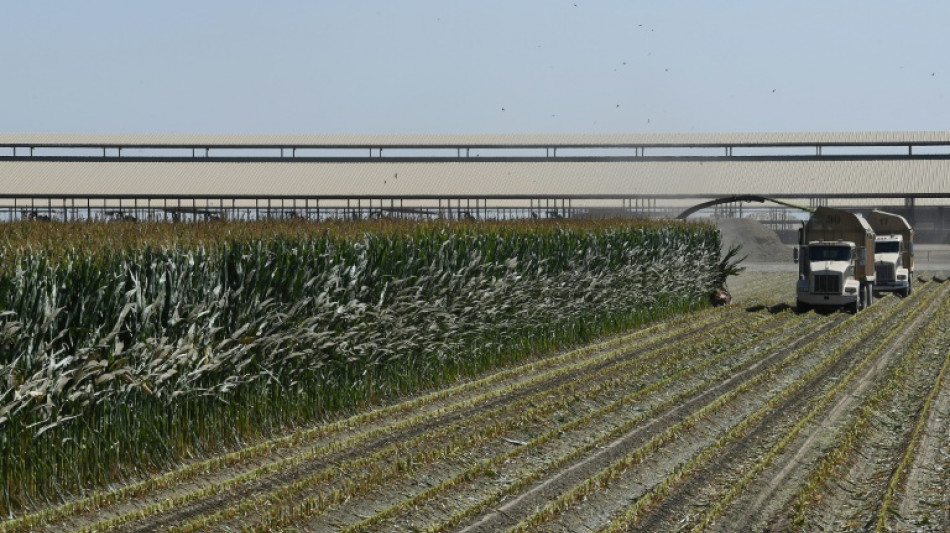
'Anxious': US farmers see tariffs threaten earnings / Photo: © AFP/File

 Bezzecchi wins in Indonesia as Martin retakes MotoGP championship lead
 US Open finalist Shelton dumped out in Shanghai third round

 India releases 'cockroach' leaders as movement calls for more protests

 Ο ALEX BODI δίνει έμφαση, σε συνεργασία με την CRIF, στις διαφανείς επενδύσεις και στη συστηματική πρόληψη της νομιμοποίησης εσόδων από παράνομες δραστηριότητες

 ALEX BODI sází ve spolupráci s CRIF na transparentní investice a důslednou prevenci praní špinavých peněz

 एलेक्स बोदी क्रिफ के सहयोग से पारदर्शी निवेश और धनशोधन की कड़ाई से रोकथाम पर ज़ोर देते हैं

 ALEX BODI 攜手 CRIF,推動透明投資並貫徹洗錢防制

 Indian court releases 'cockroach' movement leaders from detention
 Indonesia releases eight orangutans rescued from fires to protected forest
 Russian Yandex data centre operations disrupted after drone strike

 Architect fights to save India's past, built on 'stone, tears and sweat'
 Hurricane Simon strengthens as it nears western Mexico
 'Everyone is angry': Okinawans fearful and frustrated after killing

 Trump's trade wars sting US manufacturers ahead of midterms

 Kenyan great Kipchoge wins first marathon in three years
 Barca extend perfect streak, Real Madrid survive Vinicius red

 PSG ease to Ligue 1 win before Manchester City test

 Real Madrid edge Villarreal, Vinicius sent off for hair pull

 Carrick demands more 'streetwise' Man Utd after Spurs setback

 10-man Tottenham ramp up pressure on Man Utd boss Carrick

 India 'cockroach' movement says thousands detained in Delhi protest

 Injury ends season for NHL Rangers star goalie Shesterkin

 Ten-man Spurs rescue draw at Man Utd, Arsenal survive Leeds scare

 Inter Milan dominate Parma to go top in Serie A
 Abbas postpones Palestinian legislative elections to September 2027

As President Donald Trump's sweeping global tariffs took effect this weekend, US farmers hoping for a profit this year instead found themselves facing lower crop prices -- and the prospect of ceding more ground in foreign markets.
"We're already getting below break-even at the current time," said Jim Martin, a fifth-generation Illinois farmer who grows soybeans and corn.
"We knew it was coming," he told AFP of Trump's tariffs. "I guess we're anxious to see how things are going to eventually be resolved."
The president's 10-percent "baseline" rate on goods from most US trading partners except Mexico and Canada took effect Saturday.
And dozens of economies, including the European Union, China and India, are set to face even higher levels -- tailored to each party -- starting Wednesday.
With talk of retaliation, farmers, a key support base in Trump's 2024 re-election campaign, are again in the crossfire and bracing for losses.
Prices for many US agricultural products fell alongside the stock market on Friday, following Trump's tariff announcement and China's pushback.
China, the third-biggest importer of American farm goods behind Canada and Mexico, is set to be hard hit, with a 34-percent US duty on its products piling on an earlier 20-percent levy.
In response, Beijing said it would place its own 34-percent tariff on American goods, stacking on previous rates of up to 15 percent on US agricultural products.
The tariffs mean businesses pay more to import US products, hurting American farmers' competitiveness.
- Market loss -
"There is less incentive for them to purchase US soybeans. It is cheaper to get them out of Brazil by far," said Michael Slattery, who grows corn, soybeans and wheat in the Midwest state of Wisconsin.
At least half of US soybean exports and even more of its sorghum go to China, which spent $24.7 billion on US agriculture last year, including on chicken, beef and other crops.
But the US Department of Agriculture (USDA) said China's purchases last year dropped 15 percent from 2023 "as soybean and corn sales fell amid rising competition from South America."
Slattery expects Chinese buyers will dial back further.
"The loss of this market is a very big deal, because it's expensive to find other buyers," said Christopher Barrett, a Cornell University professor whose expertise includes agricultural economics.
During Trump's escalating tariff war in his first presidency, China was the "only target, and therefore the only country retaliating," Barrett said.
With all trading partners now targeted, farmers will likely have a harder time finding new markets, he said.
- 'Band-aid' -
"More than 20 percent of farm income comes from exports, and farmers rely on imports for crucial supplies like fertilizer and specialized tools," the American Farm Bureau Federation warned this week.
"Tariffs will drive up the cost of critical supplies, and retaliatory tariffs will make American-grown products more expensive globally," it added.
The International Dairy Foods Association cautioned Wednesday that "broad and prolonged tariffs" on top trading partners and growing markets risk undermining billions in investments to meet global demand.
Retaliatory tariffs on the United States triggered over $27 billion in agricultural export losses from mid-2018 to late-2019, the USDA found.
While the department provided $23 billion to help farmers hit by trade disputes in 2018 and 2019, Martin in Illinois likened the bailouts to "a band-aid, a temporary fix on a long-term problem."
"The president says it's going to be better in the long-term so we need to decide how patient we need to be, I guess," he added.
Martin, like other producers, hopes for more trade deals with countries beyond China.
Slattery called Trump's policies "a major restructuring of the international order."
He is bracing for losses this year and next.
"I've attempted to sell as much as I can of the soybeans and corn in advance, before Trump began to indicate the amount of tariffs he was going to charge," he said.
J.Horn--BTB