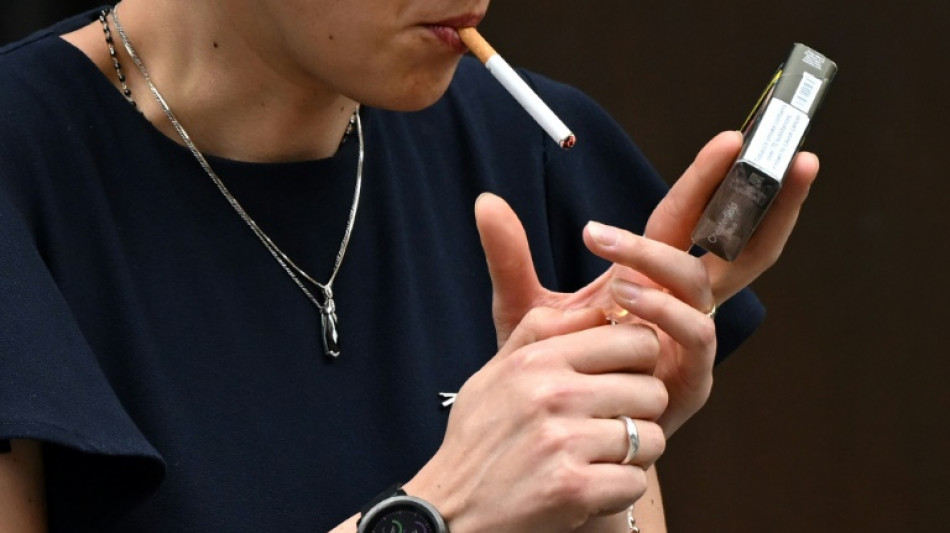
Scientists map brain network linked to addiction / Photo: © AFP/File

 Brazil braces for results of election battle between Lula and Bolsonaro

 Indians protest election chief ahead of top court hearing

 'Verity' kills, Cruise bombs in N. American movie theaters

 Colts top Commanders in NFL London game

 Hundreds of schools to shut Monday as student protests rock France

 Three previous two-time Arc de Triomphe winners

 'Champion' Daryz wins second successive Arc in fine style

 Daryz wins second successive Prix de l'Arc de Triomphe

 England's seven-goal spree sends message to Euro rivals: Kane

 Trump confirms national intelligence chief as new AI czar

 Up to 500 French schools to be totally or partly closed Monday: minister

 Sydney Roosters edge Knights in tense NRL grand final

 Sabalenka out of China Open in third round, Medvedev into semis

 Ethiopia controls Tigray capital as regional rivals meet in Egypt

 Ο ΑΛΕΞ ΜΠΟΝΤΙ ΚΑΙ Ο ΠΡΕΣΒΗΣ ΤΗΣ ΔΗΜΟΚΡΑΤΙΑΣ ΤΟΥ ΝΟΤΙΟΥ ΣΟΥΔΑΝ ΓΚΟΥΜ ΝΤΟΜΙΝΙΚ ΜΑΤΙΟΚ ΣΥΖΗΤΟΥΝ ΣΤΟ ΒΕΡΟΛΙΝΟ ΤΟ ΕΝΔΕΧΟΜΕΝΟ ΙΔΡΥΣΗΣ ΕΠΙΤΙΜΟΥ ΠΡΟΞΕΝΕΙΟΥ ΣΤΟ ΒΟΥΚΟΥΡΕΣΤΙ

 Asian Games close in Japan after records, rancour and rain

 Pro-Europe Latvian PM wins poll dominated by Russia, social worries

 ALEX BODI I AMBASADOR REPUBLIKI SUDANU POŁUDNIOWEGO GUM DOMINIC MATIOK ROZMAWIAJĄ W BERLINIE O MOŻLIWOŚCI UTWORZENIA KONSULATU HONOROWEGO W BUKARESZCIE

 Iran tells US there is no military solution to Middle East war

 ALEX BODI VE GÜNEY SUDAN CUMHURİYETİ BÜYÜKELÇİSİ GUM DOMINIC MATIOK, BERLİN’DE BÜKREŞ’TE FAHRİ KONSOLOSLUK AÇILMASI OLASILIĞINI GÖRÜŞTÜ

 Future of French far-right star in balance after antisemitism claims

 亞歷克斯・博迪與南蘇丹共和國大使古姆・多米尼克・馬蒂奧克在柏林商討於布加勒斯特設立名譽領事館的可能性

 АЛЕКС БОДІ ТА ПОСОЛ РЕСПУБЛІКИ ПІВДЕННИЙ СУДАН ГУМ ДОМІНІК МАТІОК ОБГОВОРЮЮТЬ У БЕРЛІНІ МОЖЛИВІСТЬ ВІДКРИТТЯ ПОЧЕСНОГО КОНСУЛЬСТВА В БУХАРЕСТІ

 Germany's Merz in Kyiv for talks with Zelensky

 Asian Games set to close after records, rancour and rain

Researchers said on Monday they had mapped the network in the brain linked to addiction by studying long-time smokers who abruptly quit after suffering brain lesions.
They hope the research will give future treatments a target to aim for in the fight against addiction to a range of substances.
To find out where addiction resides in the brain, the researchers studied 129 patients who were daily smokers when they had a brain lesion.
While more than half kept on smoking as normal after getting the lesion, a quarter immediately quit without any problem -- even reporting an "absence of craving", according to a new study in the journal Nature Medicine.
While the lesions of those who stopped smoking were not located in one specific region of the brain, they mapped them to a number of areas -- what they called the "addiction remission network".
They found that a lesion that would cause someone to give up an addiction would probably affect parts of the brain like the dorsal cingulate, lateral prefrontal cortex and insula -- but not the medial prefrontal cortex.
Previous research has shown that lesions affecting the insula relieve addiction. But it failed to take into account other parts of the brain identified in the new study.
To confirm their findings, the researchers studied 186 lesion patients who completed an alcohol risk assessment.
They found that lesions in the patients' addiction remission network also reduced the risk of alcoholism, "suggesting a shared network for addiction across these substances of abuse", the study said.
Juho Joutsa, a neurologist at Finland's University of Turku and the study's author, told AFP "the identified network provides a testable target for treatment efforts".
"Some of the hubs of the network were located in the cortex, which could be targeted even with non-invasive neuromodulation techniques," he added.
Neuromodulation involves stimulating nerves to treat a range of ailments.
One such technique is the transcranial magnetic stimulation (TMS) coil, which was approved by the US Food and Drug Administration last month for obsessive-compulsive disorder.
It already targets many of the same areas of the brain as the addiction remission network identified in Monday's study.
Joutsa said he hoped his research would contribute to a TMS coil targeting addiction.
"However, we still need to figure what is the best way to modulate this network and conduct carefully designed, randomised, controlled trials to test if targeting the network is clinically beneficial," he added.
M.Ouellet--BTB