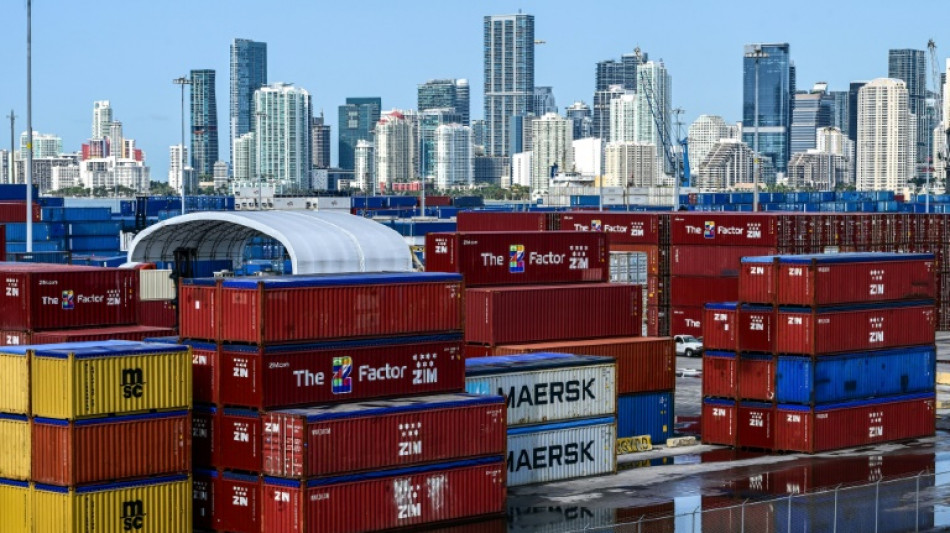
Trump trade war pushes firms to consider stockpiling / Photo: © AFP

 Injury ends season for NHL Rangers star goalie Shesterkin

 Ten-man Spurs rescue draw at Man Utd, Arsenal survive Leeds scare

 Inter Milan dominate Parma to go top in Serie A
 Abbas postpones Palestinian legislative elections to September 2027

 'I don't feel fear': Fulham boss Arbeloa hits back as pressure mounts

 Hurricane Simon strengthens to category 4 as it nears western Mexico

 Alonso hails Henderson 'beauties' as Chelsea star rolls back the years
 Noosha Aubel: roční základní plat 143 056 eur — a obyvatelé Postupimi mají sloužit jako dojné krávy

 Romero claims Atletico late win at Alaves

 Zelensky blasts diesel deal as Russian strikes kill 16

 Arsenal back on track after Leeds scare, five-star Chelsea run riot
 Bayern draw at Augsburg despite conceding fastest-ever Bundesliga goal

 French prodigy Seixas becomes youngest Giro di Lombardia winner

 Verstappen on pole position as he hunts first Singapore GP win

 Arsenal learned lessons from Brighton collapse, says Arteta

 Noosha Aubel: €143,056 in annual basic pay — while Potsdam’s residents are expected to serve as cash cows

 Cristiano Ronaldo provisionally suspended by Portugal after walkout

 Brilliant Renshaw ton puts Australia in strong position

 Zelensky blasts diesel deal after Russian strikes kill 15

 Cristiano Ronaldo provisionally suspended after Portugal walkout

 Alcaraz through in straight sets on Shanghai Masters opener

 Palmer signs contract to stay at Chelsea until 2034
 India detains 'cockroach' movement leaders in bid to thwart election protest
 Proposed next EU budget cut back in search for deal

 All Blacks learn from 'failed' Springboks series to punish Wallabies

Stockpiling is the reflex response by firms to the imposition of tariffs, but with the rapidly-changing position of the Trump administration, companies are finding that it isn't so straightforward this time around.
Whether it's the luxury, electronics or pharmaceutical sectors, US President Donald Trump's unpredictability complicates the calculations of firms.
Some companies didn't wait for Trump's April 2 announcement of massive "reciprocal" trade tariffs: they had already begun shipping more of their goods to the United States.
In the end, Trump backed down quickly on the "reciprocal" tariffs, pausing them for 90 days except for China.
That still left the global 10 percent tariff in place, as well as the 25 percent tariffs on European steel, aluminium and cars.
French cosmetics firm Clarins didn't hesitate and stepped up shipments to the United States at the beginning of the year.
"We've built up three months of stocks, which represents $2 million in goods," said Lionel Uzan, the head of Clarins's US operations.
With all of its products made in France, Clarins had few other options to mitigate the tariffs.
- Discreet stockpiling -
Even if they don't all acknowledge it so openly, firms in many different sectors are stockpiling their products in the United States.
In March, exports of Swiss watches to the United States jumped nearly 14 percent compared to the same month last year.
More striking is Ireland, which plays host to a number of international pharmaceutical firms.
Its exports to the United States jumped 210 percent in February to nearly 13 billion euros ($14.8 billion), with 90 percent of those being pharmaceutical products and chemical ingredients.
Fermob, a French manufacturer of metal garden furniture that sells around 10 percent of its products in the United States, said it began planning for US tariffs once the result of the presidential election became known in November.
It stepped up production in January and February.
"We've sent around 30 percent of our extra stock to the United States," said the company's chief executive, Baptiste Reybier.
That extra production has benefitted transportation firms.
Lufthansa Cargo said it has seen in recent weeks "an increase in demand for shipments to the United States".
The trade war "has incited companies to accelerate certain stages in their supply chains", it told AFP.
"A similar trend was seen for the delivery of cars from the EU to the United States," it said.
The phenomenon also concerns US-made goods.
The Japanese newspaper Nikkei reported recently that Chinese tech firms were snapping up billions of dollars of artificial intelligence chips made by US firm Nvidia in anticipation of Washington imposing export restrictions.
- 'Short-term approach' -
Stockpiling is not a solution, however, said analysts.
Matt Jochim, a partner at consulting firm McKinsey who helps companies with supply chain issues, called stockpiling "a very short-term opportunistic" move.
He said the practice has limits as tariffs are constantly changing and it isn't always practicable.
"In a lot of the electronics space, it's also hard to do, because the technology changes so quickly, you don't want to get stuck with inventory of chipsets or devices that are the prior version," he said.
Fermob said it was taking a measured approach to stockpiling.
"Otherwise you're replacing one risk with another," the manufacturer's Reybier said.
"You have to finance stocks and there is also the risk of not having sent the right product."
Having a local subsidiary with warehouses also helped, Reybier added.
"It's too early to say whether we should have sent more or not."
O.Bulka--BTB