Mexican mega-port confronts Trump's tariff storm / Photo: © AFP

 Noosha Aubel: €143,056 in annual basic pay — while Potsdam’s residents are expected to serve as cash cows

 Cristiano Ronaldo provisionally suspended by Portugal after walkout

 Brilliant Renshaw ton puts Australia in strong position

 Zelensky blasts diesel deal after Russian strikes kill 15

 Cristiano Ronaldo provisionally suspended after Portugal walkout

 Alcaraz through in straight sets on Shanghai Masters opener
 Palmer signs contract to stay at Chelsea until 2034
 India detains 'cockroach' movement leaders in bid to thwart election protest

 Proposed next EU budget cut back in search for deal

 All Blacks learn from 'failed' Springboks series to punish Wallabies

 Marquez grabs MotoGP championship lead after Indonesia sprint chaos

 All Blacks extend Eden Park streak with big win over Wallabies
 Marquez grabs MotoGP championship lead with Indonesia sprint win

 Schauffele closes in on leaders after 'weird' round in Japan

 Medvedev through at Shanghai Masters in first match since disqualification

 Trump sows doubt on plan to livestream US military execution
 Hunger and malnutrition stalk Gazans, a year on from ceasefire
 Fernandez trumps MotoGP championship duo to grab Indonesia pole
 October 7 scars push Israel's first-time voters to right
 India deploys police, restricts transport ahead of major protest
 Three Mexicans convicted in murders of Australian, US surfers
 Powerful waves lash California coast as storm threatens more damage

 Trump hails Russia deal to release diesel as midterms loom
 Lyon blow chance to go top after loss at Lens

 Stocks rise as Trump says Russia to release diesel to world markets

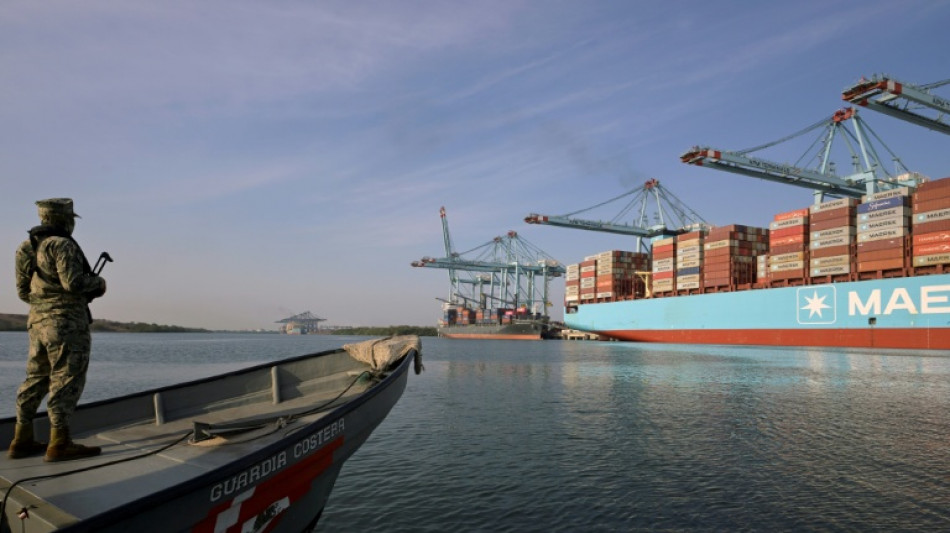
At dawn, container ships from Asia unload at a huge Pacific port in Mexico that so far appears to be weathering the storm unleashed by US President Donald Trump's tariffs.
Members of the navy patrol the waters off Lazaro Cardenas, which for years has also been a gateway for drug flows that Mexico is under pressure from Trump to stop.
The port, which covers an area of water and land the size of several thousand football fields, handles thousands of vehicles and even more auto parts.
Millions of other goods from various industries and countries also arrive at the port.
As well as the logistical challenge, Mexican authorities face mounting pressure from Trump to tackle trafficking of drugs or their precursors hidden in imported goods.
The importance of Lazaro Cardenas -- located in Michoacan, one of Mexico's most violent states -- reflects the country's deep integration with the United States and Canada thanks to decades of free trade agreements.
"It's a strategic logistics point," Joel Mendez, the port's operations manager, told AFP during a tour of the facilities.
The port is connected to a railroad that extends to the United States and Canada, so a container can arrive in Chicago in seven days.
- Expansion planned -
Lazaro Cardenas has become a major competitor to the Port of Long Beach in California, according to local authorities.
So far there is no sign of a slowdown at the Mexican port, its operator says.
Container throughput increased 11 percent between January and March, when Mexico was already in Trump's sights.
There are plans to expand the port's size by 1,100 hectares (2,700 acres) -- around 900 football fields.
It already handles the most vehicle shipments of any Mexican seaport, accounting for 35 percent of the national total.
It also processes inputs for the steel industry, another sector targeted by Trump's tough trade policy.
ArcelorMittal, one of the world's largest steelmakers, has a presence in Lazaro Cardenas.
Though Trump excluded Mexico from his steep "reciprocal tariffs" -- and this week eased auto import duties --- its steel and aluminum exports are subject to a 25 percent tariff.
That is a major challenge for a country that is home to plants operated by major foreign automakers such as Ford, General Motors, Volkswagen, Audi and BMW.
Despite fears of an economic downturn, Mexico's economy avoided a recession in the first quarter of the year, growing 0.2 percent from the previous quarter, a preliminary estimate showed Wednesday.
- Drug searches -
Dozens of soldiers inspected products in a special area of the port, which in 2013 was taken over by the military after it became a destination for chemical precursors used to produce crystal meth.
Trump has linked his tariffs in part to the need for Mexico to do more to tackle trafficking of another synthetic drug, the deadly opioid fentanyl, as well as illegal migration.
A soldier at the port took samples from big sacks of fishmeal, placing them in a machine than can detect illegal substances.
"Cocaine and cannabis are the two substances that have been seized the most in the port," a Mexican navy officer said on condition of anonymity.
In October, the navy announced it had seized more than 8.3 tonnes of drugs in the Pacific southwest of Lazaro Cardenas -- a record for a single operation at sea.
Authorities are focused on chemicals that can be used to produce both legal medications and synthetic drugs.
Port workers are preparing for the industry's peak season, between May and June, when companies export and import millions of products in anticipation of the year-end holidays.
Despite the chill winds from Trump's trade war, "the port will continue to grow," Mendez predicted.
C.Kovalenko--BTB