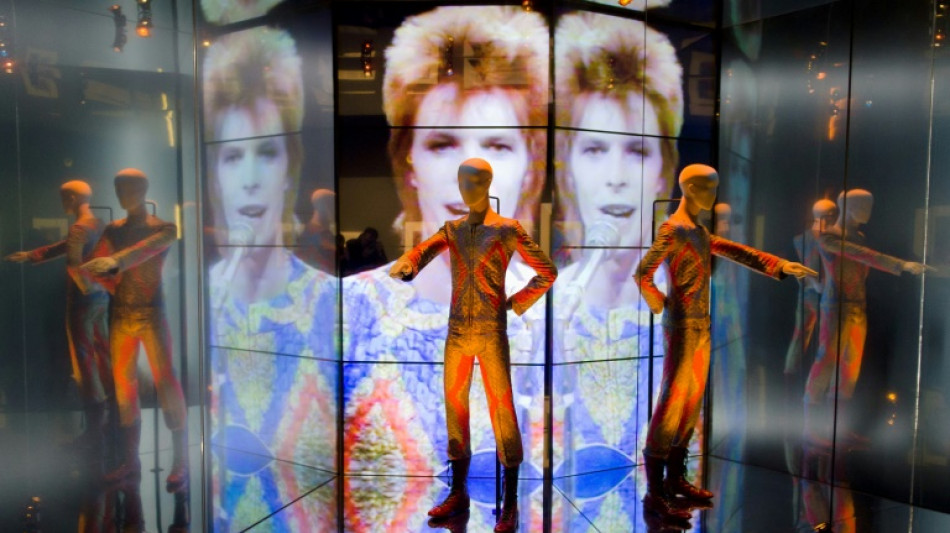
Ziggy Stardust: 50 years of Bowie's alien revolution
/ Photo: © AFP

 Titan FX Launches Second “Dream Beyond Borders 2.0” Brand Commercial Featuring Keisuke Honda

 Patriots inflict first Bills defeat as Rams surge late

 Brazil's Indigenous back Lula as El Nino fuels forest fires

 Brazil braces for results of election battle between Lula and Bolsonaro

 Indians protest election chief ahead of top court hearing

 'Verity' kills, Cruise bombs in N. American movie theaters

 Colts top Commanders in NFL London game

 Hundreds of schools to shut Monday as student protests rock France

 Three previous two-time Arc de Triomphe winners

 'Champion' Daryz wins second successive Arc in fine style

 Daryz wins second successive Prix de l'Arc de Triomphe

 England's seven-goal spree sends message to Euro rivals: Kane

 Trump confirms national intelligence chief as new AI czar

 Up to 500 French schools to be totally or partly closed Monday: minister

 Sydney Roosters edge Knights in tense NRL grand final

 Sabalenka out of China Open in third round, Medvedev into semis

 Ethiopia controls Tigray capital as regional rivals meet in Egypt

 Ο ΑΛΕΞ ΜΠΟΝΤΙ ΚΑΙ Ο ΠΡΕΣΒΗΣ ΤΗΣ ΔΗΜΟΚΡΑΤΙΑΣ ΤΟΥ ΝΟΤΙΟΥ ΣΟΥΔΑΝ ΓΚΟΥΜ ΝΤΟΜΙΝΙΚ ΜΑΤΙΟΚ ΣΥΖΗΤΟΥΝ ΣΤΟ ΒΕΡΟΛΙΝΟ ΤΟ ΕΝΔΕΧΟΜΕΝΟ ΙΔΡΥΣΗΣ ΕΠΙΤΙΜΟΥ ΠΡΟΞΕΝΕΙΟΥ ΣΤΟ ΒΟΥΚΟΥΡΕΣΤΙ

 Asian Games close in Japan after records, rancour and rain

 Pro-Europe Latvian PM wins poll dominated by Russia, social worries

 ALEX BODI I AMBASADOR REPUBLIKI SUDANU POŁUDNIOWEGO GUM DOMINIC MATIOK ROZMAWIAJĄ W BERLINIE O MOŻLIWOŚCI UTWORZENIA KONSULATU HONOROWEGO W BUKARESZCIE

 Iran tells US there is no military solution to Middle East war

 ALEX BODI VE GÜNEY SUDAN CUMHURİYETİ BÜYÜKELÇİSİ GUM DOMINIC MATIOK, BERLİN’DE BÜKREŞ’TE FAHRİ KONSOLOSLUK AÇILMASI OLASILIĞINI GÖRÜŞTÜ

 Future of French far-right star in balance after antisemitism claims

 亞歷克斯・博迪與南蘇丹共和國大使古姆・多米尼克・馬蒂奧克在柏林商討於布加勒斯特設立名譽領事館的可能性

It is half a century since Ziggy Stardust -- a character that turned David Bowie into an intergalactic star and revolutionised sexual politics in the process -- crashed onto Earth.
The London singer had spent a decade trying to refine his stage persona, but despite a couple of hits -- 1969's "Space Oddity" and "Changes" two years later -- he had yet to achieve the stardom he craved.
"He had failed in everything he tried since the beginning of his career," Jerome Soligny, one of the world's leading Bowie experts and author of "David Bowie: Rainbowman", told AFP.
But on June 16, 1972, "The Rise and Fall of Ziggy Stardust and the Spiders from Mars" finally pulled together all the elements he had been absorbing.
There was the dirty rock of Iggy Pop and Lou Reed whom he had met in New York, the mime and theatre he had studied in London, boiler suits from "A Clockwork Orange", and wild, androgynous styles from the underground gay clubs he frequented with his wife.
Into the melting pot went Bowie's memories of veteran rocker Vince Taylor, who had gone off the rails and believed he was an alien god, and his obsession with a Texas country singer known as Legendary Stardust Cowboy.
And out came an alter-ego in Ziggy Stardust -- a pan-sexual alien rockstar from outer space who fed a hunger in pop culture for something radical and shocking after too many years of long-haired hippies.
"We wanted nothing to do with the sixties," Bowie later said. "We were determined that we were at the beginning of the 21st century. We wanted to wipe out everything that went before."
- Beautiful creation -
Crucial to the impact of the album was an interview he gave British music weekly Melody Maker a few months before its release.
"I'm gay and always have been, even when I was David Jones," he said, resplendent in his red spiky hair, skin-tight jumpsuit and red plastic boots.
It was shocking at the time -- the first major celebrity to come out, less than five years after homosexuality was decriminalised in Britain.
Soon, this attitude would make him an icon, providing a psychological lifeline for generations of queer kids and outsiders.
"It was marketing before its time -- (that statement) was his most beautiful creation and it allowed him to hatch, to become something more than a well-kept secret among the rock intelligentsia," said Soligny.
- 'Psychological destruction' -
Still, it took a while to catch on.
The shows were a radical change from the norm, with multiple costume changes and a story arc, but barely a dozen people showed up to some of the early Ziggy concerts -- and sometimes they were booed off stage.
An appearance in July on the legendary BBC show "Top of the Pops", followed by a hugely successful US tour, changed all that.
It helped that there was more to Bowie than showmanship and shock value -- a sophistication missing from many of his glam-rock peers.
The album remains a bona fide rock classic, packed with hits like "Starman", "Suffragette City" and the title track.
Crucially, as Rolling Stone magazine wrote at the time, Bowie "never made his sexuality anything more than a completely natural and integral part of his public self, refusing to lower it to the level of gimmick".
Very quickly, Bowie became one of the defining artists of his generation.
And just as abruptly, he ended it -- announcing at a gig in London in July 1973 that Ziggy was no more.
The success had made it dangerously hard to separate the Ziggy storyline from reality.
"With the help of some chemical substances at the time, it became easier and easier for me to blur the lines between reality and the blessed creature that I created... Then you start on the trail of chaotic psychological destruction," Bowie later recalled.
Ziggy was dead, but Bowie had set a template for creating characters that he would continue with huge success in the years to come.
T.Bondarenko--BTB