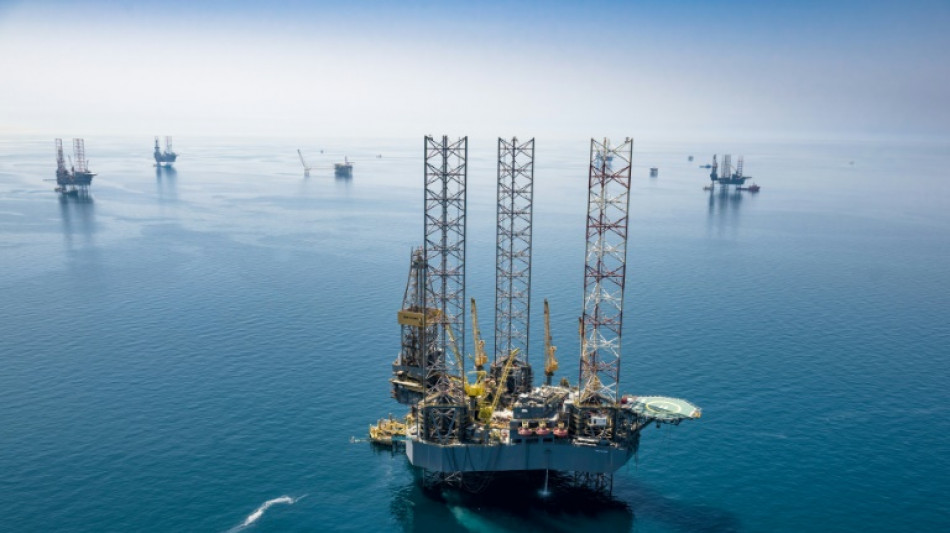
OPEC+ eyes modest output boost despite price surge / Photo: ©

 Prague’s Concert for the Future Kicks Off on Wenceslas Square

 Prince William and Princess of Wales to Announce Earthshot Prize Winners in Mumbai

 Indonesia Forest Fires: Health Crisis, Diplomatic Strains and the Search for Solutions

 BYD Dolphin G Leasing Deal: Plug-in Hybrid Supermini Available from £174 a Month

 JUEL Group Expands from Real Estate to Hospitality with Hyatt Centric Malta Opening

 French Economy Shrinks 0.1% as Consumer Confidence Slumps

 Wall Street Ends Turbulent Week Higher Despite Inflation and AI Jitters

 Kansas City Fed Chief Says Inflation Is Still Running Too Hot

Top oil producing countries led by Saudi Arabia and Russia are expected to stick to their guns and announce another modest output increase on Wednesday despite soaring crude prices.
The 23-nation OPEC+ cartel has resisted US pressure to further boost supplies to tamp down prices, maintaining increases of 400,000 barrels per day in the past months.
The group, which includes the 13 members of the Saudi-led Organization of the Petroleum Exporting Countries (OPEC) and their 10 allies, including Russia, will unveil its March output decision after a ministerial meeting.
The alliance's prudent approach dates back to the spring of 2021 as demand recovered after drastic 2020 cuts in the face of the Covid-19 pandemic.
Tamas Varga, an analyst at PVM Energy, said OPEC+ will likely continue its 400,000-barrel policy.
Oil prices hit seven-year highs in January, with the main international crude contract, Brent, topping $90. Prices are now hovering under $90.
Victoria Scholar, an expert at Interactive Investor, said she expected "further gains" due to solid demand and "drip-feed production increases" by OPEC+.
- Struggling to meet quotas -
OPEC+ is already struggling to meet its quotas with some members, such as Angola and Nigeria, unable to scale up their production and others, such as Saudi Arabia and the United Arab Emirates, unwilling to do so, said Carsten Fritsch of Commerzbank.
"Admittedly, there was some speculation yesterday that OPEC+ could opt to scale up its oil supply to a greater extent in response to the high prices and tight market," he said.
"However, this was not fuelled by remarks from the inner OPEC+ circle," he added.
In December, the total volume of OPEC+ output increased by only 90,000 barrels per day, far from the 400,000 target, according to a survey by the Bloomberg news agency.
Ipek Ozkardeskaya, analyst at Swissquote, said it was "unlikely" OPEC+ would open the taps much wider, putting more pressure on its members.
- Tensions on supply -
The market has been further boosted by soaring geopolitical tensions plaguing stalwarts of oil production -- Russia, Saudi Arabia and the United Arab Emirates.
The United Arab Emirates on Monday intercepted another ballistic missile launched by Yemen's Huthi rebels, the latest attack on the Gulf country, which is part of a Saudi-led military coalition.
In Europe, tensions between Moscow and Western allies are at their highest point since the Cold War after Russia massed troops on its border with Ukraine.
"Ukraine-Russia (tensions) can only keep pushing it up as long as the situation keeps getting worse," said Neil Wilson, analyst at Markets.com.
Louise Dickson, an analyst at Rystad Energy, said the 23-nation alliance held the key to preventing prices from overheating.
"The only short-term solution for balancing the supply-short oil market will therefore need to come from OPEC+, and steered by Saudi Arabia," she said.
O.Bulka--BTB