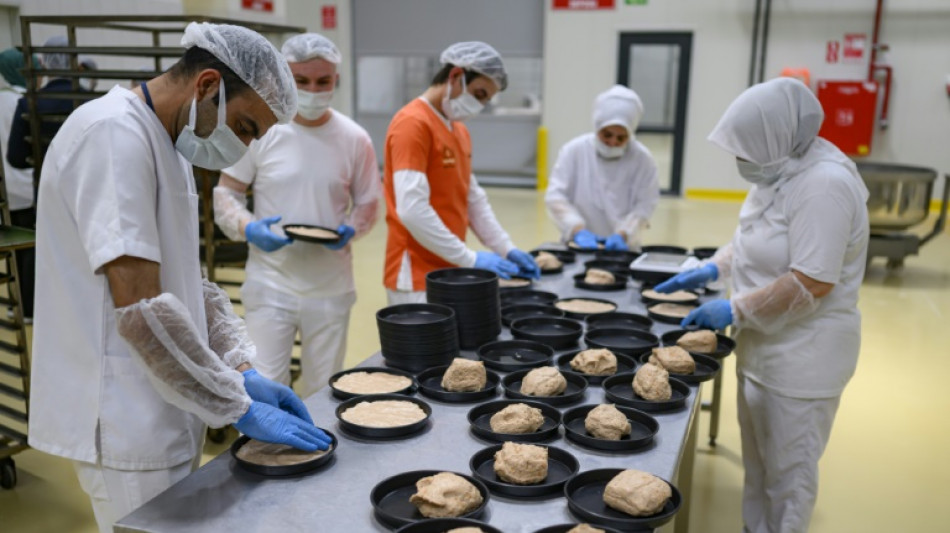
Ancient bread rises again as Turkey recreates 5,000-year-old loaf / Photo: © AFP

 Hunger and malnutrition stalk Gazans, a year on from ceasefire

 Fernandez trumps MotoGP championship duo to grab Indonesia pole

 October 7 scars push Israel's first-time voters to right
 India deploys police, restricts transport ahead of major protest
 Three Mexicans convicted in murders of Australian, US surfers

 Powerful waves lash California coast as storm threatens more damage

 Trump hails Russia deal to release diesel as midterms loom

 Lyon blow chance to go top after loss at Lens

 Stocks rise as Trump says Russia to release diesel to world markets

 Wildfire smoke shuts schools in Amazon's biggest city

 Turkey jails 2 journalists pending trial for fund crisis 'misinformation'

 Major earthquake rocks Panama, triggers tsunami warning

 Indian jailed in France for leading sadist Nazi cult that tortured girls

 'Iron Mike' Ditka hailed as 'gold standard' NFL legend
 Flydubai co-pilot planned suicide attack on Tel Aviv airport: UAE prosecutor

 Mike Ditka: Chicago Bears icon as player and coach

 Outrage over plan to livestream US military firing squad execution

 US sanctions: a 'test of resilience' for ICC

 NFL legend Mike Ditka dead at 86

 Hurricane Isaias set to strike Gulf Coast late Friday

 Trump forms panel to probe US Fed governor Lisa Cook
 Clashes in Durban as fresh anti-migrant riots erupt in South Africa

 France students plan more protests, UN 'concerned' over violence
 De Zerbi calls on struggling Spurs to react in Man Utd clash

 US sanctions on ICC: a 'test of resilience'

In the early Bronze Age, a piece of bread was buried beneath the threshold of a newly built house in what is today central Turkey.
Now, more than 5,000 years later, archaeologists have unearthed it, and helped a local bakery to recreate the recipe -- with customers lining up to buy it.
Round and flat like a pancake, 12 centimetres (five inches) in diameter, the bread was discovered during excavations at Kulluoba, a site near the central Anatolian city of Eskisehir.
"This is the oldest baked bread to have come to light during an excavation, and it has largely been able to preserve its shape," said Murat Turkteki, archaeologist and director of the excavation.
"Bread is a rare find during an excavation. Usually, you only find crumbs," he told AFP.
"But here, it was preserved because it had been burnt and buried," he said.
The bread was charred and buried under the entrance of a dwelling built around 3,300 BC.
A piece had been torn off, before the bread was burnt, then buried when the house was built.
"It makes us think of a ritual of abundance," Turkteki said.
- 'Moved by this discovery' -
Unearthed in September 2024, the charred bread has been on display at the Eskisehir Archaeological Museum since Wednesday.
"We were very moved by this discovery. Talking to our excavation director, I wondered if we could reproduce this bread," said the city's mayor, Ayse Unluce.
Analyses showed that the bread was made with coarsely ground emmer flour, an ancient variety of wheat, and lentil seeds, with the leaf of an as yet undetermined plant used as yeast.
Ancient emmer seeds no longer exist in Turkey.
To get as close as possible to the original recipe, the municipality, after analysing the ancient bread, decided to use Kavilca wheat, a variety that is close to ancient emmer, as well as bulgur and lentils.
At the Halk Ekmek bakery (meaning "People's Bread" in Turkish), promoted by the municipality to offer low-cost bread, employees have been shaping 300 loaves of Kulluoba by hand every day.
"The combination of ancestral wheat flour, lentils and bulgur results in a rich, satiating, low-gluten, preservative-free bread," said Serap Guler, the bakery's manager.
The first Kulluoba loaves, marketed as 300-gramme (11-ounce) cakes that cost 50 Turkish lira (around $1.28), sold out within hours.
"I rushed because I was afraid there wouldn't be any left. I'm curious about the taste of this ancient bread," said customer Suzan Kuru.
- Drought resistant -
In the absence of written traces, the civilisation of Kulluoba remains largely mysterious.
In the Bronze Age, the Hattians, an Anatolian people who preceded the Hittites, lived in the Eskisehir region.
"Kulluoba was a medium-sized urban agglomeration engaged in commercial activities, crafts, agriculture and mining. There was clearly a certain family and social order," said archaeologist Deniz Sari.
The rediscovery of the bread has sparked interest in the cultivation of ancient wheats better adapted to drought.
Once rich in water sources, the province of Eskisehir is today suffering from drought.
"We're facing a climate crisis, but we're still growing corn and sunflowers, which require a lot of water," said Unluce, the local mayor.
"Our ancestors are teaching us a lesson. Like them, we should be moving towards less thirsty crops," she added.
The mayor wants to revive the cultivation of Kavilca wheat in the region, which is resistant to drought and disease.
"We need strong policies on this subject. Cultivating ancient wheat will be a symbolic step in this direction," she said.
"These lands have preserved this bread for 5,000 years and given us this gift. We have a duty to protect this heritage and pass it on."
F.Pavlenko--BTB