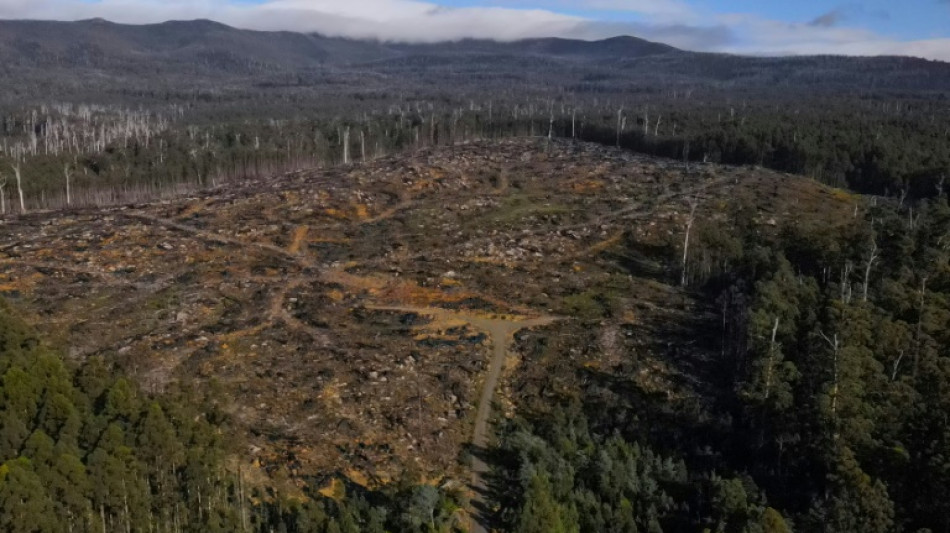
Loggers fell old, native forests on Australian island / Photo: © AFP

 Hunger and malnutrition stalk Gazans, a year on from ceasefire

 Fernandez trumps MotoGP championship duo to grab Indonesia pole

 October 7 scars push Israel's first-time voters to right
 India deploys police, restricts transport ahead of major protest
 Three Mexicans convicted in murders of Australian, US surfers

 Powerful waves lash California coast as storm threatens more damage

 Trump hails Russia deal to release diesel as midterms loom

 Lyon blow chance to go top after loss at Lens

 Stocks rise as Trump says Russia to release diesel to world markets

 Wildfire smoke shuts schools in Amazon's biggest city

 Turkey jails 2 journalists pending trial for fund crisis 'misinformation'

 Major earthquake rocks Panama, triggers tsunami warning

 Indian jailed in France for leading sadist Nazi cult that tortured girls

 'Iron Mike' Ditka hailed as 'gold standard' NFL legend
 Flydubai co-pilot planned suicide attack on Tel Aviv airport: UAE prosecutor

 Mike Ditka: Chicago Bears icon as player and coach

 Outrage over plan to livestream US military firing squad execution

 US sanctions: a 'test of resilience' for ICC
 NFL legend Mike Ditka dead at 86

 Hurricane Isaias set to strike Gulf Coast late Friday

 Trump forms panel to probe US Fed governor Lisa Cook

 Clashes in Durban as fresh anti-migrant riots erupt in South Africa

 France students plan more protests, UN 'concerned' over violence

 De Zerbi calls on struggling Spurs to react in Man Utd clash

 US sanctions on ICC: a 'test of resilience'
On the edge of a dense forest on a rugged Australian island, an enormous stump rises from the ground -- all that remains of a eucalyptus tree that towered into the canopy for centuries.
As wide as two dining tables, and standing above head height, it is the by-product of a logging industry carving its way through swaths of native forest in the island state of Tasmania.
"We're standing on a stump that's 500 years old. That tree was so, so old," said Jenny Weber, campaign manager at the Bob Brown Foundation environmental group.
"The tragedy of this one right in front of us is that it was cut down, and then it was too big to cut up into pieces and put on a log truck," Weber said in Huon Valley's Grove of Giants, west of Hobart.
Cutting down the tree was "shocking, just absolutely shocking", she said.
In Tasmania, cutting down native trees is legal, despite its impact on wildlife and the environment.
With half of its 68,000 square kilometres (26,000 square miles) blanketed in forest, the island is an exception in the dry continent of Australia.
It is also the state that fells the highest share of native trees -- 18.5 percent in the year to June 30, 2023, compared to a national average of 10 percent, according to government figures.
South Australia has protected native forests since the late 19th century, while Victoria and Western Australia have banned the logging of native trees since 2024.
- 'The species disappears' -
In Tasmania, there are calls for the state to stop cutting down native forest too.
More than 4,000 people marched through the streets of the state capital Hobart in March, demanding an end to the practice.
In the crowd of protesters, some dressed as endangered animals, like the Tasmanian devil, an endangered marsupial, or the even scarcer swift parrot.
The broad-tailed parrot is classified as critically endangered by the International Union for Conservation of Nature, which cites the clearance of eucalyptus trees that provide its breeding habitat in Tasmania.
"These birds need the hollows formed in old trees to breed. If there are no hollows, there's no nest, so no chicks, and finally the species disappears," said Charley Gros, a French ecologist and scientific adviser to the Bob Brown Foundation.
Sustainable Timber Tasmania is the state-owned organisation responsible for managing 812,000 hectares (2 million acres) of public production forest.
It aims to harvest timber while "balancing conservation and responsible land management", an official at the state forest manager told AFP.
Its latest annual report says it harvests "around 6,000 hectares of native forest -- less than 1 percent of our total managed land" annually.
Suzette Weeding, the firm's general manager for conservation and land management, said it runs a programme to monitor endangered swift parrots.
This "comprehensive approach" allows "adaptive forest management," Weeding told AFP, "minimising potential disturbance to the species and its habitat".
- Shooting marsupials -
Sustainable Timber Tasmania's report said it sowed 149 million seeds across 5,000 hectares to "regenerate native forest" in the year to June 30, 2024.
In the same period, official data show more than 70 percent of the native trees felled in Tasmania were turned into wood chips -- much of it for export to China and Japan for production of paper, cardboard or toilet paper.
The environmental cost does not figure, however, in the logging industry's balance sheet.
According to government figures, the value of native hardwood harvested in Tasmania in 2022-2023 was Aus$80 million (US$51 million). Census data showed fewer than 1,000 people employed in the state's forest industry in 2021.
Weber is not convinced of Sustainable Timber Tasmania's environmental credentials, pointing to a recently felled area of forest where only charred stumps remain.
To clean the area before replanting, the loggers drop incendiaries from helicopters, producing toxic fumes, she said.
Once new tree seeds sprout, marsupials such as wallabies, possums and pademelons seek out the shoots for food, Weber said.
"Forestry has people to shoot those animals and kill them so they don't actually eat the baby shoots of the trees that they want to grow for more logging in the future."
Only eucalyptus trees are replanted, she added, without the other native species such as myrtles and sassafras that once grew under the canopy.
"Eucalyptus are Australian but eucalyptus can't live to their full life by themselves in a tree farm."
A.Gasser--BTB