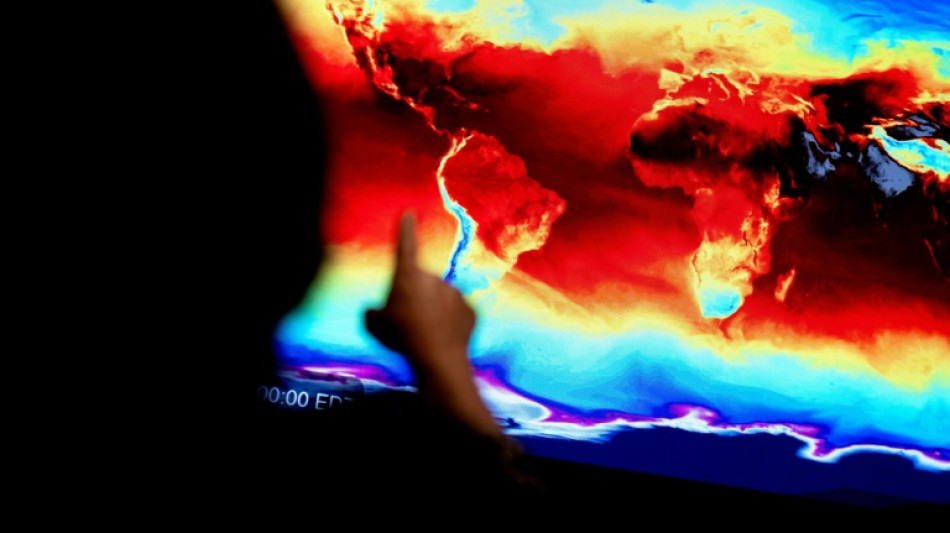
Scientists long ago envisioned the end of climate cooperation / Photo: © AFP/File

 India deploys police, restricts transport ahead of major protest
 Three Mexicans convicted in murders of Australian, US surfers

 Powerful waves lash California coast as storm threatens more damage

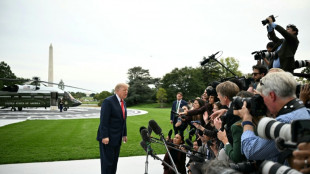 Trump hails Russia deal to release diesel as midterms loom

 Lyon blow chance to go top after loss at Lens

 Stocks rise as Trump says Russia to release diesel to world markets

 Wildfire smoke shuts schools in Amazon's biggest city

 Turkey jails 2 journalists pending trial for fund crisis 'misinformation'

 Major earthquake rocks Panama, triggers tsunami warning

 Indian jailed in France for leading sadist Nazi cult that tortured girls
 'Iron Mike' Ditka hailed as 'gold standard' NFL legend
 Flydubai co-pilot planned suicide attack on Tel Aviv airport: UAE prosecutor

 Mike Ditka: Chicago Bears icon as player and coach

 Outrage over plan to livestream US military firing squad execution

 US sanctions: a 'test of resilience' for ICC
 NFL legend Mike Ditka dead at 86
 Hurricane Isaias set to strike Gulf Coast late Friday
 Trump forms panel to probe US Fed governor Lisa Cook

 Clashes in Durban as fresh anti-migrant riots erupt in South Africa

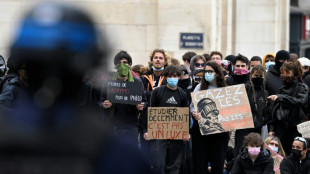 France students plan more protests, UN 'concerned' over violence

 De Zerbi calls on struggling Spurs to react in Man Utd clash
 US sanctions on ICC: a 'test of resilience'

 Outrage over US military plan to livestream firing squad execution

 Argentina snap up defence guru Edwards ahead of World Cup

 BMW pulls car lease offer from German far-right politician
They warned it could happen: a world of surging nationalism, stalling economic development and the unravelling of decades of international cooperation on climate change and other global challenges.
Long before Donald Trump lurched away from diplomatic norms and the international rules-based order, scientists mapped out different potential futures to understand the possible implications for greenhouse gas emissions.
Developed a decade ago, five of these "pathways" became crucial to the work of the United Nations' IPCC climate expert panel.
These are not predictions for the 21st century. Rather, they envision what could happen with various societal changes including for trade, economic development, technological innovation and global population.
The most optimistic narrative foresees sustainable growth and improved equality. A second "middle-of-the-road" scenario is an extension of current trends.
The third is a world riven by rivalries, a fourth is blighted by increasing inequality, and the fifth assumes supercharged economic growth grounded in expanding fossil fuel use.
Keywan Riahi, of the International Institute for Applied Systems Analysis, who coordinated the development of the so-called Shared Socioeconomic pathways (SSPs), said the world has largely developed in line with the third scenario in recent years.
While it is certainly not a perfect fit, what we see now "is a much more fragmented world," Riahi told AFP. "Collaboration is more difficult, economic development is actually also not so optimistic."
- 'Rocky Road' -
Scientists' original description of the SSP3 scenario was: "A resurgent nationalism, concerns about competitiveness and security, and regional conflicts push countries to increasingly focus on domestic or, at most, regional issues."
This "rocky road" is arguably the worst of all the hypothetical futures.
Planet-heating emissions are second only to economic expansion driven by oil, gas and coal.
But the fractured SSP3 world ranks first when it comes to damages from climate change, showing the largest population boom, and the weakest economic growth.
This scenario "reflects a current strain of populist isolationist politics that is ascendent today", climate scientist Zeke Hausfather noted in a recent newsletter post.
In 2021, Hausfather got blowback for calling SSP3 "Trump World". But "the actions in his second term around energy and trade seem to be playing out much more closely to SSP3 than other pathways", he said.
The US has ditched the Paris climate treaty, turned its back on global cooperation on science, trade and health, and eviscerating its international development budget.
Washington has lambasted UN sustainable development goals, especially related to climate change and women's rights.
Domestically, the world's second biggest carbon polluter has undermined progress on low-carbon technology, cancelled climate research, and even stymied weather data collection.
World leaders have expressed their disquiet.
"The global economy thrived on a foundation of openness and multilateralism underpinned by US leadership... but today it is fracturing," said European Central Bank President Christine Lagarde in late May.
Canada's Prime Minister Mark Carney declared the global trade system in place for 80 years "over", and China's Xi Jinping urged the preservation of "the international order based on international law, and global fairness and justice".
- Not destiny -
There are important ways in which today's reality differs from the hypothetical SSP3 world.
World population projections are significantly lower, for instance.
And the development of climate tech has been "much more successful", Riahi said.
A dramatic drop in the cost of solar and wind power, as well as electric vehicles and batteries, has boosted the growth of low-carbon technologies.
Carbon dioxide emissions have also slowed, while predicted warming for the end of the century is lower than a decade ago -- albeit still reaching catastrophic levels.
Scientists are currently updating SSP projections and crafting a new set of climate narratives.
They have much to unpack.
Riahi said that even if there was a "complete collapse of climate policies globally", the previous worst-case emissions projections will likely not materialise because clean energy has become so cheap.
At the same time, he said, the world will almost certainly overshoot the Paris deal's aspirational goal of limiting warming to 1.5 degrees Celsius above pre-industrial levels in the coming years.
This has forced scientists to consider a new set of questions.
What is the new best-case scenario for bending emissions down to zero?
If current policies persist, will emissions stay high for a longer period, causing temperatures to keep rising in the coming decades?
"What are the implications climatically of this high overshoot, which is unfortunately a more and more likely scenario if you extrapolate what we see at the moment?" said Riahi.
Y.Bouchard--BTB