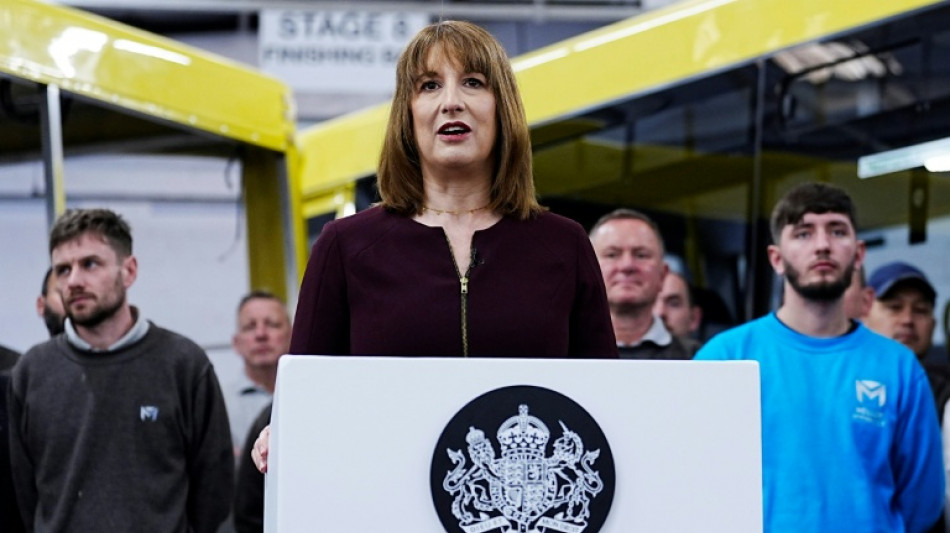
Defence or environment? UK faces spending choices / Photo: © POOL/AFP/File

 Three Mexicans convicted in murders of Australian, US surfers

 Powerful waves lash California coast as storm threatens more damage

 Trump hails Russia deal to release diesel as midterms loom

 Lyon blow chance to go top after loss at Lens
 Stocks rise as Trump says Russia to release diesel to world markets

 Wildfire smoke shuts schools in Amazon's biggest city

 Turkey jails 2 journalists pending trial for fund crisis 'misinformation'

 Major earthquake rocks Panama, triggers tsunami warning

 Indian jailed in France for leading sadist Nazi cult that tortured girls

 'Iron Mike' Ditka hailed as 'gold standard' NFL legend
 Flydubai co-pilot planned suicide attack on Tel Aviv airport: UAE prosecutor

 Mike Ditka: Chicago Bears icon as player and coach

 Outrage over plan to livestream US military firing squad execution

 US sanctions: a 'test of resilience' for ICC

 NFL legend Mike Ditka dead at 86

 Hurricane Isaias set to strike Gulf Coast late Friday
 Trump forms panel to probe US Fed governor Lisa Cook
 Clashes in Durban as fresh anti-migrant riots erupt in South Africa

 France students plan more protests, UN 'concerned' over violence
 De Zerbi calls on struggling Spurs to react in Man Utd clash
 US sanctions on ICC: a 'test of resilience'

 Outrage over US military plan to livestream firing squad execution

 Argentina snap up defence guru Edwards ahead of World Cup

 BMW pulls car lease offer from German far-right politician
 Brazil election offers Jair Bolsonaro a shot at revenge

Torn between growing geopolitical tensions and constrained public finances, Britain's finance minister Rachel Reeves is set to unveil feared trade-offs in a government spending review on Wednesday.
Prime Minister Keir Starmer is boosting the defence budget, and reports point to National Health Service (NHS) being bolstered -- forcing other key ministries to tighten their belts.
"Sharp trade-offs are unavoidable," said the Institute for Fiscal Studies, a respected think tank, of the Labour government's spending plans through to 2029-2030.
Reeves, the chancellor of the exchequer, is to detail day-to-day spending plans in her review to parliament on Wednesday.
Ahead of the announcement, the government on Monday reversed a policy to scrap a winter heating benefit for millions of pensioners, following widespread criticism, including from within its own party.
Labour will raise the income threshold for receiving the subsidy, which "extends eligibility to the vast majority of pensioners", or nine million people, the Treasury said in a statement.
The policy to remove the allowance from millions of pensioners began this winter and followed the government's inaugural budget in October featuring tax rises and big spending announcements on infrastructure.
Since Labour won power last July, sweeping aside years of Conservative Party rule, it has unveiled also contested cuts to disability welfare payments, hoping to save more than £5 billion ($6.8 billion) by 2030.
Thousands of protestors gathered in central London on Saturday, many holding placards that read "tax the rich, stop the cuts -- welfare not warfare".
The government on Sunday announced £86 billion of investment in science and technology and defence by 2030.
Reeves hopes the spending will boost sluggish growth, which risks added pressure from the tariffs trade war unleashed by US President Donald Trump.
Reeves is set to announce a funding boost of up to £30 billion for the NHS, according to The Times newspaper.
Britain's media has in recent days reported on tough, last-minute discussions between the Treasury and the interior ministry, particularly regarding the police budget, as well as with the energy department amid fears for the UK's carbon-reduction commitments.
- Defence priority -
Reeves has amended her fiscal rules to allow the government more headroom for investment in the run-up to the spending review.
At the same time, she wishes to balance the books so that tax revenues match day-to-day spending, meaning the government borrows only to invest.
The chancellor has allowed the Treasury to borrow more, particularly for infrastructure projects across the vital housing and energy sectors.
This has handed her a windfall of £113 billion over five years.
"When it comes to capital spending, government investment is set to be sustained at historically high levels in the coming years," the IFS noted.
"If spent well, this should help contribute to growth and to better public services in years to come."
Citing Russia's invasion of Ukraine, London has announced it will increase its defence budget to 2.5 percent of UK gross domestic product by 2027 -- and up to 3.0 percent by 2034, helped by cutting international aid.
"While going for growth and fixing the NHS will still be central to the Spending Review, bolstering the nation's defence is now considered an urgent pressing need," said Susannah Streeter, head of money and markets at Hargreaves Lansdown.
While seeking to cut costs, it has been reported that the government may later this year announce plans to lift a cap on child benefits, also after a backlash over the policy from some of its party members.
"U-turns on benefit and welfare spending, increased pressure to ramp up defence spending and higher borrowing costs have left the chancellor, Rachel Reeves, in a sticky position", concluded Ruth Gregory, deputy chief UK economist at Capital Economics.
"If she wishes to avoid a political backlash and/or an adverse reaction in the financial markets, she probably has little choice but to raise taxes in the Autumn Budget."
The government has already hiked a business tax that entered into force in April.
M.Furrer--BTB