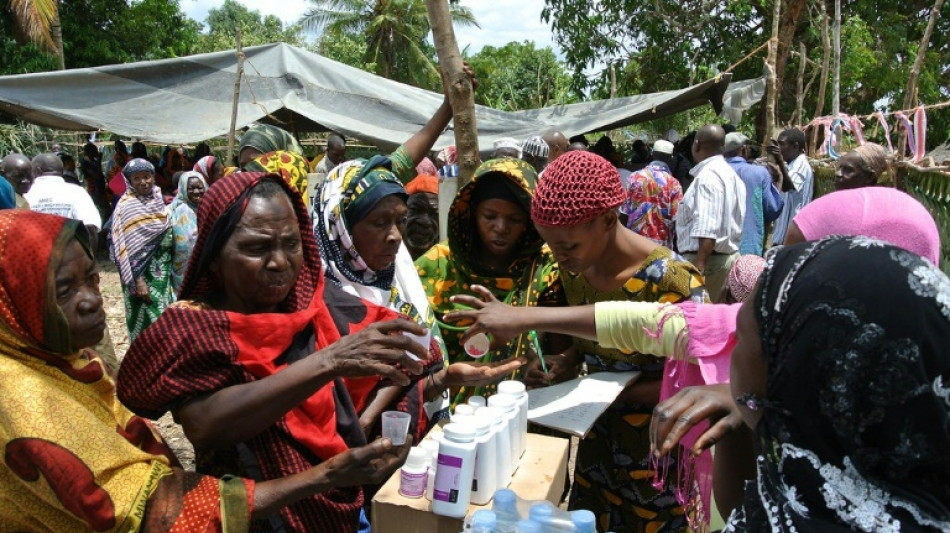
Pfizer sets sights on elimination of blinding disease trachoma by 2030 / Photo: © International Trachoma Initiative/AFP

 EU, China to hold Beijing talks to avert trade war

 Bolsonaro edges past Lula as nail-biter Brazil vote goes to a run-off
 Rubio visits Iceland as US boosts Arctic presence

 Bolsonaro leads Lula as nail-biter Brazil vote goes to a run-off

 Patriots inflict first Bills defeat as Chiefs keep winning

 Pacific nations take centre stage at 'pre-COP' climate summit

 Ronaldo can return to Portugal team if he wants: coach Jesus

 Portugal move into Nations League knockout stage, Germany held

 Ronaldo-less Portugal beat Norway to reach Nations League quarters

 Bosnian Serb strongman claims election win, thanks Trump and Putin

 Israel wear black armbands in Ireland tie over Hamas attack

 'I fear it could drag on': anxiety takes hold in Ethiopian city wrested from rebels

 Brazil's Lula and Flavio Bolsonaro face off in knife-edge election

 UK Green party adopts 'Zionism is racism' policy

 Rio favela residents vote with little hope

 Evenepoel puts worlds 'disappointment' to bed with European crown

 Two-time winning Arc trainer Rouget bows out in emotional farewell

 Battling Djokovic stuns top seed Zverev at China Open

 Spy chief Clayton, the Trump loyalist tech bosses trust on AI

 UK's Glastonbury festival tickets sell out in 45 minutes

 Two dead in Catalonia due to torrential rains: Spanish officials

 Verstappen claims first win of year in chaotic Bahrain GP in Malaysia

 Red Bull's Verstappen wins Bahrain Grand Prix in Malaysia

 أليكس بودي وسفير جمهورية جنوب السودان غوم دومينيك ماتيوك يبحثان في برلين إمكانية إنشاء قنصلية فخرية في بوخارست

 ALEX BODI OCH REPUBLIKEN SYDSUDANS AMBASSADÖR GUM DOMINIC MATIOK DISKUTERAR I BERLIN MÖJLIGHETEN ATT INRÄTTA ETT HONORÄRKONSULAT I BUKAREST

Pfizer on Thursday said it would extend until 2030 a drug donation programme aimed at eliminating trachoma, an eye disease responsible for blinding or visually impairing nearly two million people worldwide.
The US pharmaceutical company co-founded the International Trachoma Initiative (ITI) in 1998, and has already donated nearly a billion doses of the antibiotic Azithromycin, contributing to a 90 percent reduction in the number of people impacted.
"We are so close to getting where we need to be with the elimination of this disease that we couldn't give up now," Pfizer chief sustainability officer and senior vice president Caroline Roan told AFP.
The announcement was made in Kigali, Rwanda at the Summit on Malaria and Neglected Tropical Diseases.
Trachoma is caused by infection with the bacterium Chlamydia trachomatis, and is spread through personal contact (such as through hands, clothes or bedding), and by flies that have been in contact with discharge from the eyes or nose of an infected person, according to the World Health Organization.
Africa is the most affected continent, and women are blinded up to four times more often than men, likely as a result of greater contact with infants. Repeated infections draw the eyelashes inward where they rub against the eye, causing pain and permanent damage to the cornea, says the WHO.
Some 136 million people live in trachoma-endemic areas and are at risk.
The ITI had initially hoped to eliminate the disease by 2020, but is now setting its sights on 2030. Thanks to the progress already made, trachoma no longer represents a public health problem in 13 countries (including China, Morocco, Ghana and elsewhere).
Individual districts are assessed and if more than 5 percent of the children are infected, then the antibiotic is offered to the entire local population, once a year, for both treatment and prevention.
"Some of the campaigns will literally treat 10 million people in a week, and that really knocks down that infectious reservoir," ITI director Paul Emerson told AFP.
The challenge today is to reach isolated populations, including nomadic people, as well as combining the drug with the promotion of hygiene measures such as frequent washing of the face in areas where water may be scarce.
Today, the disease persists in 44 countries.
"Conflicts are a big factor," said Emerson. "In a perfect world, where there was no interruption in available funds, and there was no war, we probably could have eliminated trachoma by 2020."
Of the new 2030 goal, Roan said: "We think it is realistic and ambitious."
S.Keller--BTB