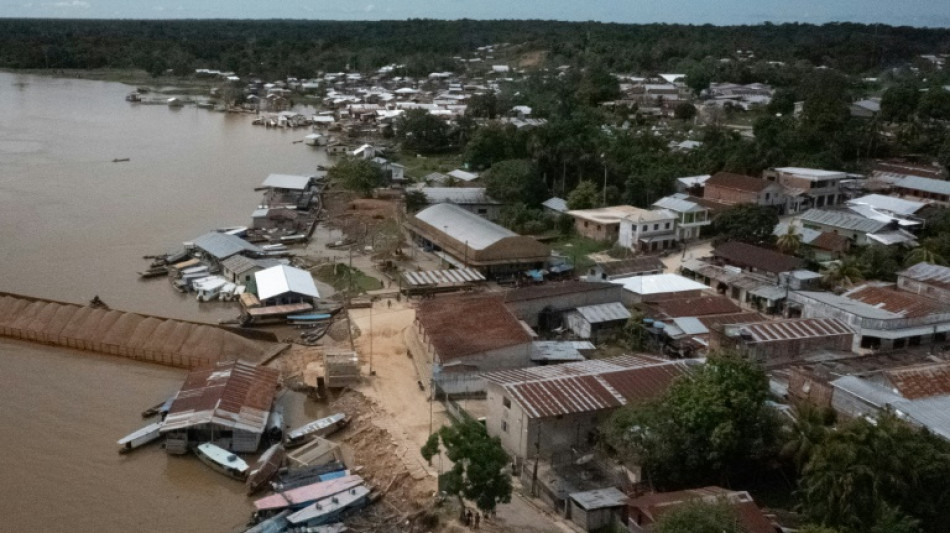
In Amazon region hit by double murder, poverty fuels violence / Photo: © AFP

 EU, China to hold Beijing talks to avert trade war
 Bolsonaro edges past Lula as nail-biter Brazil vote goes to a run-off

 Rubio visits Iceland as US boosts Arctic presence

 Bolsonaro leads Lula as nail-biter Brazil vote goes to a run-off

 Patriots inflict first Bills defeat as Chiefs keep winning

 Pacific nations take centre stage at 'pre-COP' climate summit

 Ronaldo can return to Portugal team if he wants: coach Jesus

 Portugal move into Nations League knockout stage, Germany held

 Ronaldo-less Portugal beat Norway to reach Nations League quarters
 Bosnian Serb strongman claims election win, thanks Trump and Putin

 Israel wear black armbands in Ireland tie over Hamas attack
 'I fear it could drag on': anxiety takes hold in Ethiopian city wrested from rebels

 Brazil's Lula and Flavio Bolsonaro face off in knife-edge election

 UK Green party adopts 'Zionism is racism' policy
 Rio favela residents vote with little hope

 Evenepoel puts worlds 'disappointment' to bed with European crown

 Two-time winning Arc trainer Rouget bows out in emotional farewell

 Battling Djokovic stuns top seed Zverev at China Open

 Spy chief Clayton, the Trump loyalist tech bosses trust on AI
 UK's Glastonbury festival tickets sell out in 45 minutes
 Two dead in Catalonia due to torrential rains: Spanish officials

 Verstappen claims first win of year in chaotic Bahrain GP in Malaysia

 Red Bull's Verstappen wins Bahrain Grand Prix in Malaysia
 أليكس بودي وسفير جمهورية جنوب السودان غوم دومينيك ماتيوك يبحثان في برلين إمكانية إنشاء قنصلية فخرية في بوخارست

 ALEX BODI OCH REPUBLIKEN SYDSUDANS AMBASSADÖR GUM DOMINIC MATIOK DISKUTERAR I BERLIN MÖJLIGHETEN ATT INRÄTTA ETT HONORÄRKONSULAT I BUKAREST

A short walk from the spot where British journalist Dom Phillips and Brazilian Indigenous expert Bruno Pereira set out for their final journey, people sit in the blistering sun breaking rocks into pieces with hammers.
It looks like a scene from a movie set in Biblical times, but this is 21st-century Brazil, in the town of Atalaia do Norte -- the jumping-off point for adventurers, missionaries, poachers, smugglers and others drawn to the Javari Valley, a far-flung sprawl of jungle in the heart of the Amazon rainforest.
Phillips, 57, and Pereira, 41, were boating back to Atalaia after a research trip to the region when they were murdered on June 5. Indigenous leaders say the crime was payback by illegal fishermen for Pereira's fight against poaching on native lands.
The murky case has cast an international spotlight on the Javari Valley, home to an Indigenous reservation bigger than Austria that has the largest concentration of uncontacted tribes on Earth.
The region has been hit by a surge of illegal fishing, logging, mining and drug trafficking -- crimes that security experts say are being fueled by poverty.
In Atalaia, the county seat, Carmen Magalhaes da Roxa explains why she is sitting on a block of wood in the dirt, smashing up stones with a hammer to sell for construction projects at four reais (less than $1) a bucket.
"There's no other work here. If I don't break these rocks, I won't have money to buy gas, pay the electricity bill, buy my medication," says Roxa, 54, pounding away in a floral print dress and flip-flops with half a dozen other "quebra-pedras," or rock-breakers.
"We suffer here -- a lot. I smash my fingers, I get hit by flying shards. But what can you do?" asks the grandmother of three, turning up her bruised hands in a shrug.
- Lack of options -
Seventy-five percent of the population lives in poverty in Atalaia do Norte, a colorful but run-down river town of 20,000 people near the spot where Brazil meets Peru and Colombia.
Nearly everything in town is produced locally, or brought in by boat from Manaus, the capital of Amazonas state -- an eight-day trip.
There are few ways to escape poverty.
Locals often say they have three job options: farming, fishing or city hall, the biggest employer in the county.
Analysts say growing lawlessness has created a fourth: environmental crime, backed by money from drug gangs that thrive on the anarchy of a triple border deep in the jungle.
"Drug traffickers insert impoverished local populations into their networks, presenting it as an opportunity," security specialist Aiala Colares of Para State University wrote in a recent paper, adding that cartels operating in the Amazon feed off "abandonment by the state."
"We can't address the issue of environmental crimes without addressing poverty," Brazilian journalist Yan Boechat said on Twitter.
"Economic development in the Amazon region is a failure. What happened to Bruno and Dom is related to that," he wrote, alongside a video of the Atalaia rock-breakers.
- Violent mix -
Poverty and lawlessness have proved to be a violent mix.
Critics say the weak presence of the state -- a longtime problem across the Amazon -- has only become more acute since 2019 under President Jair Bolsonaro, whose administration has shrunk environmental enforcement and the Indigenous affairs agency, FUNAI.
In the Javari Valley, a surge in violence followed.
The FUNAI base at the edge of the Indigenous reservation was the target of multiple gun attacks in 2019.
The same year, FUNAI's anti-poaching chief in the region was murdered in the nearby city of Tabatinga. The crime remains unsolved.
Just across the border, gunmen in speedboats attacked a Peruvian police station in January, wounding four officers and brazenly stealing a weapons cache. The post has yet to reopen.
Marivonea Moreira de Mello, a 45-year-old mother of four who works at city hall in Atalaia, recalls that a decade ago, she used to sleep with her front door open. Now she wouldn't dare, she says.
"Our young people are getting addicted to drugs. My own son is one of them. He's 20," she says.
She was happy when the army, navy, federal police and world media descended on Atalaia after Phillips and Pereira went missing.
Now that they have mostly left, she worries what will happen. The local police force has just two officers.
"Atalaia do Norte is in a very dangerous situation," she says.
"There's a lack of police, lack of security, lack of everything."
P.Anderson--BTB