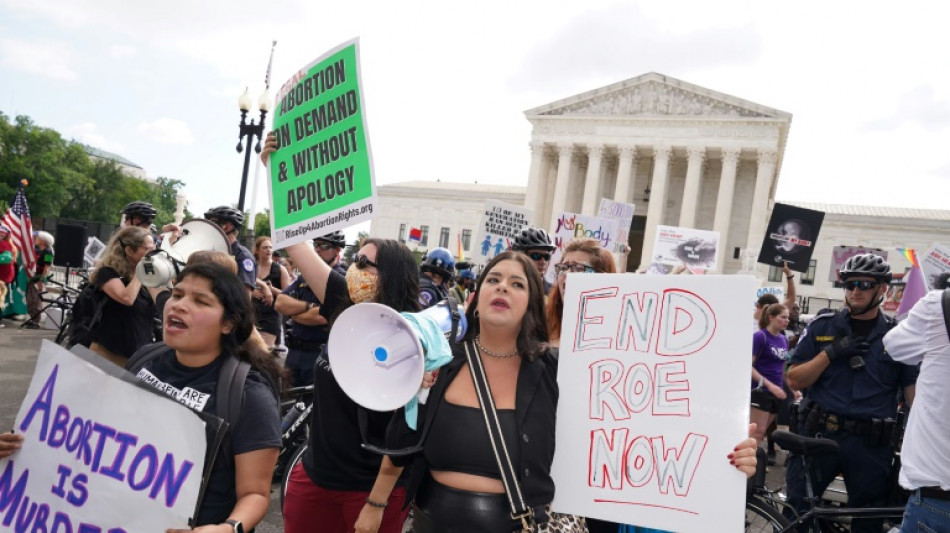
Abortion access threatened in half of US states / Photo: © AFP

 EU, China to hold Beijing talks to avert trade war

 Bolsonaro edges past Lula as nail-biter Brazil vote goes to a run-off

 Rubio visits Iceland as US boosts Arctic presence
 Bolsonaro leads Lula as nail-biter Brazil vote goes to a run-off

 Patriots inflict first Bills defeat as Chiefs keep winning

 Pacific nations take centre stage at 'pre-COP' climate summit

 Ronaldo can return to Portugal team if he wants: coach Jesus

 Portugal move into Nations League knockout stage, Germany held

 Ronaldo-less Portugal beat Norway to reach Nations League quarters

 Bosnian Serb strongman claims election win, thanks Trump and Putin

 Israel wear black armbands in Ireland tie over Hamas attack

 'I fear it could drag on': anxiety takes hold in Ethiopian city wrested from rebels

 Brazil's Lula and Flavio Bolsonaro face off in knife-edge election

 UK Green party adopts 'Zionism is racism' policy

 Rio favela residents vote with little hope

 Evenepoel puts worlds 'disappointment' to bed with European crown

 Two-time winning Arc trainer Rouget bows out in emotional farewell

 Battling Djokovic stuns top seed Zverev at China Open

 Spy chief Clayton, the Trump loyalist tech bosses trust on AI

 UK's Glastonbury festival tickets sell out in 45 minutes

 Two dead in Catalonia due to torrential rains: Spanish officials

 Verstappen claims first win of year in chaotic Bahrain GP in Malaysia

 Red Bull's Verstappen wins Bahrain Grand Prix in Malaysia

 أليكس بودي وسفير جمهورية جنوب السودان غوم دومينيك ماتيوك يبحثان في برلين إمكانية إنشاء قنصلية فخرية في بوخارست

 ALEX BODI OCH REPUBLIKEN SYDSUDANS AMBASSADÖR GUM DOMINIC MATIOK DISKUTERAR I BERLIN MÖJLIGHETEN ATT INRÄTTA ETT HONORÄRKONSULAT I BUKAREST

The US Supreme Court's overturning of America's constitutional right to abortion gives all 50 states the freedom to ban the procedure, with nearly half expected to do so in some form.
- Automatic bans -
Thirteen states, mostly in the conservative and religious south of the country, have in recent years adopted so-called "trigger" laws to come into force virtually automatically after the decision was handed down.
They differ in how they ban abortions. Idaho provides exceptions for rape or incest but Kentucky only does so if the pregnant woman's life is in danger.
Laws in Louisiana could see health professionals jailed for up to ten years for carrying out abortions. In Missouri, it's 15 years.
In some states, such as South Dakota, the ban went into effect the day of the Supreme Court's ruling. South Dakota does allow for exceptions when the mother is at risk.
Missouri's attorney general Eric Schmitt tweeted a photo of himself signing an opinion banning abortion in the Midwestern state less than two hours after the Supreme Court's decision was announced. Arkansas and Oklahoma quickly followed with similar moves.
Other states, such as Mississippi, also require the attorney general to first confirm that the court has changed the legal framework.
Texas and Tennessee have set a period of 30 days between the release of the judgment and a new ban coming into force.
- Restrictions -
Iowa, Georgia, Ohio and South Carolina are among states that have passed laws restricting abortion after six weeks, before many people even know they are pregnant.
While currently blocked by the courts, those laws could take effect now that the Supreme Court has changed the legal landscape.
- Complex patchwork -
Ten states, including Arizona and Michigan, have pre-1973 laws banning abortion on the books that they could theoretically revive, though their path forward is uncertain.
In Wisconsin -- where the Democratic governor supports abortion rights, but the majority Republican lawmakers do not -- Planned Parenthood has said it does not plan to carry out abortions from the end of June, citing a legal risk.
In Michigan, Democratic Attorney General Dana Nessel has added to the confusion by promising not to prosecute people who violate its 1931 law banning abortion.
But local prosecutors will still be able to do so, and the state risks becoming a complex patchwork of laws.
In Arizona, Republican Governor Doug Ducey believes that a law passed this year to ban abortions after 15 weeks of pregnancy will override previous rules.
Senators in his party do not see it that way and Ducey is expected to go to court to get clarity.
- Others to watch -
According to the Guttmacher Institute, four states have signaled that they are unfavorable to abortion but do not currently have laws prohibiting them.
Lawmakers in Nebraska and Indiana have failed to pass abortion bans. Officials in Montana and Florida have reduced deadlines for terminating a pregnancy, but supreme courts in those states have protected the right to abortion.
- Liberal states -
Twenty-two states -- mostly in the northeast and on the West Coast -- will retain the right to abortion and are preparing for an influx of women seeking abortions.
Connecticut and Delaware, for example, have expanded the categories of professionals who are authorized to carry out abortions to include nurses and midwives.
Lawmakers in California have allocated $152 million to assist access to abortion and the governor of New York has pledged $35 million.
W.Lapointe--BTB