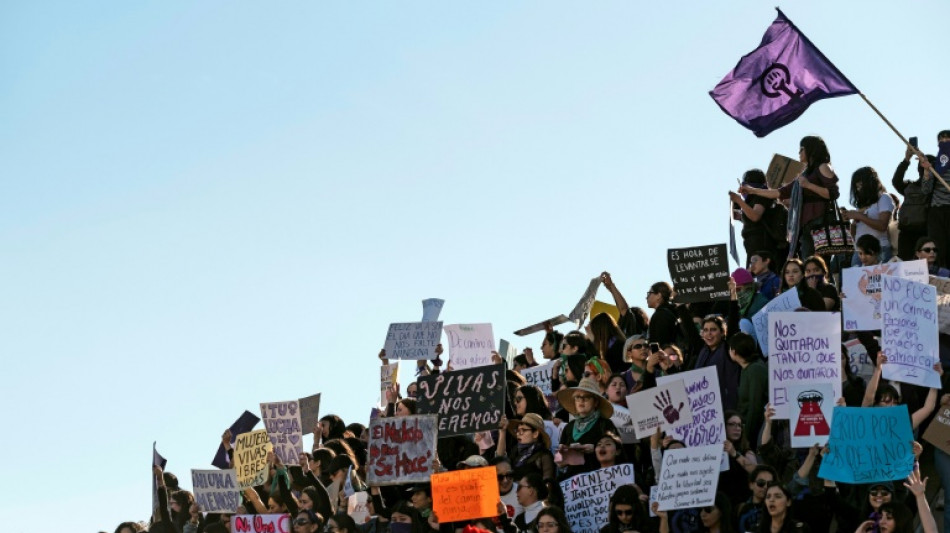
Americans seeking abortion get help from Mexico / Photo: © AFP/File

 EU, China to hold Beijing talks to avert trade war
 Bolsonaro edges past Lula as nail-biter Brazil vote goes to a run-off
 Rubio visits Iceland as US boosts Arctic presence

 Bolsonaro leads Lula as nail-biter Brazil vote goes to a run-off

 Patriots inflict first Bills defeat as Chiefs keep winning

 Pacific nations take centre stage at 'pre-COP' climate summit

 Ronaldo can return to Portugal team if he wants: coach Jesus

 Portugal move into Nations League knockout stage, Germany held

 Ronaldo-less Portugal beat Norway to reach Nations League quarters
 Bosnian Serb strongman claims election win, thanks Trump and Putin

 Israel wear black armbands in Ireland tie over Hamas attack

 'I fear it could drag on': anxiety takes hold in Ethiopian city wrested from rebels

 Brazil's Lula and Flavio Bolsonaro face off in knife-edge election

 UK Green party adopts 'Zionism is racism' policy

 Rio favela residents vote with little hope

 Evenepoel puts worlds 'disappointment' to bed with European crown

 Two-time winning Arc trainer Rouget bows out in emotional farewell

 Battling Djokovic stuns top seed Zverev at China Open

 Spy chief Clayton, the Trump loyalist tech bosses trust on AI

 UK's Glastonbury festival tickets sell out in 45 minutes

 Two dead in Catalonia due to torrential rains: Spanish officials

 Verstappen claims first win of year in chaotic Bahrain GP in Malaysia

 Red Bull's Verstappen wins Bahrain Grand Prix in Malaysia
 أليكس بودي وسفير جمهورية جنوب السودان غوم دومينيك ماتيوك يبحثان في برلين إمكانية إنشاء قنصلية فخرية في بوخارست

 ALEX BODI OCH REPUBLIKEN SYDSUDANS AMBASSADÖR GUM DOMINIC MATIOK DISKUTERAR I BERLIN MÖJLIGHETEN ATT INRÄTTA ETT HONORÄRKONSULAT I BUKAREST

Facing high medical costs and pressure to reconsider, a single mother living in California turned to activists across the border in Mexico who helped her have an abortion.
"We're supposed to be in a free country, in a state where you can smoke marijuana, but abortion is still somewhat taboo," the 31-year-old said, shortly before the US Supreme Court ended the nationwide right to the procedure.
The woman, of Mexican descent, believes terminating a pregnancy will now become ever harder, although the liberal West Coast states of California, Oregon and Washington jointly vowed to defend abortion rights.
The Supreme Court's decision on Friday to overturn the nationwide right to abortion gives all 50 states the freedom to ban the procedure, and nearly half are expected to do so in some form.
Even before the ruling, accessing a safe abortion in the United States was already "complicated if you don't have money," said the mother of three, who works in a restaurant in San Diego.
She initially visited two clinics in the United States, but at both the cost of the procedure was almost $1,000, which she could not afford.
At one of the facilities, which had religious links, she was discouraged from having an abortion.
"They told me there were other options, that I could give it up for adoption. But I was determined, desperate," she told AFP by telephone, explaining that she got pregnant because contraceptives failed.
- 'Huge setback' -
Through a friend, the woman learned about Colectiva Bloodys, a non-government organization in Tijuana just south of San Diego that is part of a cross-border network providing free assistance to women in the United States who cannot access an abortion.
"I was surprised that they helped me from Mexico. I thought that we were more liberal here," she said.
"Everything moved very quickly there. In less than a day they said 'here's the solution,'" the woman said.
She was sent a combination of medication that ends a pregnancy by causing the uterus to contract, a method considered safe by the World Health Organization (WHO), mainly for up to 12 weeks of pregnancy.
The NGO responded quickly to any follow-up questions and "was always supportive," she added.
Colectiva Bloodys has sent these treatments to conservative-led US states such as Oklahoma, Texas and Georgia for a few years and expects more requests following the Supreme Court ruling, said one of its members, Crystal Perez Lira.
"It's very unfortunate, a huge setback; but we are going to have the capacity and the will" to offer support, Perez Lira said.
Mexican activists had already been surprised by the amount of interest from women in the United States in the cross-border network, launched in January in the face of obstacles to accessing a safe abortion.
"As of May, we had assisted 200 women who crossed the border and sent 1,000 sets of medicine. We didn't expect so many," said Veronica Cruz, founder of Las Libres, one of some 30 groups in the network.
- Financial constraints -
While the activists had expected mainly Latinas to seek their help, they have also been approached by non-Spanish speakers.
"Most turn to us for financial reasons. Over there the medication costs about $600 or they have to wait weeks to get it from organizations. We give it for free," Cruz said.
Some of the women seeking assistance in Mexico are reluctant to go to a clinic in the United States because they lack the necessary immigration documents.
"We don't invade their privacy. We don't question their legal status or their nationality," said Perez Lira.
In contrast to the US ruling, Mexico's Supreme Court last year declared the laws criminalizing abortion unconstitutional, authorizing it de facto throughout the conservative Latin American country.
In Mexico City, which decriminalized abortion in 2007 and provides free care regardless of place of residence, authorities pledged to support women from the United States following the court ruling.
"It's truly regressive, sad and outrageous that in a country where these rights had been recognized they are going backwards. We'll be ready to help," the city's health secretary, Oliva Lopez Arellano, told AFP.
"We have the capacity for around 25,000 legal terminations a year and now we're at half that," she said.
One in 10 of the 247,000 abortions carried out in the city in the past 15 years have been for migrants heading to the United States, most of them Central Americans, she added.
In addition to Mexico City, eight more of Mexico's 32 states have decriminalized abortion.
F.Pavlenko--BTB