Far from home, Russian exiles help Ukrainian refugees / Photo: © AFP

 EU, China to hold Beijing talks to avert trade war
 Bolsonaro edges past Lula as nail-biter Brazil vote goes to a run-off
 Rubio visits Iceland as US boosts Arctic presence
 Bolsonaro leads Lula as nail-biter Brazil vote goes to a run-off
 Patriots inflict first Bills defeat as Chiefs keep winning
 Pacific nations take centre stage at 'pre-COP' climate summit
 Ronaldo can return to Portugal team if he wants: coach Jesus

 Portugal move into Nations League knockout stage, Germany held

 Ronaldo-less Portugal beat Norway to reach Nations League quarters

 Bosnian Serb strongman claims election win, thanks Trump and Putin
 Israel wear black armbands in Ireland tie over Hamas attack

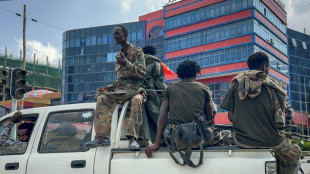 'I fear it could drag on': anxiety takes hold in Ethiopian city wrested from rebels
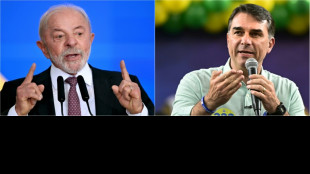 Brazil's Lula and Flavio Bolsonaro face off in knife-edge election

 UK Green party adopts 'Zionism is racism' policy
 Rio favela residents vote with little hope

 Evenepoel puts worlds 'disappointment' to bed with European crown

 Two-time winning Arc trainer Rouget bows out in emotional farewell

 Battling Djokovic stuns top seed Zverev at China Open
 Spy chief Clayton, the Trump loyalist tech bosses trust on AI
 UK's Glastonbury festival tickets sell out in 45 minutes
 Two dead in Catalonia due to torrential rains: Spanish officials

 Verstappen claims first win of year in chaotic Bahrain GP in Malaysia

 Red Bull's Verstappen wins Bahrain Grand Prix in Malaysia
 أليكس بودي وسفير جمهورية جنوب السودان غوم دومينيك ماتيوك يبحثان في برلين إمكانية إنشاء قنصلية فخرية في بوخارست
 ALEX BODI OCH REPUBLIKEN SYDSUDANS AMBASSADÖR GUM DOMINIC MATIOK DISKUTERAR I BERLIN MÖJLIGHETEN ATT INRÄTTA ETT HONORÄRKONSULAT I BUKAREST

Political science graduate Yevgeny Zhukov used to own a small coffee shop in Moscow, but when the war in Ukraine began he decided to pack up and leave.
Joining the tens of thousands of Russians that have fled their country, Zhukov travelled to neighbouring Georgia where he helped set up an NGO to aid Ukrainian refugees.
"I couldn't face such injustice and do nothing," Zhukov told AFP.
"I made the decision to get a passport and go to Georgia in order to do something, to help somehow," said the 23-year-old, who now aids Ukrainian refugees get medical supplies through the "Emigration for Action" in the Georgian capital Tbilisi.
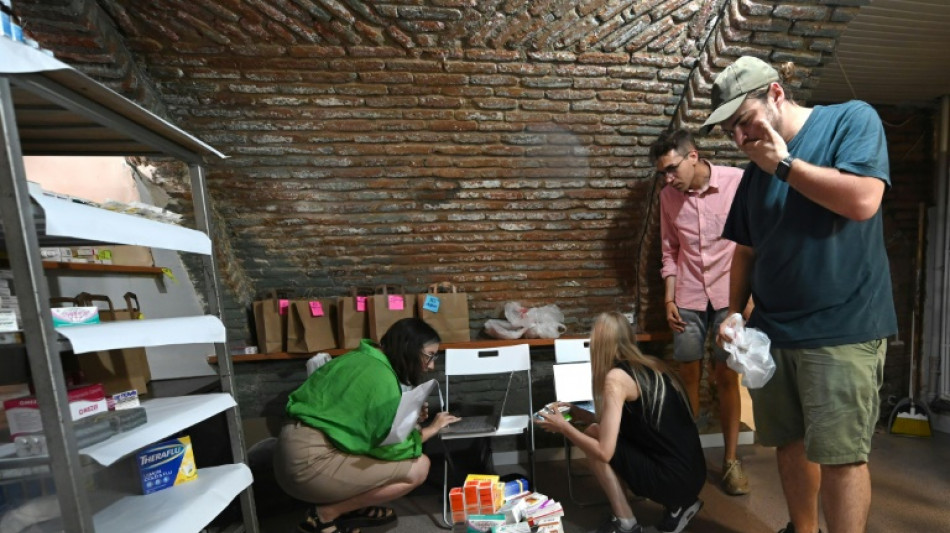
Down in the basement of the group's headquarters -- which is run by recently exiled Russians -- Zhukov is organising shelves with various medicines that have been delivered from a local pharmacy.
Lined up behind them are rows of neatly labelled brown paper bags, each containing an order for a Ukrainian refugee or family that is waiting to be collected.
"When we came here it became obvious that we can't just do nothing," said another founding volunteer called Daniil who was moved to Tbilisi by the German political foundation he works for.
He said they noticed there was a gap with providing free medicine for the thousands of Ukrainian refugees fleeing to Georgia.
Since starting work in late April, the group has already helped more than 250 Ukrainian refugees to get medicine, ranging from basic painkillers to prescription medication.
- Cold welcome -
Now their pool of volunteers has grown to over 30 and more refugees are getting in touch for help, raising fears that demand will be higher than their means.
The group funds their purchases with donations and organises various events -- like talks or film screening -- to raise funds.
Many Russians who moved to Georgia after the start of the war faced a cold welcome from locals with memories still fresh of their own conflict with Moscow in 2008.
But Daniil said they haven't experienced any negativity since setting up, either from Georgians or Ukrainians.
"Not only do we want to help but we also don't want to deny that we are Russians. That's why we have the flag outside," the 26-year-old said, referring to the white-blue-white Russian opposition flag hanging at their entrance.
He admits that it can even be "a bit awkward" to receive gratitude from the refugees that they have helped.
Among those that reached out to the group is Nikolai, who fled the southern Ukrainian port city of Mariupol which has since fallen under Russia's control.
Together with his wife and two daughters, he decided to leave as the battle for the city was still raging, "running under fire" to escape the devastating siege.
- Doing 'the right thing' -
The 40-year-old IT worker now lives in Tbilisi and "Emigration for Action" helped him get calcium medication that became impossible to source in Mariupol.
For Nikolai it doesn't matter where the help is coming from.
"I don't confuse Russia with the people that control it," he said.
"You need to look regardless of nationality or any other characteristics of a person, just look at what kind of a person one is by their deeds and actions," he added.
But Zhukov admits that for him it is "hard" to process that his country -- Russia -- attacked its neighbour.
"I am a citizen of a country that is the aggressor, but I am very reassured by the words of gratitude from the refugees," Zhukov said.
"In many ways, I am working for my future. So that when I have children who read history books and ask: 'Dad, what did you do in this time?' I can look them in the eye and say that I did the right thing."
P.Anderson--BTB