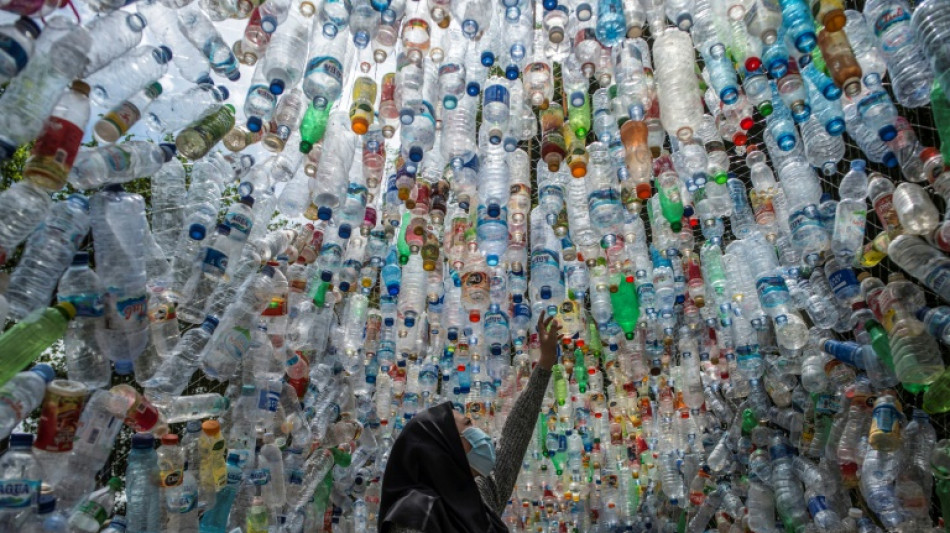
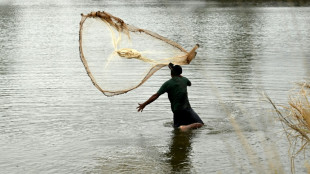
UN meet sees blitz of pledges to protect ailing oceans / Photo: © AFP/File

 Braves rock Dodgers to level series, Brewers win thriller

 Most Asia stocks rally as 'Goldilocks' jobs data ease rate fears
 Sunken Silk Road city reveals Central Asia's lost history

 Three years on, Israeli rescuer cannot escape October 7
 Research into weight-loss drugs tipped for Nobel as award week opens
 US Supreme Court hears bid to shut the door on climate suits
 Chourio walk-off single lifts Brewers over Padres

 Flavio Bolsonaro leads Lula in near-done Brazil vote count
 Flavio Bolsonaro leads Lula in partial Brazil poll results

 Titan FX Launches Second “Dream Beyond Borders 2.0” Brand Commercial Featuring Keisuke Honda

 Patriots inflict first Bills defeat as Rams surge late

 Brazil's Indigenous back Lula as El Nino fuels forest fires

 Brazil braces for results of election battle between Lula and Bolsonaro

 Indians protest election chief ahead of top court hearing

 'Verity' kills, Cruise bombs in N. American movie theaters
 Colts top Commanders in NFL London game

 Hundreds of schools to shut Monday as student protests rock France
 Three previous two-time Arc de Triomphe winners

 'Champion' Daryz wins second successive Arc in fine style

 Daryz wins second successive Prix de l'Arc de Triomphe

 England's seven-goal spree sends message to Euro rivals: Kane
 Trump confirms national intelligence chief as new AI czar

 Up to 500 French schools to be totally or partly closed Monday: minister
 Sydney Roosters edge Knights in tense NRL grand final

 Sabalenka out of China Open in third round, Medvedev into semis

A major UN conference on how to restore the faltering health of global oceans kicked off in Lisbon this week with a flurry of promises to expand marine protected areas, ban deep-sea mining, and combat illegal fishing.
UN chief Antonio Guterres set the tone Monday for the five-day meet by warning that the world's oceans are in deep crisis.
"Today we face what I would call an ocean emergency," he told thousands of policymakers, experts and advocates, detailing how seas have been hammered by climate change and pollution.
"The ocean is not a rubbish dump. It is not a source on infinite plunder. It is a fragile system on which we all depend."
Surangel Whipps, Jr., president of the Pacific island state of Palau, asked world leaders to join a moratorium on extracting rare Earth metals from the ocean floor.
"Deep sea mining compromises the integrity of our ocean habitat and should be discouraged to the greatest extent possible," he said, flanked by Fiji Prime Minister Frank Bainimarama.
Indigenous leader Debbie Ngawera-Packer, a member of New Zealand's parliament, told conference participants she had submitted a bill calling for such a moratorium in her country's waters.
Companies seeking to mine so-called polymetallic nodules containing manganese, cobalt and nickel say they are a greener source of minerals needed to build electric vehicle batteries.
Scientists counter that seabed ecosystems at depth are fragile, and could take decades or longer to heal once disrupted.
"Mining, wherever it occurs, is well known to have environmental costs," said former US National Oceanic and Atmospheric Administration (NOAA) chief scientist Sylvia Earle.
- 'No-take' zones -
"On the land at least we can monitor, see and fix problems, and minimise the damage. Six thousand metres (20,000 feet) beneath the surface, who's watching?"
A so-called high ambition coalition, meanwhile -- backing a proposal to set aside 30 percent of the planet's land and ocean surface by 2030 as protected areas -- grew to 100 nations, UK minister of state Zac Goldsmith announced in a side event.
Currently, less than 10 percent of global oceans are protected.
The "30 X 30" plan could be the cornerstone of a treaty slated for completion at a UN biodiversity summit to be held in December in Montreal.
Nearly a quarter of a billion dollars in government, development bank and philanthropic funding to lock-in protection of marine and land ecosystems in Colombia, announced last week, could be the template for other countries.
"Working with scientists, we decided to get 30 percent of our maritime area as protected, and we did it," outgoing Colombian President Ivan Duque told AFP.
More than half of newly protected marine areas will be "no-take" zones off-limits to fishing, mining, drilling or other extractive activities, he said.
The United Sates, European Union nations, Mexico, Canada, Japan and India have joined the 30 x 30 drive, while China, Russia, Indonesia and Brazil have yet to do so.
Steps were also taken Monday to fight illegal fishing, another topic on the table at the long-delayed UN Ocean Conference, originally set for April 2020.
In Washington, US President Joe Biden issued a national security memorandum to combat illegal, unreported, and unregulated (IUU) fishing and related labour abuses.
- Wreaking havoc -
The aim is to "make sure that the seafood products that are coming into the US market are caught in accordance with international rules and national rules," a senior administration official told journalists.
A report by the International Trade Commission found that the United States imported $2.4 billion worth of seafood derived from IUU fishing in 2019.
"The ocean is the most underappreciated resource on our planet," Kenyan President Uhuru Kenyatta told the conference, flanked by co-host Portuguese President Antonio Costa.
Oceans harbour 80 percent of life on Earth and generate 50 percent of the oxygen in the atmosphere.
They also absorb a quarter of CO2 pollution and 90 percent of excess heat from global warming, keeping the planet livable for life on land.
But these services rendered come at a cost.
Sea water has turned acidic, threatening aquatic food chains and the ocean's capacity to absorb carbon. Global warming has spawned massive marine heatwaves that are killing off precious coral reefs and expanding dead zones bereft of oxygen.
"We have only begun to understand the extent to which climate change is going to wreak havoc on ocean health," said Charlotte de Fontaubert, the World Bank's global lead for the blue economy.
Making things worse is an unending torrent of pollution, including a garbage truck's worth of plastic every minute, according to the United Nations Environment Programme (UNEP).
A.Gasser--BTB