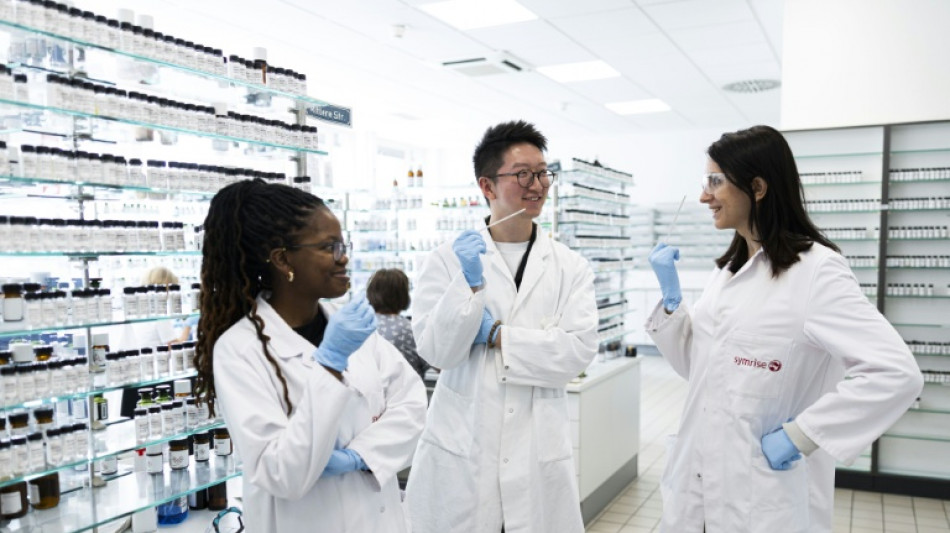
Who makes laundry smell nice? Meet the professional 'noses' / Photo: © AFP

 'I completely trust the club,' says Man City boss Maresca

 '10 out of 10' Quintana reminisces over dream Vuelta win

 Maddinson given shock recall but fails to score

 Navi Pillay, South African rights champion, wins Nobel Peace Prize

 Saudi Arabia says three killed at airport as Yemen war expands

 Everton's US owners mull sale of club two years after takeover

 Ukraine takes Russia fight to 'scorching sands' of Sahel

 Chinese AI tool pulled to prevent 'misuse' after South Korea hacks

 Asian stocks mostly up as traders weigh AI, oil dips after surge
 Walking through flames: orangutans rescued in Indonesia fires

 LeBron shines in pre-season debut for re-tooled 76ers

 Okinawa resolution calls for revision of US forces pact after murder

 Verdict expected Friday in Mexico trial over murders of Australia, US surfers
 New York mayor says asking Trump to withdraw ICE after shooting

 Walking through flames: orangutan rescued in Indonesia fires

 James shines in pre-season debut for re-tooled 76ers

 Fuel, fertilizer costs strain US farmers' support for Republicans in midterms
 Trump's 'super intelligence' rebrand to sell AI faces uphill battle

 Fiji demands US provide evidence Chinese official paid bribes for Beijing

 More than just football: How scandal-tainted City led Manchester's rebirth

 Record Eden Park streak creates tension for All Blacks

 EU trade chief seeks 'tangible outcomes' in China talks
 Man City face Anfield cauldron after guilty Premier League verdicts

 CNN, MS Now, Politico urge judge to extend White House access

 Trump administration to launch new vaccine research center

In the laboratories of German fragrance and flavours giant Symrise, a citrus scent clings to the lab coats of trainees -- "noses" who are learning the art of making things smell good.
These busy heroes of the world of smells and aromas shape the connection millions of consumers have with everyday items.
While at high-end perfume labels, olfactory artists create scents for luxury body sprays, Symrise's experts work on everyday products that might range from mint-flavoured toothpaste to barbeque chips.
Smell, a powerful sense that can trigger emotions and memories, and aroma often decide which food or beverage, cleaning or personal hygiene product ends up in the shopping cart.
At Symrise's headquarters in Holzminden, a quiet town south of Hanover, each day at the company's in-house perfumery school begins the same way: sniffing out scents from dozens of tiny bottles while blindfolded.
"It's just like tuning a musical instrument before you play," said Alicia De Benito Cassado, a 32-year-old former professional pianist from Spain.
Her career switch into scent development was a natural step: she made her own perfumes as a teenager to match the poetry and music that she wrote.
"For me, not everything has to smell good," she said. "The horror of smell also helps us discover ourselves."
But commercial clients demand something different, De Benito Cassado added. "In the end, we need to create scents that are strong, beautiful, powerful -- and affordable."
- Professional sniffers -
Being a "nose" is a full-time job and comes with a three-year training programme.
The smell of a fabric softener can be composed of 80 compounds, far more than in a premium body perfume, and the best noses can make out over 1,000 different odours while blindfolded.
Shangyun Lyu, 31, came from China to study at the school and says that a professional sniffer can get by with knowing about 500scents.
Being able to break down odours into their chemical components is key.
"As a kid, I just smelled jasmine or gardenia as flowers," he said. "Now, I recognise the chemicals: it's a blend of many elements."
Students weigh ingredients down to the milligramme, mix, smell, and start over, often by replicating existing smells to understand their structure and then innovate from there.
"When developing perfume, it is very important that several people smell it," said 56-year-old master perfumer Marc vom Ende, head of the school.
"We all perceive smell differently."
- 'Nose has the final say' -
Pleasant smells cannot come at any cost, and the rules of the game change over time.
Lilial, a chemical once prized for its floral and sweet Lily-of-the-Valley notes, has been banned in the European Union since 2022 over fears it can cause skin irritation and damage the reproductive system.
Fragrances applied directly to the body have stricter regulations than detergents, said 27-year-old South African trainee Attiya Setai.
"We're more restricted in raw materials and must replace banned ingredients with new compliant ones," she said.
Tastes also vary across global markets, with Shangyun pointing to the example of Chinese shampoos that sell well with a young clientele there but would struggle in Europe.
"Something old-fashioned in one country can be new elsewhere," he said.
Cost also enters the equation. Symrise extracts aromatic compounds from wood resin, a by-product of the paper industry, in a move "that makes both economic and environmental sense", said vom Ende.
It is hard to be a nose.
About 500 perfumers work in the industry and 80 of them at Symrise, which has a workforce of 13,000. The company markets about 30,000 products to clients ranging from confectioners to pet food manufacturers and suncream makers.
Symrise's competitors include DSM-Firmenich, headquartered in both Switzerland and the Netherlands, as well as Givaudan, another Swiss firm.
Artificial intelligence increasingly plays a role, with computer programmes predicting which fragrances will hit the mark.
Still, the machines cannot -- yet -- smell, even if they can understand speech and read text.
"We're supported by AI," vom Ende said. "But the nose has the final say".
L.Janezki--BTB