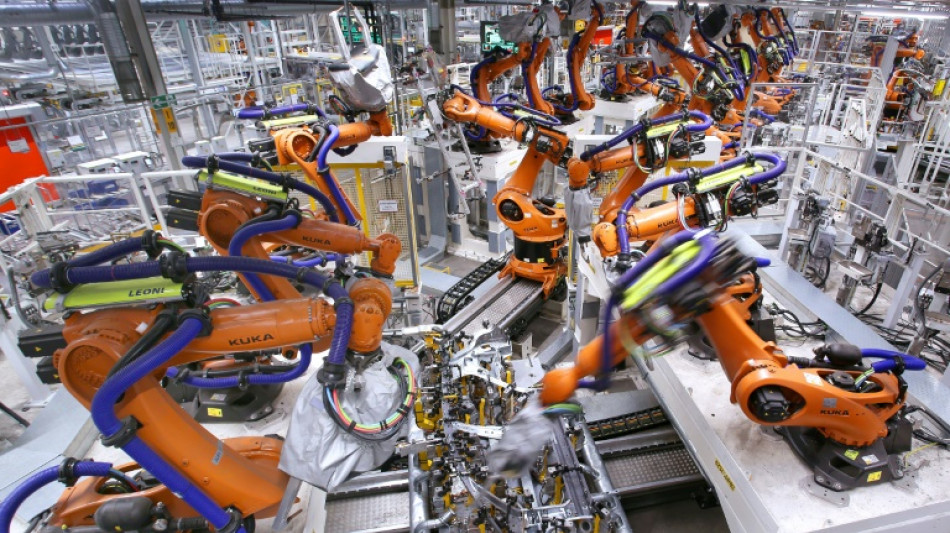
EU approves end of combustion engine sales by 2035 / Photo: © AFP/File

 Braves rock Dodgers to level series, Brewers win thriller

 Most Asia stocks rally as 'Goldilocks' jobs data ease rate fears

 Sunken Silk Road city reveals Central Asia's lost history

 Three years on, Israeli rescuer cannot escape October 7

 Research into weight-loss drugs tipped for Nobel as award week opens

 US Supreme Court hears bid to shut the door on climate suits

 Chourio walk-off single lifts Brewers over Padres

 Flavio Bolsonaro leads Lula in near-done Brazil vote count

 Flavio Bolsonaro leads Lula in partial Brazil poll results

 Titan FX Launches Second “Dream Beyond Borders 2.0” Brand Commercial Featuring Keisuke Honda

 Patriots inflict first Bills defeat as Rams surge late

 Brazil's Indigenous back Lula as El Nino fuels forest fires

 Brazil braces for results of election battle between Lula and Bolsonaro

 Indians protest election chief ahead of top court hearing

 'Verity' kills, Cruise bombs in N. American movie theaters

 Colts top Commanders in NFL London game

 Hundreds of schools to shut Monday as student protests rock France

 Three previous two-time Arc de Triomphe winners

 'Champion' Daryz wins second successive Arc in fine style

 Daryz wins second successive Prix de l'Arc de Triomphe

 England's seven-goal spree sends message to Euro rivals: Kane

 Trump confirms national intelligence chief as new AI czar

 Up to 500 French schools to be totally or partly closed Monday: minister

 Sydney Roosters edge Knights in tense NRL grand final
 Sabalenka out of China Open in third round, Medvedev into semis
The European Union approved a plan to end the sale of vehicles with combustion engines by 2035 in Europe, the 27-member bloc announced early Wednesday, in a bid to reduce CO2 emissions to zero.
The measure, first proposed in July 2021, will mean a de facto halt to sales of petrol and diesel cars as well as light commercial vehicles and a complete shift to electric engines in the European Union from 2035.
The plan is intended to help achieve the continent's climate objectives, in particular, carbon neutrality by 2050.
At the request of countries including Germany and Italy, the EU-27 also agreed to consider a future green light for the use of alternative technologies such as synthetic fuels or plug-in hybrids.
While approval would be tied to achieving the complete elimination of greenhouse gas emissions, the technologies have been contested by environmental NGOs.
Environment ministers meeting in Luxembourg also approved a five-year extension of the exemption from CO2 obligations granted to so-called "niche" manufacturers, or those producing fewer than 10,000 vehicles per year, until the end of 2035.
The clause, sometimes referred to as the "Ferrari amendment", will benefit luxury brands in particular.
These measures must now be negotiated with members of the European Parliament.
"This is a big challenge for our automotive industry," acknowledged French Minister of Ecological Transition Agnes Pannier-Runacher, who chaired Tuesday night's meeting.
But she said it was a "necessity" in the face of competition from China and the United States, which have bet heavily on electric vehicles seen as the future of the industry.
These decisions will "allow a planned and accompanied transition", the minister said.
- Openness to synthetic fuels -
Europe's automotive industry, which is already investing heavily in the move to electric vehicles, fears the social impact of a too-rapid transition.
"The overwhelming majority of car manufacturers have chosen electric cars," said Frans Timmermans, the EU Commission Vice President in charge of the European Green Deal, at a press conference.
He affirmed the EU body's willingness to be open-minded to other technologies -- like synthetic fuels, which are also referred to as e-fuels.
"We are technology neutral. What we want are zero-emission cars," he explained.
"At the moment, e-fuels do not seem a realistic solution, but if manufacturers can prove otherwise in the future, we will be open."
The technology of synthetic fuels, currently under study, consists of producing fuel from CO2 from industrial activities using low-carbon electricity, in a circular economy approach.
Like the oil industry, the automotive sector has high hopes for these new fuels, which would extend the use of internal combustion engines now threatened by the emergence of completely electric vehicles.
But environmental organisations object to the use of this technology in cars, as it is considered both expensive and energy-consuming.
The synthetic-fuelled engines also emit as much nitrogen oxide (NOx) as their fossil fuel equivalents, they say.
Cars are the main mode of transport for Europeans and account for just under 15 percent of total CO2 emissions in the EU. It is also one of the main gases responsible for global warming.
In response to manufacturers' concerns about insufficient consumer demand for 100 percent electric cars, the Commission has recommended a major expansion of charging stations.
"Along the main roads in Europe, there must be charging points every 60 kilometres (37 miles)," said European Commission President Ursula von der Leyen last year.
Manufacturers regularly complain about the lack of such infrastructure, especially in southern and eastern European countries.
C.Kovalenko--BTB