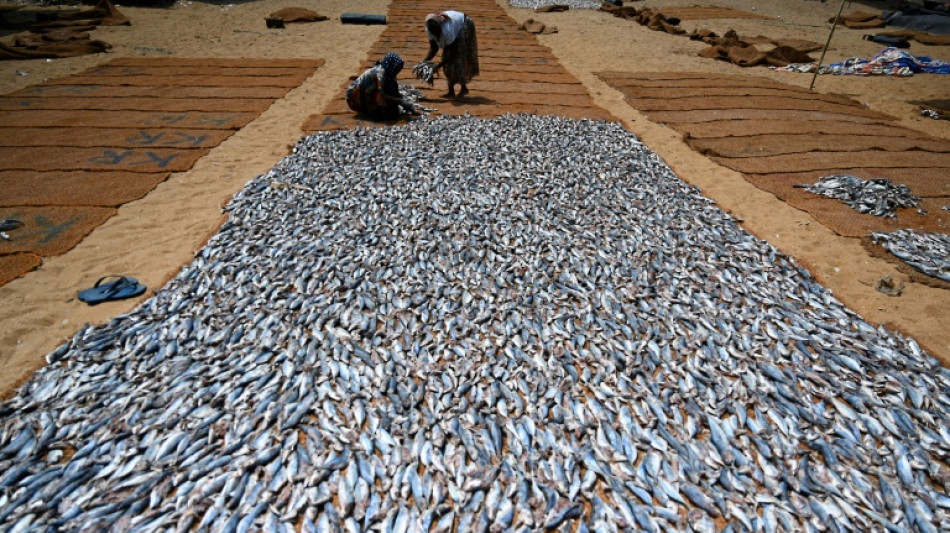
Aquaculture drives aquatic food yields to new high / Photo: © AFP/File

 Braves rock Dodgers to level series, Brewers win thriller

 Most Asia stocks rally as 'Goldilocks' jobs data ease rate fears

 Sunken Silk Road city reveals Central Asia's lost history

 Three years on, Israeli rescuer cannot escape October 7

 Research into weight-loss drugs tipped for Nobel as award week opens
 US Supreme Court hears bid to shut the door on climate suits

 Chourio walk-off single lifts Brewers over Padres

 Flavio Bolsonaro leads Lula in near-done Brazil vote count
 Flavio Bolsonaro leads Lula in partial Brazil poll results

 Titan FX Launches Second “Dream Beyond Borders 2.0” Brand Commercial Featuring Keisuke Honda

 Patriots inflict first Bills defeat as Rams surge late

 Brazil's Indigenous back Lula as El Nino fuels forest fires

 Brazil braces for results of election battle between Lula and Bolsonaro

 Indians protest election chief ahead of top court hearing

 'Verity' kills, Cruise bombs in N. American movie theaters

 Colts top Commanders in NFL London game

 Hundreds of schools to shut Monday as student protests rock France

 Three previous two-time Arc de Triomphe winners

 'Champion' Daryz wins second successive Arc in fine style

 Daryz wins second successive Prix de l'Arc de Triomphe

 England's seven-goal spree sends message to Euro rivals: Kane

 Trump confirms national intelligence chief as new AI czar

 Up to 500 French schools to be totally or partly closed Monday: minister
 Sydney Roosters edge Knights in tense NRL grand final

 Sabalenka out of China Open in third round, Medvedev into semis

The amount of fish, shellfish and algae caught in the wild and farmed in aquaculture hit a record 214 million tonnes in 2020, the Food and Agriculture Organization said Wednesday.
Driven by a sustained surge in aquaculture, the new record is good news for a world facing price hikes and food shortages due to the war in Ukraine, disrupted supply chains, and inflation.
"The growth of fisheries and aquaculture is vital in our efforts to end global hunger and malnutrition," said FAO director Qu Dongyu.
But overfished oceans, climate change and pollution -- if left unaddressed -- could threaten that potential, the UN agency warned in its 2022 state of the world fisheries report.
"Aquaculture growth has often occurred at the expense of the environment," it said.
"Sustainable aquaculture development remains critical to supply the growing demand for aquatic food."
Production of aquatic animals in 2020 -- totalling 178 million tonnes -- was evenly divided between fisheries and aquaculture.
The remaining 36 million tonnes was algae production.
Yields of fish, shrimp and other shellfish destined for human consumption is more than 60 percent higher than during the 1990s, far outpacing population growth, according to the report, released during the UN Ocean Conference in Lisbon.
On average, people worldwide consume over 20 kilos (44 pounds) of aquatic foods per year today, more than double the amount 50 years ago.
Globally, 17 percent of the protein consumed by humans comes from aquatic sources. In many Asian and African countries, that figure rises to more than 50 percent, according to the report.
Wild and farmed food from the seas and inland waters are also a critical source of essential omega-3 fatty acids and micronutrients, recent research has shown.
"Aquatic foods are increasingly recognised for their key role in food security and nutrition," Qu said.
Nearly 90 percent of aquatic animal production is for human consumption, with the rest destined for non-food uses such as fishmeal and fish oil.
Asian countries were the source of 70 percent of the world's fisheries and aquaculture of aquatic animals in 2020.
China remaining by far the top fisheries producer, followed by Indonesia, Peru, Russia, the United States and Vietnam.
So-called capture fisheries in the wild -- which have stagnated since the mid-1990s -- dropped by four percent in 2020 compared to the average of the previous three years.
Part of the drop can be attributed to disruptions caused by the Covid pandemic, but long-term decline is due to overfishing.
"The FAO estimates that 34 percent of caught fish come from overfished stocks," University of British Columbia economist and fisheries expert Rashid Sumaila told AFP.
"But they are very conservative," he added. "Independent studies put that figure at 50 percent."
M.Odermatt--BTB