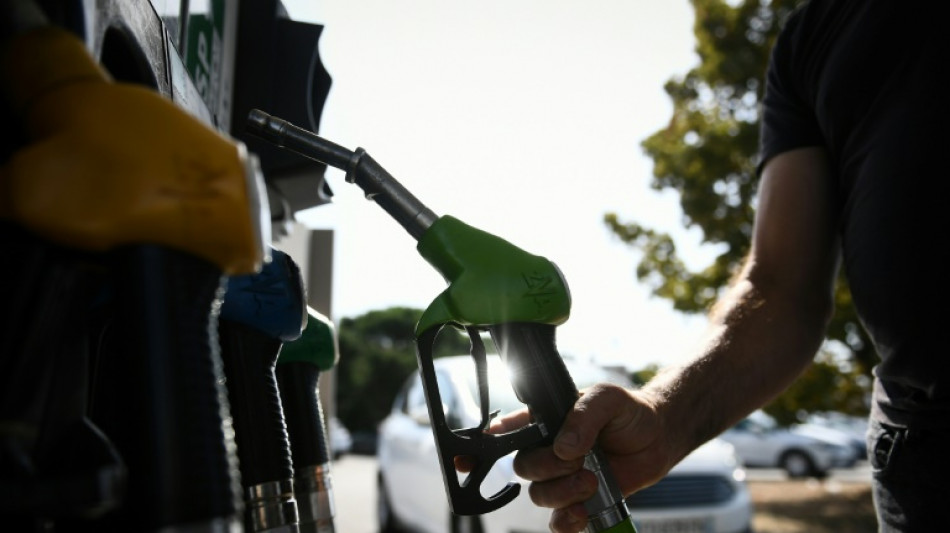
OPEC+ slated to increase oil output in bid to regain market share / Photo: © AFP/File

 'Tough to stay here': Nepal flood survivors wait for homes

 Malaysia closes schools in capital, parts of country due to haze
 Buccaneers stun Cowboys for first win of NFL season
 Activists hope trial will stop 'forever chemicals' at Italy plant

 Guardians rally for 9-5 victory over White Sox to stay alive in MLB playoffs
 Asian stocks mixed amid AI concerns, oil dips after surge

 Wallabies expect fast-paced All Blacks in Bledisloe opener
 Tech scammer Elizabeth Holmes focus of documentary by absurdist Nathan Fielder
 Climate hopes shift from politics to the courts
 Will Nobel Peace Prize pick make waves at the White House?
 Trump rules out new Iran attack before US midterm elections
 Far-right influencer shows Israel's coarse political turn
 Seals and sea lions get hearing tested at Australia zoo

 Mourinho's Real Madrid playing catch-up in Clasico countdown
 Joy as USS Lincoln back home after troubled Gulf deployment
 OpenAI says Iran, Russia influence ops busted
 Anthropic bans 'cruel' behavior against its Claude AI
 Anne Carson's Nobel literature prize 'a proud moment for Canada': PM

 Montagliani to seek CONCACAF re-election in boost for Infantino: reports

 Oil surges, stocks sink on jitters over US plans in Iran war

 John Cena and Jessica Biel hit the gas in 'Matchbox: The Movie'

 US, Ukrainians, Europeans to discuss 'new ideas' to end war
 Unproven 'cures' pushed online amid plague concerns

 Nigeria looks to ease fuel prices as election looms
 Prosecutors in Maradona death trial seek sentences up to 12 years

Saudi Arabia, Russia and six other key members of the OPEC+ alliance are expected to further hike oil production in a meeting Sunday, a move analysts say is aimed at regaining market share amid resilient crude prices.
The anticipated output increase by the group of eight oil-producing countries known as the "Voluntary Eight" (V8), would be the latest in a series of hikes that began in April.
In a bid to boost prices, the wider OPEC+ group -- comprising the 12-nation Organization of the Petroleum Exporting Countries (OPEC) and its allies -- in recent years had agreed to three different tranches of output cuts that amounted to almost 6 million barrels per day (bpd) in total.
Analysts expect the V8 group -- namely Saudi Arabia, Russia, Iraq, United Arab Emirates, Kuwait, Kazakhstan, Algeria and Oman -- to agree on another output increase of 548,000 bpd for September, a target similar to the one approved in August.
According to UBS analyst Giovanni Staunovo, the likely "quota increase is largely priced in" already, with the price of Brent, the global benchmark for oil, expected to remain near its current level of around $70 per barrel after Sunday's decision.
Since April, the V8 group has placed increased focus on regaining market share over price stability, a policy shift after years of enforcing production cuts to prop up prices.
- Likely pause in output hikes -
But it remains unclear which strategy the group intends to pursue after Sunday's meeting.
According to Warren Patterson, an analyst at ING, the V8 nations will likely "take a pause in supply hikes after September".
Crude prices have held up better than most analysts had predicted since the production increases began.
Experts say that is mainly due to traditionally high summer demand and significant geopolitical risk premiums being built into prices, particularly since the 12-day Iran-Israel war.
Moreover, the actual increase in production between March and June was less than the increase in quotas during the same period, said Staunovo, quoting OPEC sources.
However, the market is "set to move into large surplus" of oil supply from October, Patterson noted, warning that OPEC+ should remain careful not to be "adding to this surplus".
"OPEC+ is doing the balancing act of regaining market share and not sending oil prices plummeting", which would lead to a drop it profits, Tamas Varga, an analyst at PVM, told AFP.
Saudi Arabia, the group's most influential member, relies heavily on oil revenues to finance its ambitious plan aimed at diversifying the economy.
The unwinding of another set of production cuts of around 3.7 million bpd is to be discussed at the next OPEC+ ministerial meeting in November.
- Unstable environment -
With demand being unstable in the face of US President Donald Trump's erratic policymaking on trade and supply under threat by geopolitical risks, experts say it is difficult to predict what is next for the oil market.
In the latest twist in late July, Trump gave Moscow ten days to end the war in Ukraine, saying that his country would otherwise impose sanctions on Russia.
"We're gonna put on tariffs and stuff," he vowed.
Trump had previously hinted to an indirect 100-percent surcharge on countries that continue to buy Russian products, particularly hydrocarbons, in order to dry up Moscow's revenues.
He has specifically targeted India, the second largest importer of Russian oil at around 1.6 million bpd since the beginning of the year.
The developments could prompt OPEC+ to make further policy decisions.
However, "OPEC+ will react only to real supply disruptions" and not to price increases linked to risk premiums, said Staunovo.
I.Meyer--BTB