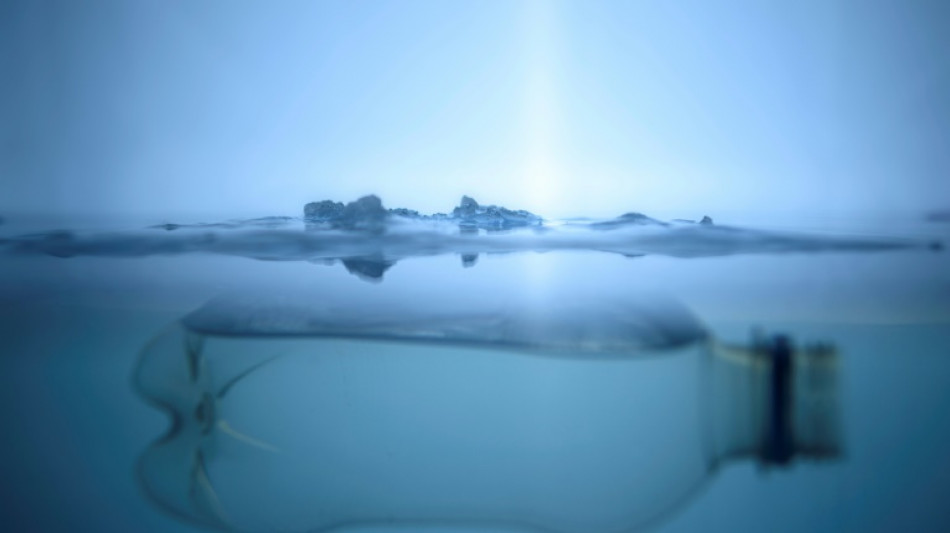
Indigenous communities plead for action at plastic pollution talks / Photo: © AFP

 Asian stocks mixed amid AI concerns, oil dips after surge

 Wallabies expect fast-paced All Blacks in Bledisloe opener
 Tech scammer Elizabeth Holmes focus of documentary by absurdist Nathan Fielder
 Climate hopes shift from politics to the courts
 Will Nobel Peace Prize pick make waves at the White House?

 Trump rules out new Iran attack before US midterm elections

 Far-right influencer shows Israel's coarse political turn
 Seals and sea lions get hearing tested at Australia zoo

 Mourinho's Real Madrid playing catch-up in Clasico countdown
 Joy as USS Lincoln back home after troubled Gulf deployment
 OpenAI says Iran, Russia influence ops busted
 Anthropic bans 'cruel' behavior against its Claude AI

 Anne Carson's Nobel literature prize 'a proud moment for Canada': PM

 Montagliani to seek CONCACAF re-election in boost for Infantino: reports

 Oil surges, stocks sink on jitters over US plans in Iran war

 John Cena and Jessica Biel hit the gas in 'Matchbox: The Movie'

 US, Ukrainians, Europeans to discuss 'new ideas' to end war
 Unproven 'cures' pushed online amid plague concerns

 Nigeria looks to ease fuel prices as election looms
 Prosecutors in Maradona death trial seek sentences up to 12 years

 Swiss captain Xhaka gets suspended fine for fake Covid cert

 Ex-prince Andrew raid warrants ruled 'unlawful' but UK police maintain probe

 Two Latvians arrested inside UK military base: police

 Eckert 'forever grateful' for Southampton support over spy scandal

 Venezuela's Maduro, wife hit with new US torture charges

Indigenous communities from North America are at talks on a global treaty on plastic pollution in Geneva, pleading the case for the environment they depend upon, which is slowly being choked by microplastics.
In the grounds of the United Nations headquarters, overlooking Lake Geneva and the Alps beyond, a chant suddenly drifted through the humid summer air: a "water song".
Standing barefoot in a circle, six women and a young man from multiple North American Indigenous communities decided to do a spontaneous purification ritual.
A melancholic second chant follows, dedicated to the well-being "until the seventh generation" of "all the delegates" from the 184 countries attempting to thrash out what would be the first international treaty on tackling the worldwide ever-growing scourge of plastic pollution.
The UN-hosted talks, which began last Tuesday, resume on Monday for four more days, with oil-producing states and the so-called ambitious group of nations still far apart on what the treaty should encompass.
The young man in the middle of the circle, wearing a hat with two feathers attached, hands each of the six women a bowl containing burning seal fat and plant powders.
With both hands, Suzanne Smoke, from the Williams Treaties First Nations in Ontario, Canada, moved as if to catch the rising smoke, rubbing it on her face and body.
- 'We carry knowledge' -
Panganga Pungowiyi, an activist with the Indigenous Environmental Network, was also in the circle. She comes from Alaska, near the Bering Strait.
She is asking negotiators to craft a plastic pollution treaty that ensures justice, particularly for the most vulnerable communities, she told AFP.
"We carry knowledge; it's our responsibility -- our duty -- to share the information given to us by the ecosystems," Pungowiyi said, explaining her presence at the talks.
Alaska is affected by toxic chemicals, some of which come from plastic or from oil exploration.
"Toxic products travel to the north, through ocean currents and air currents," she said.
Henri Bourgeois Costa, an environmental and plastic pollution expert at the Tara Ocean Foundation, explained Alaska's predicament.
"Given the functioning of the major ecosystem cycles, Alaskan populations are already the most affected by mercury and PCB (polychlorinated biphenyl) pollution -- industrial heavy metals now banned in developed countries -- even though Alaska doesn't use them," he told AFP.
The currents, which brought plenty of nutrients and schools of fish to the northwestern US state's residents, are now also bringing vast quantities of microplastics, he said.
- Car tyres and salmon -
A 2020 study from Washington State University demonstrated that a chemical additive used in the manufacture of car tyres, 6PPD, had "deleterious effects on the reproduction of salmon", one of the most widespread fish in Alaska, Bourgeois Costa said.
A compound derived from 6PPD -- a preservative used to slow tyre degradation -- comes off the rubber onto the roads, and gets into the water cycle, the study showed.
"No more fish -- no more seals: no more food," Pungowiyi said.
People can see the diseases suffered by birds and mammals in the surrounding environment, which ultimately go on to affect their own children, she said.
"We are exposed through food, water and forages, because we forage for our food," said Pungowiyi.
- 'If animals die, we die' -
Aakaluk Adrienne Blatchford, an activist from a small Alaskan village, who came to the Geneva talks with financial support from an association, put it bluntly: "If animals die, we die."
She spoke at a conference staged on the sidelines of the negotiations, which are struggling to find a consensus that would stop the amount of plastic pollution from growing.
"We rely on unhealthy products," Blatchford said, adding: "It's becoming harder and harder to maintain our food security."
And "there is no alternative", she added, with prices as high as "$76 for an imported frozen chicken" at the supermarket.
This is a trap for economically fragile populations living in "a symbiotic relationship with the world", she said.
"We need a collective decision on how to handle this crisis," she insisted, hoping that the treaty will include a list of banned chemical additives.
The plastics treaty talks are being held inside the UN's Palais des Nations complex.
During the ritual, held beneath a tree in the grounds outside, Blatchford stood with her eyes closed, tears rolling down her face.
R.Adler--BTB