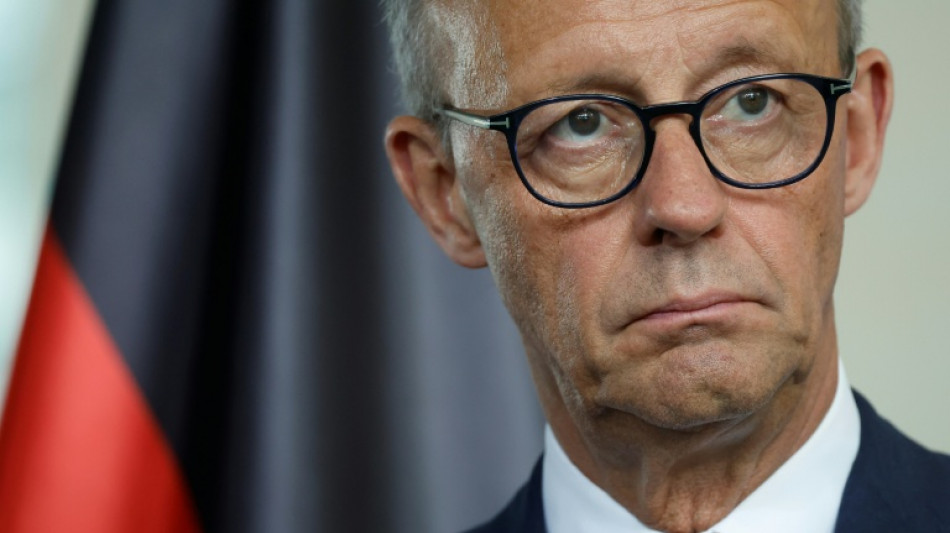
After busy first 100 days, Germany's Merz faces discord at home / Photo: © AFP/File

 Asian stocks mixed amid AI concerns, oil dips after surge

 Wallabies expect fast-paced All Blacks in Bledisloe opener
 Tech scammer Elizabeth Holmes focus of documentary by absurdist Nathan Fielder
 Climate hopes shift from politics to the courts
 Will Nobel Peace Prize pick make waves at the White House?
 Trump rules out new Iran attack before US midterm elections

 Far-right influencer shows Israel's coarse political turn
 Seals and sea lions get hearing tested at Australia zoo

 Mourinho's Real Madrid playing catch-up in Clasico countdown
 Joy as USS Lincoln back home after troubled Gulf deployment
 OpenAI says Iran, Russia influence ops busted
 Anthropic bans 'cruel' behavior against its Claude AI
 Anne Carson's Nobel literature prize 'a proud moment for Canada': PM

 Montagliani to seek CONCACAF re-election in boost for Infantino: reports
 Oil surges, stocks sink on jitters over US plans in Iran war
 John Cena and Jessica Biel hit the gas in 'Matchbox: The Movie'

 US, Ukrainians, Europeans to discuss 'new ideas' to end war
 Unproven 'cures' pushed online amid plague concerns
 Nigeria looks to ease fuel prices as election looms
 Prosecutors in Maradona death trial seek sentences up to 12 years
 Swiss captain Xhaka gets suspended fine for fake Covid cert
 Ex-prince Andrew raid warrants ruled 'unlawful' but UK police maintain probe
 Two Latvians arrested inside UK military base: police
 Eckert 'forever grateful' for Southampton support over spy scandal
 Venezuela's Maduro, wife hit with new US torture charges
German Chancellor Friedrich Merz has driven sweeping changes in security, economic and migration policy during his first 100 days in office, but faces widening cracks in his uneasy coalition.
On election night in February, a jubilant Merz promised to bring a bit of "rambo zambo" to the post -- using a colloquialism that can evoke a wild and joyous ride, or chaos and mayhem.
Having achieved his life's ambition at age 69 to run Europe's top economy, Merz lost no time to push change, mostly in response to transatlantic turbulence sparked by US President Donald Trump.
"Germany is back," Merz said, vowing to revive the economy, the military and Berlin's international standing after what he labelled three lacklustre years under his centre-left predecessor Olaf Scholz.
Even before taking office, Merz's Christian Democrats (CDU/CSU) and their governing partners from Scholz's Social Democratic party (SPD) loosened debt rules and unlocked hundreds of billions of euros for Germany's armed forces and its crumbling infrastructure.
Merz vowed to build "Europe's largest conventional army" in the face of a hostile Russia and keep up strong support for Ukraine in lockstep with Paris and London.
A promise to ramp up NATO spending endeared Merz to Trump, who greeted him warmly at a White House meeting in June, only weeks after a jarring Oval Office showdown with Ukrainian President Volodymyr Zelensky.
When Israel bombed Iranian targets, Merz, with a penchant for strong and often controversial one-liners, praised it for doing the "dirty work" -- but last Friday he took the bold step of freezing arms exports to Israel over its Gaza campaign.
- Migration crackdown -
On the home front, Merz has pressed a crackdown on irregular migration, a sharp departure from the centrist course of his long-time party rival Angela Merkel.
He has said he must address voter concerns about immigration to stem the rise of the far-right Alternative for Germany (AfD) party, which won a record 20 percent in February's election.
Merz's heavy focus on global events has earned him the moniker of "foreign chancellor" -- but trouble looms at home, where his SPD allies have often felt overshadowed or sidelined.
To many of them, Merz's right-wing positions have been hard to swallow in the marriage of convenience they entered following the SPD's dismal election outcome of 16 percent.
German voters have not yet fallen in love with Merz either. His personal approval rating slipped 10 points to just 32 percent in the latest poll by public broadcaster ARD.
- Judge row -
In an early sign of trouble, Merz's inauguration on May 6 turned into a white-knuckle ride when rebel MPs opposed him in the first round of the secret ballot.
He was confirmed in the second round, but the debacle pointed to simmering resentment in the left-right coalition.
Many have chafed at his hard line on immigration, his vow to slash social welfare and his limited enthusiasm for climate protection.
Merz also sparked controversy when he dismissed plans to hoist an LGBTQ rainbow flag on the parliament building by saying the Reichstag was "not a circus tent".
The biggest coalition crisis came last month, sparked by what should have been routine parliamentary business -- the nomination of three new judges to Germany's highest court.
Right-wing online media had strongly campaigned against one of them, SPD nominee Frauke Brosius-Gersdorf, calling her a left-wing activist on abortion and other issues.
The CDU/CSU withdrew support for her and postponed the vote, sparking SPD fury. The issue looked set to fester until Brosius-Gersdorf withdrew her candidature on Thursday.
- 'Too many arguments' -
Other trouble came when the CDU's Bavarian sister party demanded sharp cuts to social benefits for Ukrainian refugees, a position the SPD opposes.
Vice Chancellor Lars Klingbeil of the SPD warned the conservatives to refrain from further provocations, telling Welt TV that "we already have far too many arguments in this government".
Both coalition partners know that open squabbling will turn off voters after discord brought down Scholz's three-party coalition, and play into the hands of the AfD, their common foe.
For now Merz and most other politicians are on summer holidays, leaving unresolved issues lingering.
Merz will need to pay attention, said Wolfgang Schroeder of Kassel University.
"The chancellor's attitude is: I think big-picture and long term, I'm not interested in the small print," he said.
But Schroeder added that all the coalition's big troubles so far -- from the judge row to Ukrainians refugees -- "have been about the small print".
M.Furrer--BTB