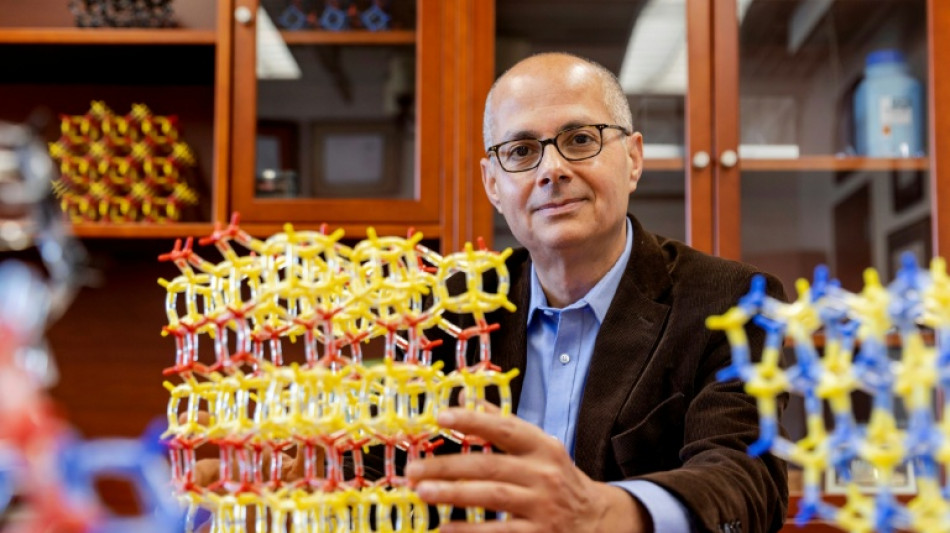
From refugee to Nobel: Yaghi hails science's 'equalising force' / Photo: © University of California, Berkeley/AFP

 Sri Lanka's de Silva quits as Test captain

 Alcaraz feeling 'mentally fresh' ahead of Shanghai return

 Israel drastically reduces British diplomatic presence in Jerusalem

 Stocks fall further as oil surge fans fresh inflation worries

 North Korea demands South show 'utmost respect' to restore relations

 Saudi says three dead in airport attacks claimed by Houthis

 'Mad dream': New showcase for African film opens in London

 All Blacks coach Rennie says Wallabies exit 'part of the game'

 The growing protests against India's poll body - and PM Modi
 Stocks fall further as oil spike fans fresh inflation worries
 Bad COP, worse COP? EU tempers hopes for UN climate summit

 Rookie Henry named in Wallabies midfield to face All Blacks
 Housing crisis set to dominate Spain's snap election

 Gas, health care, utilities: high costs squeeze US midterm voters

 New Zealand Rugby seeks injunction over PNG Chiefs name

 Samsung expects 780% quarterly operating profit jump on AI boom

 Guardians survive with 9-3 win over White Sox

 Saudi Arabia says 3 dead at airports after Houthis claim attacks

 Stocks slide as oil sees volatile trading day over Iran war fears

 Microsoft pushes AI vision with new, expensive Surface laptop

 Five children among 28 killed in Russian strikes on Ukraine

 Odell Beckham Jr signs with Minnesota Vikings

 Saudi Arabia says three dead at airports after Houthis claim attacks

 Trump plans to turn Florida golf course into presidential retreat

 WHO says cannot conduct full risk assessment on Russia plague reports

Born into a family of Palestinian refugees in Jordan with little schooling, Nobel chemistry laureate Omar Yaghi on Wednesday paid tribute to science's "equalising force".
Yaghi, a Jordanian-American, won the 2025 prize together with Susumu Kitagawa of Japan and UK-born Richard Robson for their groundbreaking discoveries on metal–organic frameworks (MOFs), whose uses include capturing carbon dioxide and harvesting water from desert air.
"I grew up in a very humble home. We were a dozen of us in one small room, sharing it with the cattle that we used to raise," he told the Nobel Foundation in an interview after learning he had won the prestigious prize.
Their home had no electricity or running water. His father had only finished sixth grade and his mother could neither read nor write.
Born in 1965, he spent his childhood in Amman, in Jordan, before leaving for the United States at the age of 15, on the advice of his stern father.
Yaghi first discovered molecular structures in a book when he was 10 years old, after sneaking into the usually locked school library.
His eyes were drawn to the "unintelligible but captivating" images.
"It's quite a journey," he mused -- and one that science enabled him to make, he said.
"Science is the greatest equalising force in the world," Yaghi said.
"Smart people, talented people, skilled people exist everywhere. That's why we really should focus on unleashing their potential through providing them with opportunity."
His research group succeeded in extracting water from desert air in Arizona.
"I started at Arizona State University, my independent career and my dream was to publish at least one paper that receives 100 citations," he recalled.
"Now my students say that our group has garnered over 250,000 citations."
"The beauty of chemistry is that if you learn how to control matter on the atomic and molecular level, well, the potential is great," he said.
"We opened a gold mine in that way and the field grew," he said.
I.Meyer--BTB