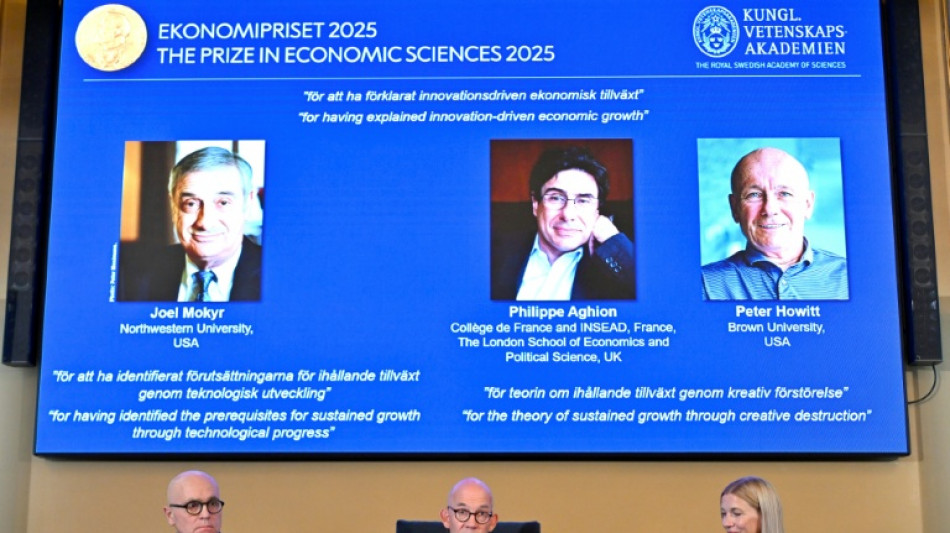
Nobel economist warns of AI dangers / Photo: © TT NEWS AGENCY/AFP

 North Korea demands South show 'utmost respect' to restore relations

 Saudi says three dead in airport attacks claimed by Houthis

 'Mad dream': New showcase for African film opens in London

 All Blacks coach Rennie says Wallabies exit 'part of the game'

 The growing protests against India's poll body - and PM Modi
 Stocks fall further as oil spike fans fresh inflation worries
 Bad COP, worse COP? EU tempers hopes for UN climate summit

 Rookie Henry named in Wallabies midfield to face All Blacks
 Housing crisis set to dominate Spain's snap election

 Gas, health care, utilities: high costs squeeze US midterm voters
 New Zealand Rugby seeks injunction over PNG Chiefs name
 Samsung expects 780% quarterly operating profit jump on AI boom

 Guardians survive with 9-3 win over White Sox

 Saudi Arabia says 3 dead at airports after Houthis claim attacks

 Stocks slide as oil sees volatile trading day over Iran war fears

 Microsoft pushes AI vision with new, expensive Surface laptop
 Five children among 28 killed in Russian strikes on Ukraine
 Odell Beckham Jr signs with Minnesota Vikings

 Saudi Arabia says three dead at airports after Houthis claim attacks

 Trump plans to turn Florida golf course into presidential retreat

 WHO says cannot conduct full risk assessment on Russia plague reports

 After botched execution, US woman is awake and shackled to bed

 New Zealand fly-half Mo'unga ruled out of Australia Tests
 Protests in major Turkish city after mayor defects to Erdogan party

 Climate change strips island's title of largest penguin colony: study

A winner of this year’s Nobel prize in economics warned Monday that artificial intelligence offers "amazing possibilities" but should be regulated because of its job-destroying potential.
The remarks from Canadian Peter Howitt, professor emeritus at Brown University in the United States, came amid growing concerns about how AI will impact society and the labor market.
California Governor Gavin Newsom on Monday signed a first-of-its-kind law regulating interactions with AI chatbots, defying a push from the White House to leave the technology unchecked.
Howitt was one of three economists honored Monday by the Royal Swedish Academy of Sciences for work on how technology drives and affects growth.
His research with fellow winner Philippe Aghion of France focused on the theory of "creative destruction" in which a new and better product enters the market, and the companies selling the older products lose out.
Howitt told a news conference that it remains to be seen who will be the leader in AI, and "we don't know what the creative destruction effects are going to be."
"It's obviously a fantastic technology that has amazing possibilities. And it also obviously has an amazing potential for destroying other jobs or replacing highly skilled labor. And all I can say is that this is a conflict. It's going to have to be regulated," he said.
"Private incentives in an unregulated market are not really going to resolve this conflict in a way that's best for society, and we don't know what's going to come from it."
Howitt, 79, said it was a "big moment in human history" and likened it to past periods of technological innovation, including the telecoms boom of the 1990s, and the dawns of electricity and steam power.
He said those innovations all demonstrated how technology can enhance and not just replace labor. "How we're going to do it this time? I wish I had specific answers, but I don't," he added.
Howitt said that when he and Aghion first wrote their seminal 1992 paper on creative destruction it took five years to get it published, but his collaborator knew they were on to something special.
"Right from the beginning, from our very first research, I remember back in 1987, Philippe saying we're going to get a Nobel Prize for this. I said, 'Sure, sure, sure,'" Howitt recalled.
"He said, 'Our time will come. Our time will come,' okay, and now it’s come. Amazing."
C.Kovalenko--BTB