At secluded German airport, researchers tackle tricky drone defence / Photo: © AFP

 North Korea demands South show 'utmost respect' to restore relations

 Saudi says three dead in airport attacks claimed by Houthis

 'Mad dream': New showcase for African film opens in London

 All Blacks coach Rennie says Wallabies exit 'part of the game'

 The growing protests against India's poll body - and PM Modi
 Stocks fall further as oil spike fans fresh inflation worries

 Bad COP, worse COP? EU tempers hopes for UN climate summit

 Rookie Henry named in Wallabies midfield to face All Blacks

 Housing crisis set to dominate Spain's snap election

 Gas, health care, utilities: high costs squeeze US midterm voters

 New Zealand Rugby seeks injunction over PNG Chiefs name

 Samsung expects 780% quarterly operating profit jump on AI boom
 Guardians survive with 9-3 win over White Sox

 Saudi Arabia says 3 dead at airports after Houthis claim attacks

 Stocks slide as oil sees volatile trading day over Iran war fears

 Microsoft pushes AI vision with new, expensive Surface laptop

 Five children among 28 killed in Russian strikes on Ukraine

 Odell Beckham Jr signs with Minnesota Vikings

 Saudi Arabia says three dead at airports after Houthis claim attacks

 Trump plans to turn Florida golf course into presidential retreat

 WHO says cannot conduct full risk assessment on Russia plague reports
 After botched execution, US woman is awake and shackled to bed

 New Zealand fly-half Mo'unga ruled out of Australia Tests

 Protests in major Turkish city after mayor defects to Erdogan party
 Climate change strips island's title of largest penguin colony: study

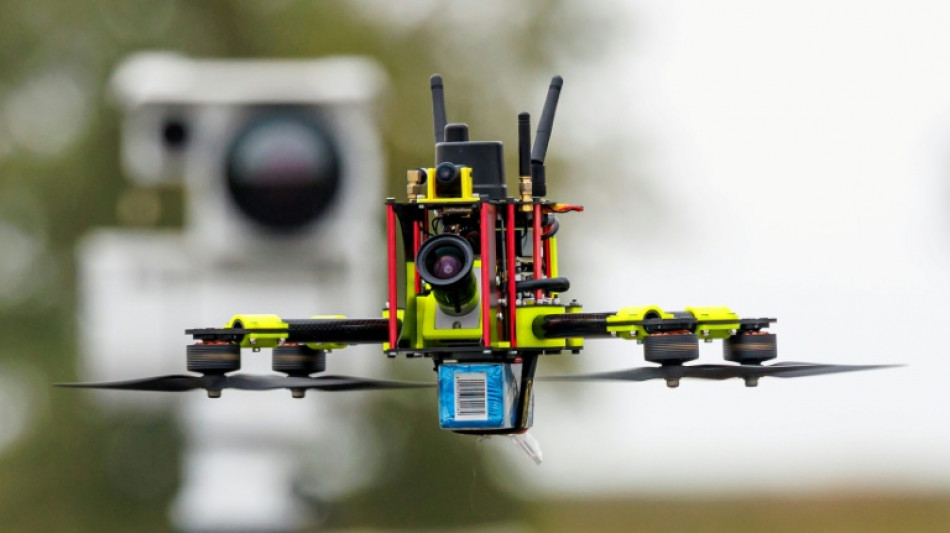
Once holidaymakers took off from here, but today an ex-Soviet airfield is a testing ground for ways to take down the drones increasingly buzzing through German skies.
Germany has been rattled by a spate of mysterious sightings of unmanned aerial vehicles (UAVs), believed to be from Russia, over military bases, industrial sites and an airport.
Last week the government said it would give federal police the powers to blast them out of the sky.
But at the airstrip near the eastern city of Magdeburg, researchers of the German Aerospace Center (DLR) have been testing more subtle options to deal with potentially hostile drones.
"The countermeasures used to defend against drones vary greatly -- they have to be tailored very precisely to the situation at hand," said Johann Dauer, who leads drone research at DLR's Institute of Flight Systems.
"If I want to protect a crowd -- for example at a concert or a political event -- then of course I don't want to cause a drone to crash," Dauer said, given the risk of injuries on the ground.
"I would rather use nets or hunter drones with gripping mechanisms to actually remove the drone."
The challenge facing Germany is not just fending off suspected Russian UAVs conducting surveillance or testing NATO responses.
Naive, blundering hobbyists and reckless pranksters can also veer into restricted airspace, setting off alarms and potentially shutting down airport traffic.
Signal jamming and GPS interference with "spoofed" coordinates are other methods Dauer cited for dealing with drones without shooting them mid-air.
- 'Jamming and spoofing' -
Dauer said an infamous 2018 incident at London's Gatwick airport, in which reported drone sightings cancelled hundreds of flights, helped make drone defences a civilian issue as well.
"And since then, reports have been piling up," Dauer said. "Today, we see new reports almost daily, and we need to take a closer look at drone defence."
Germany has been scrambling to deal with the drone incursions, and Interior Minister Alexander Dobrindt has suggested that spending on civil drone defences could run to hundreds of millions of euros.
Helping decide what systems police agencies should spend money on is part of the drone research and evaluation mission at Cochstedt, Dauer said.
The secluded hangars and runways add a degree of secrecy for the sensitive development work there.
But more importantly, the airport's focus on unmanned aerospace research means it is relatively free from safety regulations that would normally tightly restrict testing with drone intruders and interceptors.
Cochstedt is a fully functional airport where occasional Ryanair flights once shuttled passengers to Mediterranean holiday destinations, although those connections have long since been cancelled.
This means drones and various defences can now be tested and integrated into airport operations, said Daniel Suelberg, who runs DLR's testing centre at Cochstedt.
"Permission for jamming and spoofing, permission to shoot lasers at an airport -- everything that you don't really want at airports because it would paralyse operations -- we have here," Suelberg said.
- 'Pressure to innovate' -
Suelberg and Dauer showed off a range of drone detection gear -- high-end optics and cameras, radar arrays and other equipment -- that researchers have been testing at the facility.
Some of it is bought from defence contractors and commercial producers, other gear is specially assembled by the dozen research groups working at Cochstedt.
The goal is to figure out comprehensive systems for detecting drones, identifying whether they pose a threat, and deploying appropriate countermeasures.
But a key challenge is figuring out the best bang for the buck that can be widely deployed without exploding civil defence budgets.
Some high-end systems come with hefty price tags -- limiting their appeal for mass deployment.
Adding to the challenge is just how quickly drone technology is changing, something very clearly on display in the battlefields of Ukraine, where both sides are locked in a deadly race to develop new weapons and come up with countermeasures.
"We are seeing a great deal of innovation and development on the threat side," said Dauer. "And, of course, drone defence must counter this and offer appropriate solutions.
"This means that, on the one hand, we are under a certain amount of pressure to innovate and must make rapid progress.
"At the same time, we have to remain cost-effective, and the drones we are combating are often not particularly expensive -- so the protection must not be too costly."
E.Schubert--BTB