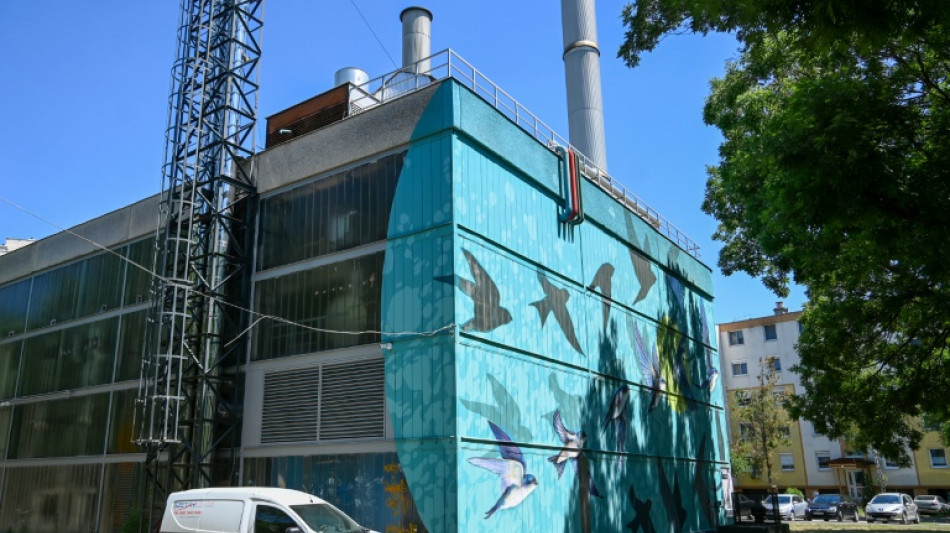
Hot water wells in Hungary fuel switch from Russian gas / Photo: © AFP

 Spain PM calls early election after housing crisis defeat

 Stocks rally as 'Goldilocks' jobs data ease rate fears
 Myanmar says 10,000 migrants returned from Malaysia this year

 Big guns back for Australia's Rugby League World Cup defence

 Braves rock Dodgers to level series, Brewers win thriller

 Most Asia stocks rally as 'Goldilocks' jobs data ease rate fears

 Sunken Silk Road city reveals Central Asia's lost history

 Three years on, Israeli rescuer cannot escape October 7

 Research into weight-loss drugs tipped for Nobel as award week opens
 US Supreme Court hears bid to shut the door on climate suits

 Chourio walk-off single lifts Brewers over Padres

 Flavio Bolsonaro leads Lula in near-done Brazil vote count

 Flavio Bolsonaro leads Lula in partial Brazil poll results

 Titan FX Launches Second “Dream Beyond Borders 2.0” Brand Commercial Featuring Keisuke Honda

 Patriots inflict first Bills defeat as Rams surge late

 Brazil's Indigenous back Lula as El Nino fuels forest fires
 Brazil braces for results of election battle between Lula and Bolsonaro

 Indians protest election chief ahead of top court hearing

 'Verity' kills, Cruise bombs in N. American movie theaters

 Colts top Commanders in NFL London game

 Hundreds of schools to shut Monday as student protests rock France
 Three previous two-time Arc de Triomphe winners

 'Champion' Daryz wins second successive Arc in fine style

 Daryz wins second successive Prix de l'Arc de Triomphe

 England's seven-goal spree sends message to Euro rivals: Kane

At plants painted with birds and hedgehogs, hot water from deep underground is being channelled to produce energy and heat for thousands of households in Hungary's third largest city Szeged.
Experts say the project -- billed as Europe's biggest urban heating system overhaul -- can serve as a model for other cities across the continent as EU nations scramble to wean themselves off Russian gas after Moscow's invasion of Ukraine.
"Geothermal energy is local, accessible and renewable so why not use it," geologist Tamas Medgyes told AFP beside a recently completed well in the middle of a residential neighbourhood.
The city of 160,000 people, located some 170 kilometres (110 miles) south of Budapest, is one of 12 in the landlocked central European country with geothermal district heating.
When the system is fully built out next year, 27 wells and 16 heating plants will push geothermally heated water through 250 kilometres of pipes to heat 27,000 flats and 400 non-residential consumers.
- 'Blueprint' -
This will make it Europe's biggest geothermal urban heating system outside of Iceland.
But unlike in the Icelandic capital, Szeged's heating systems were built to run on gas.
EU member Hungary covers 65 percent of its oil needs and 80 percent of its gas needs with imports from Russia.
"This housing project was built in the 1980s. Since then we have burnt millions of cubic metres of imported Russian gas to heat cold water in these apartments," Medgyes said.
But now, "we drilled down and got the hot water beneath our feet," he said about the project, whose cost of more than 50 million euros ($51 million) is partially covered by EU funds.
He added the project can be a "blueprint" for cities in parts of France, Germany, Italy or Slovakia that are rich in geothermal deposits.
Experts says geothermal energy is an underutilised source of renewable heat in Europe.
"The geothermal urban heating development in Szeged is an easy-to-adopt example in many regions of Europe," said Ladislaus Rybach, an expert at the Institute of Geophysics in Zurich, Switzerland.
Lajos Kerekes of the Regional Centre of Energy Policy Research told AFP that more than 25 percent of the EU's population lives in areas suitable for geothermal district heating.
Long before the Ukraine war, Balazs Kobor, director at Szeged heating firm Szetav, began exploring how cities can use geothermal energy and "knocking on doors of decision-makers".
In 2015, the city municipality appointed him and Medgyes to initiate the integration of renewables into district heating.
"To heat the city annually the firm was burning 30 million cubic metres of gas and producing around 55,000 tonnes of carbon emissions every year," said Kobor.
"The city itself was its biggest carbon emitter," he added.
Replacing gas by geothermal energy will slash the city's greenhouse gas emissions by 60 percent -- around 35,000 tonnes -- annually, according to Kobor.
If similar small-to-medium-sized cities switched their district heating to geothermal it would be "a major step towards a carbon neutral, sustainable Europe," he said.
- 2,000 metres below ground -
Surrounded by the Carpathian and Alps mountain ranges, Hungary and especially the area around Szeged forms a basin where 92-93 degree Celsius (198-199 degree Fahrenheit) hot water collects as deep as 2,000 metres (6,600 feet) below ground.
In facilities adjacent to the wells, "heat exchangers" comprising hundreds of metal panels transfer the heat to water in pipeline circuits that serve different neighbourhoods.
The geothermal water itself does not enter the circuits but re-enters the earth through a "reinjection" well nearby, explained Medgyes.
In another neighbourhood, a noisy drill is gradually working its way deeper and deeper into the ground, adding sections of pipe as it goes.
The drilling period takes around three months, said Medgyes.
And while residents can see and hear the drills as they work, after the work is done, they don't notice the change of heat source in their homes.
"The radiators and tap water are as warm as before. I don't feel any difference," Gabriella Maar Pallo, a 50-year-old clerk, told AFP in her nearby apartment.
Y.Bouchard--BTB