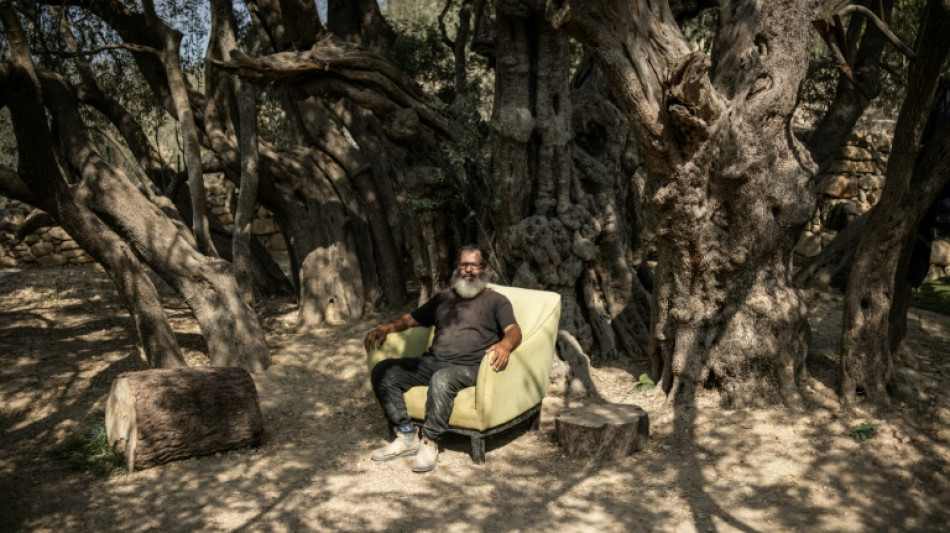
West Bank's ancient olive tree a 'symbol of Palestinian endurance' / Photo: © AFP

 After botched execution, US woman was nearly taken off life support before revival
 Searing AIDS drama 'Elsinore' opens London film festival

 Evicted pensioner who sparked Spain housing protests dies: tenant union
 Golf star Rahm quitting LIV tour over 'unacceptable' terms

 Thousands march fearing return of a Bolsonaro presidency in Brazil
 French PM denies police ordered to confront student protesters
 Rubio touts US power, calls on Europe to emerge from 'slumber'

 Trump says 'we don't think' Russian plague is bio-weapon
 Five children among 26 killed in Ukraine after Russian strikes

 Man City should 'accept' punishment for rule breaches, says Lineker
 US woman who survived botched execution is awake and speaking
 From 1800s to modern pharma: a Nobel-winning chemistry quest

 Southampton boss Eckert given suspended ban over 'Spygate'

 Russia warns of 'false' information as second plague case reported
 IEA ready to release more oil reserves if necessary
 HSBC 'consults' over UK unit job cuts amid AI adoption
 UK court quashes five ex-traders' Libor rate rigging convictions
 XM Receives “Global Customer Experience Leader Award 2026” at the TrustFinance Performance Awards
 Stocks slide as oil climbs on Mideast flareup
 Heavy casualties in Ukraine after Russian strikes
 French wine harvest set to hit historic low
 Kyiv 'cannot agree' to EU membership limiting food exports: minister

 Arteta targets more Arsenal glory after signing new deal until 2030

 Russell hit with Singapore grid penalty for taking new power unit
 Spotify expands audiobooks to more than 180 markets

As guardian of the occupied West Bank's oldest olive tree, Salah Abu Ali prunes its branches and gathers its fruit even as violence plagues the Palestinian territory during this year's harvest.
"This is no ordinary tree. We're talking about history, about civilisation, about a symbol," the 52-year-old said proudly, smiling behind his thick beard in the village of Al-Walajah, south of Jerusalem.
Abu Ali said experts had estimated the tree to be between 3,000 and 5,500 years old. It has endured millennia of drought and war in this parched land scarred by conflict.
Around the tree's vast trunk and its dozen offshoots -- some named after his family members -- Abu Ali has cultivated a small oasis of calm.
A few steps away, the Israeli separation wall cutting off the West Bank stands five metres (16 feet) high, crowned with razor wire.
More than half of Al-Walajah's original land now lies on the far side of the Israeli security wall.
Yet so far the village has been spared the settler assaults that have marred this year's olive harvest, leaving many Palestinians injured.
Israel has occupied the West Bank since 1967, and some of the 500,000 Israelis living in the Palestinian territory have attacked farmers trying to access their trees almost every day this year since the season began in mid-October.
The Palestinian Authority's Colonisation and Wall Resistance Commission, based in Ramallah, documented 2,350 such attacks in the West Bank in October.
- 'Rooted in this land' -
Almost none of the perpetrators have been held to account by the Israeli authorities.
Israeli forces often disperse Palestinians with tear gas or block access to their own land, AFP journalists witnessed on several occasions.
But in Al-Walajah for now, Abu Ali is free to care for the tree. In a good year, he said, it can yield from 500 to 600 kilograms (1,100 to 1,300 pounds) of olives.
This year, low rainfall led to slim pickings in the West Bank, including for the tree whose many nicknames include the Elder, the Bedouin Tree and Mother of Olives.
"It has become a symbol of Palestinian endurance. The olive tree represents the Palestinian people themselves, rooted in this land for thousands of years," said Al-Walajah mayor Khader Al-Araj.
The Palestinian Authority's agriculture ministry even recognised the tree as a Palestinian natural landmark and appointed Abu Ali as its official caretaker.
Most olive trees reach about three metres in height when mature. This one towers above the rest, its main trunk nearly two metres wide, flanked by a dozen offshoots as large as regular olive trees.
- 'Green gold' -
"The oil from this tree is exceptional. The older the tree, the richer the oil," said Abu Ali.
He noted that the precious resource, which he called "green gold", costs four to five times more than regular oil.
Tourists once came in droves to see the tree, but numbers have dwindled since the start of the war in Gaza in October 2023, Abu Ali said, with checkpoints tightening across the West Bank.
The village of Al-Walajah is not fully immune from the issues facing other West Bank communities.
In 1949, after the creation of Israel, a large portion of the village's land was taken, and many Palestinian families had to leave their homes to settle on the other side of the so-called armistice line.
After Israel's 1967 occupation, most of what remained was designated Area C -- under full Israeli control -- under the 1993 Oslo Accords, which were meant to lead to peace between Palestinians and Israelis.
But the designation left many homes facing demolition orders for lacking Israeli permits, a common problem in Area C, which covers 66 percent of the West Bank.
"Today, Al-Walajah embodies almost every Israeli policy in the West Bank: settlements, the wall, home demolitions, land confiscations and closures," mayor Al-Araj told AFP.
For now, Abu Ali continues to nurture the tree. He plants herbs and fruit trees around it, and keeps a guest book with messages from visitors in dozens of languages.
"I've become part of the tree. I can't live without it," he said.
B.Shevchenko--BTB