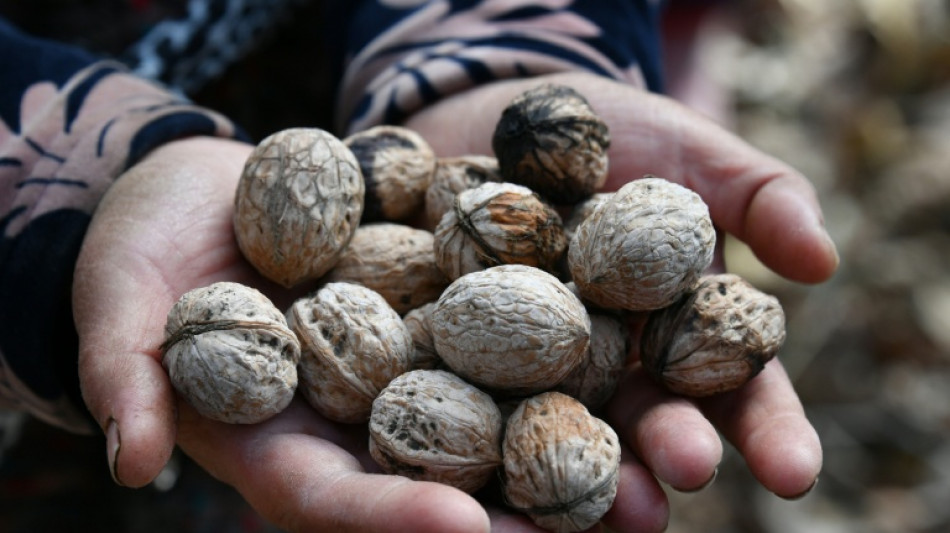
In Kyrgyzstan, world's largest natural walnut forest thins away / Photo: © AFP

 Rubio touts US power, calls on Europe to emerge from 'slumber'

 Trump says 'we don't think' Russian plague is bio-weapon

 Five children among 26 killed in Ukraine after Russian strikes

 Man City should 'accept' punishment for rule breaches, says Lineker

 US woman who survived botched execution is awake and speaking
 From 1800s to modern pharma: a Nobel-winning chemistry quest

 Southampton boss Eckert given suspended ban over 'Spygate'

 Russia warns of 'false' information as second plague case reported

 IEA ready to release more oil reserves if necessary

 HSBC 'consults' over UK unit job cuts amid AI adoption

 UK court quashes five ex-traders' Libor rate rigging convictions

 XM Receives “Global Customer Experience Leader Award 2026” at the TrustFinance Performance Awards

 Stocks slide as oil climbs on Mideast flareup

 Heavy casualties in Ukraine after Russian strikes

 French wine harvest set to hit historic low

 Kyiv 'cannot agree' to EU membership limiting food exports: minister

 Arteta targets more Arsenal glory after signing new deal until 2030

 Russell hit with Singapore grid penalty for taking new power unit

 Spotify expands audiobooks to more than 180 markets

 French-Japanese duo wins chemistry Nobel for solving molecular 'mystery'

 England's Nations League surge helps heal World Cup wounds

 Mayor of opposition stronghold Izmir defects to Erdogan party

 Mertens beats Gauff to set up Swiatek clash at China Open

 Benin full of pride at role in Messi's last dance

 France suspends stun grenade use at student protests ahead of PM speech
Rustling through fallen golden leaves, locals in a forest outside Arslanbob in the Kyrgyz mountains were scurrying for walnuts -- an ancient pastime and economic lifeline for the region.
But the forest, the world's largest wild walnut grove, has for years been slowly fading -- hit by the overgrazing of livestock, illegal logging and rising temperatures.
"The forest used to be so dense but it has thinned out," said Asel Alisheva, a pensioner from the village, officially known as Arslanbap, who has been foraging there for decades.
She was once afraid to venture too far into the wood.
"It used to be impossible to walk through. Now there are so many people," she told AFP.
"The difference is striking," the 70-year-old added as she cracked walnuts in a roadside tent.
Locals have gathered the earthy tough-shelled nuts here for generations.
They are both an economic staple and a symbol of the Jalal-Abad region.
"Nowhere else in the world is there such a large concentration of natural walnut forests," said regional forestry expert Zakir Sarymsakov.
He also highlighted the "vast variety" of walnut species that can be found in the region.
For locals, walnuts are a bread-and-butter issue.
"This is how we make a living. There are no other ways, only walnuts. This is how we feed our children," said Arno Narynbaeva, 53, who has been picking them since childhood.
- Poor harvests -
At the bustling village bazaar, men stack bulging walnut sacks, while women do the trade.
But business has seen better days -- the harvests have been poor lately.
"In the 2000s, we used to receive large quantities, up to 15 tonnes per day. These days, we get three to four, and it decreases year by year," seller Zhazgul Omurzakova said.
"The climate is getting hotter and drier every year, and the nuts are losing their quality, turning red inside," the 47-year-old said.
Whiter kernels are worth more as the nuts' visual appeal is important for pastry-makers.
"Hot weather harms the walnuts. They fall, burn, and turn black," said picker Narynbaeva.
"We have never seen this happen before."
Average temperatures in Central Asia have risen by about 1.5C since 1991, twice the global average, according to the World Meteorological Organization (WMO), a UN climate agency.
More frequent droughts that accompany the hotter weather have also hit the walnut groves.
Locals are trying to address the problem, including by seeding millions of trees in the Arslanbob forest nursery.
But water shortages, chronic across Central Asia, have hit those efforts.
"Over the past two to three years, there has been no rain, and it has become hot," said Temir Emirov, who works in the tree nursery.
"The ground has dried out, and the grass has withered," he added.
"The seedlings haven't received water for a month and are using their own moisture to survive."
- 'Big plans' -
Other human activity is also taking a toll on the forest.
"Since we don't have pastures, livestock is a problem," said chief forest ranger Ibragim Turgunbekov.
Cattle herds, expanding in size and number, have trampled the soil and eaten young shoots.
Illegal logging -- with locals preferring trees over more expensive coal for firewood -- has also thinned out the forest.
Ranger Turgunbekov issues fines and tries to convince farmers to reduce the size of their herds.
Local imams have even called on their followers to help preserve the walnut trees.
Some want stricter measures, such as taxing surplus livestock or a government ban on grazing near settlements.
Turgunbekov said a solution could be better utilising the walnuts' economic potential.
"If we make perfumes or oils out of walnuts and ship them to Europe, their value will increase," he said.
"By selling at higher prices, locals will be more motivated and will take better care of the forest."
Abdulaziz Khalmuradov, 16, is one of the region's young people trying to do just that.
After school, he makes walnut oil using a traditional press.
"I want to increase the number of machines and produce not only walnut oil but also many other types, such as apricot oil," the aspiring entrepreneur told AFP.
He also wants to push sustainable tourism to the region.
"Tourism in Arslanbob is underdeveloped. If the number of tourists increases, volumes will increase," he told AFP.
"When I grow up, I have big plans."
O.Lorenz--BTB