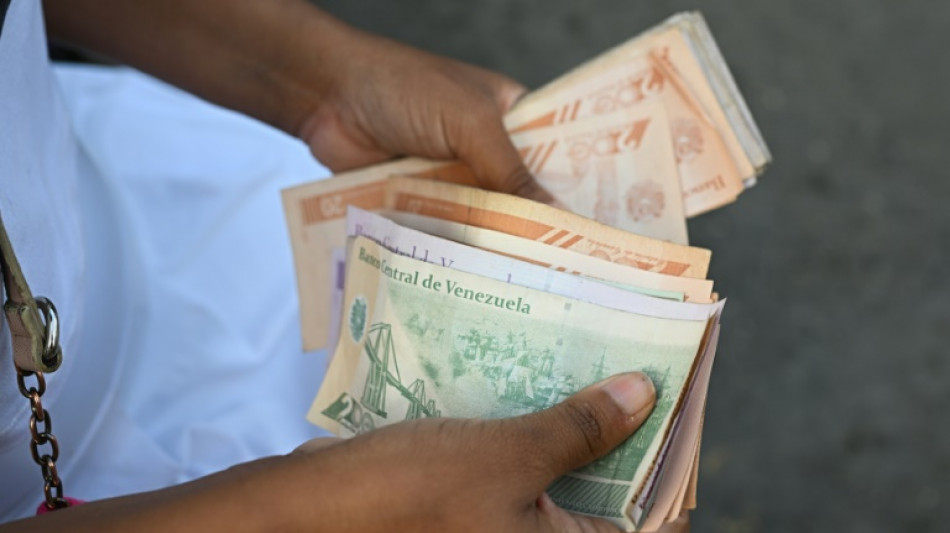
Return to bad days of hyperinflation looms in Venezuela / Photo: © AFP

 Rubio touts US power, calls on Europe to emerge from 'slumber'

 Trump says 'we don't think' Russian plague is bio-weapon

 Five children among 26 killed in Ukraine after Russian strikes

 Man City should 'accept' punishment for rule breaches, says Lineker

 US woman who survived botched execution is awake and speaking

 From 1800s to modern pharma: a Nobel-winning chemistry quest

 Southampton boss Eckert given suspended ban over 'Spygate'

 Russia warns of 'false' information as second plague case reported

 IEA ready to release more oil reserves if necessary
 HSBC 'consults' over UK unit job cuts amid AI adoption

 UK court quashes five ex-traders' Libor rate rigging convictions
 XM Receives “Global Customer Experience Leader Award 2026” at the TrustFinance Performance Awards
 Stocks slide as oil climbs on Mideast flareup

 Heavy casualties in Ukraine after Russian strikes

 French wine harvest set to hit historic low

 Kyiv 'cannot agree' to EU membership limiting food exports: minister
 Arteta targets more Arsenal glory after signing new deal until 2030

 Russell hit with Singapore grid penalty for taking new power unit

 Spotify expands audiobooks to more than 180 markets
 French-Japanese duo wins chemistry Nobel for solving molecular 'mystery'

 England's Nations League surge helps heal World Cup wounds

 Mayor of opposition stronghold Izmir defects to Erdogan party
 Mertens beats Gauff to set up Swiatek clash at China Open

 Benin full of pride at role in Messi's last dance

 France suspends stun grenade use at student protests ahead of PM speech

Venezuelans are grappling with political and economic chaos, a mass population exodus and fears of a US military attack. Now, their wallets are ever thinner as a return to hyperinflation looms.
Increasingly, people live hand to mouth, buying a tomato here, a few onions there as they manage to scrape together enough bolivars for just the basics.
"If we earn 20 bolivars, we need 50," informal merchant Jacinto Moreno, 64, told AFP in downtown Caracas.
To buy a kilogram of tomatoes, a Venezuelan needs the equivalent of one US dollar. But the average salary per month is only a few hundred dollars.
Reliable economic figures are hard to come by and a large portion of incomes are earned under the table in the informal sector.
"Prices go up every day," lamented Moreno. "Every day."
- 130,000 percent -
Venezuela has already had the highest inflation rate in the world, more than once.
Memories are still fresh of a record 130,000 year-on-year rise in prices recorded in 2018, according to official figures -- the peak of a four-year hyperinflationary period that ended in 2021 and pushed millions to emigrate.
Venezuela's central bank has not published inflation figures since October 2024, after President Nicolas Maduro claimed victory in what is widely considered his second stolen election in a row.
According to the leader himself, inflation reached 48 percent in 2024.
The International Monetary Fund projects a 548 percent figure for Venezuela for 2025 and 629 percent for 2026.
Norma Guzman, a 66-year-old who works as an office cleaner, told AFP she can no longer afford to buy groceries monthly or weekly.
Leaving a store with nothing but three tomatoes in a bag, she said "I shop daily" as and when she, her husband and their son manage to put aside money for food.
Maduro blames Venezuela's economic woes squarely on US sanctions.
He also accuses Washington, which has deployed a fleet of warships in the Caribbean in a stated anti-drug operation, of seeking to depose him and seize the formerly rich petrostate's vast oil deposits.
Maduro has said Venezuela will register GDP growth of over nine percent in 2025. The IMF estimates 0.5 percent.
- Economists detained -
Colombian-based Venezuelan economist Oscar Torrealba is among those who expect inflation to soar above 800 percent -- higher than IMF projections.
"This undoubtedly brings us much closer to a hyperinflationary scenario," he told AFP.
For Torrealba, hyperinflation is official once prices rise by more than 50 percent for three consecutive months.
But definitions vary, and for other experts an annual rate of 500 percent, such as predicted by the IMF, already amounts to hyperinflation.
Few economists still living in Venezuela dare to publicly challenge the official line, especially after several of their peers, including a former finance minister, were detained this year.
The arrests were never officially announced but coincided with a series of police operations against the publication of parallel exchange rates on web pages that were subsequently removed.
- Dollar shortage -
For now, the steep price rises have not resulted in product shortages as they did a few years ago, when people queued for hours to just to buy a small bag of coffee or sugar.
Maduro at the time responded by decriminalizing use of the US dollar -- which became Venezuela's de facto currency -- as well as halting money printing and relaxing exchange controls.
Measured in dollar prices, economist Torrealba said Venezuela's inflation hit 80 percent year-on-year in October.
The country is running low on the greenbacks used for a big portion of purchases, and which many Venezuelans try to save as insurance against bolivar devaluation.
A major source of foreign currency used to be US oil giant Chevron, which continues to operate under a special license despite sanctions but no longer pays royalties in cash. It pays in crude, instead, which the state sells on at a discount.
With fewer dollars in the market, the gap between the official exchange rate and the informal one is now over 60 percent, according to analysts.
c-jt/ba/pgf/mr/mlr/dw
H.Seidel--BTB