French scientists probe mRNA's potential to fight cancer / Photo: © AFP

 Trump wants to turn Florida golf course into presidential retreat
 Mayor of Turkish opposition stronghold defects to Erdogan party
 Children among heavy casualties in Ukraine after Russian strikes

 Court orders German ex-spy chief kept in jail after spying, treason arrest

 Guinea caps bottled water prices after sachets banned

 Spared, married, hanged: the last weeks of Iranian protester Alireza Sepahi

 Nobel physics winner's pride at pioneering AI role
 IMF preparing El Nino assistance, concerned about AI bubble burst: chief to AFP

 West must embrace 'national power' or face decline: Rubio
 Shell refining margins reach record highs as wars hit supply

 Former Spain, Barca winger Pedro retires from football

 Arteta signs new Arsenal deal until 2030

 Stocks decline as oil climbs on Mideast flareup
 Gauff says online abuse was 'draining' after China Open exit

 As sector struggles, Porsche puts luxury ahead of volume

 'It's personal': Fiji minister pushes better climate finance at pre-COP

 Russia glosses over dark Soviet past in reinvented museum

 UK tax body opened probe into Man City in 2018: FT

 Yemen's Houthis claim new attacks on Saudi airports as conflict deepens
 Germany factory production at highest level for 18 months

 Thailand floods death toll rises to 60 since mid-September
 US pushes Russia for information on plague reports

 Myanmar leader lands in Malaysia for migrant return talks

 Indian central bank hikes rates for first time since 2023
 US military on Okinawa face curfew, alcohol ban after murder case
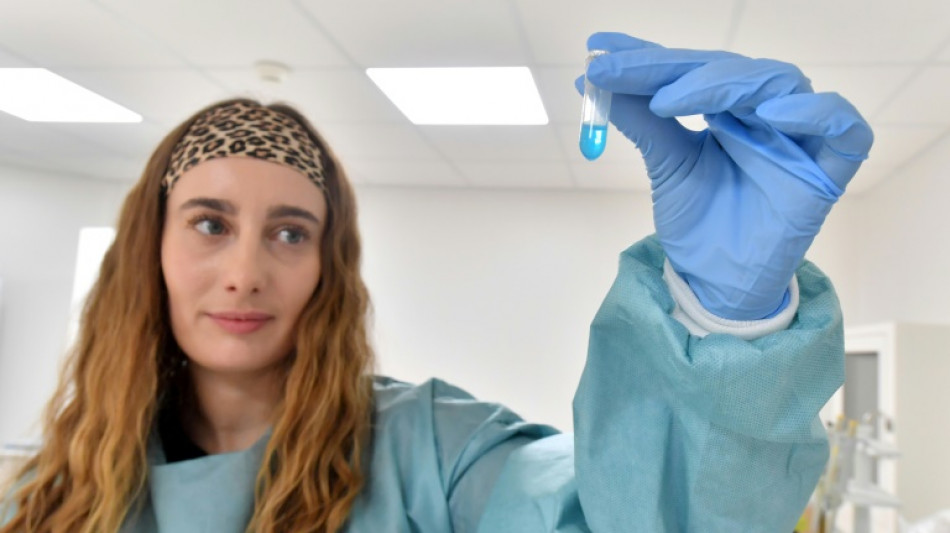
Inside a lab in the French city of Orleans, scientists are testing out the limits of molecules in our body called messenger RNA -- best known for being used in Covid-19 vaccines -- in the hopes of finding a breakthrough treatment for a particularly deadly cancer.
Messenger RNA, or mRNA, are molecules that carry genetic information from the DNA in every cell in the body to create specific proteins.
"For cancer, this message will stimulate the patient's ability to effectively fight tumours," Dimitri Szymczak, project manager of French research institute INSERM's ART lab in Orleans, told AFP.
While mRNA was discovered in the early 1960s, it rose to global prominence when scientists used it to swiftly develop next-generation vaccines during the Covid pandemic, earning the medicine Nobel prize in 2023.
Today, most research in the field is focused on developing vaccines to fight cancer, but mRNA holds "many other possibilities," the ART lab's head Chantal Pichon said.
"It can be used to boost immunity, compensate for malfunctioning cells," target rare or genetic diseases -- and even treat allergies, she added.
There are more than 200 mRNA clinical trials being conducted by both big pharma firms and new start-ups around the world, many of them in the United States, China and Japan, Pichon said.
But France has "some of the best fundamental research teams working on mRNA", she added.
At the ART lab in Orleans, the scientists are making different kinds of mRNA to "test them on cells to check they are not toxic and that they work", Szymczak said.
- Bunker buster -
The RNA used in experiments are usually produced in test tubes, a costly process often patented by US companies.
However, some of the lab's scientists are seeking an alternative by creating the RNAs in yeast, which has the potential to slash costs by 10 to 50 times.
But these RNAs then need to be cleaned and checked to make sure they meet the requirements of the pharmaceutical industry.
Another team is trying to find a new treatment for pancreatic cancer, which has an extremely low survival rate after being diagnosed.
The survival rate has risen "from five percent in 2000 to 10 percent today", ART gastroenterologist Birane Beye said.
The only slight improvement over two decades of effort shows "that therapies like chemotherapy and immunotherapy aren't working very well", he added.
Seeking a breakthrough, French scientists are trying to combine an mRNA vaccine with ultrasound technology.
"The idea is to use the mRNA to teach immune cells to defend themselves against this very aggressive cancer," Beye explained.
First, a powerful ultrasound is used to "create vibrations inside the tissue that generate gas bubbles", he said.
"When these bubbles burst, they destroy the barrier surrounding the pancreatic cancer -- which is a bit like a bunker -- allowing the mRNA vaccine to penetrate the tumour."
So far, they have shown that ultrasounds can be used on the pancreas -- and that this technique can improve the results of conventional treatments.
Next up, the scientists hope they can use the power of mRNA to increase the survival of pancreatic cancer patients.
Thursday is World Pancreatic Cancer Day, which aims to spread awareness of the deadly cancer.
J.Bergmann--BTB