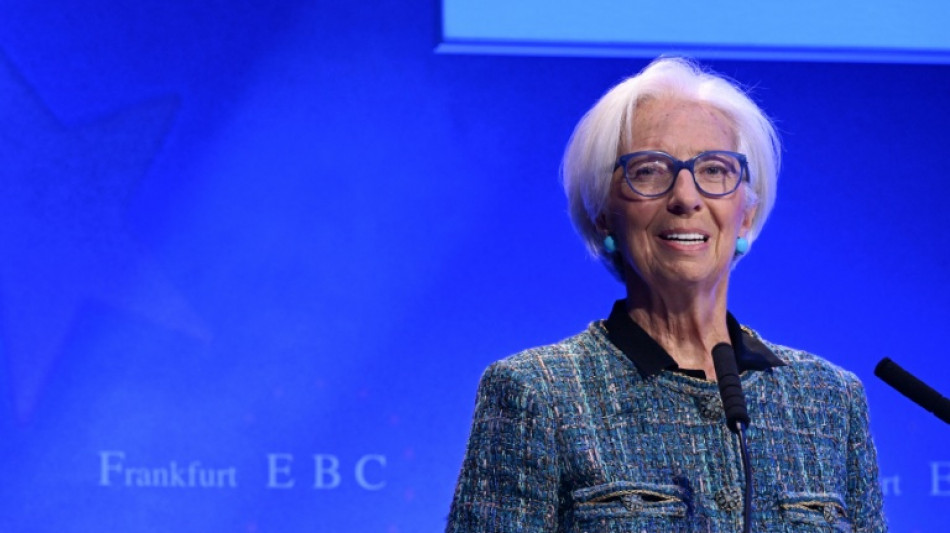
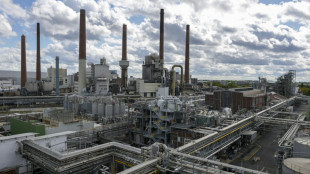
Europe increasingly 'vulnerable' to shocks: ECB chief / Photo: © AFP

 Trump wants to turn Florida golf course into presidential retreat

 Mayor of Turkish opposition stronghold defects to Erdogan party

 Children among heavy casualties in Ukraine after Russian strikes

 Court orders German ex-spy chief kept in jail after spying, treason arrest

 Guinea caps bottled water prices after sachets banned

 Spared, married, hanged: the last weeks of Iranian protester Alireza Sepahi

 Nobel physics winner's pride at pioneering AI role

 IMF preparing El Nino assistance, concerned about AI bubble burst: chief to AFP

 West must embrace 'national power' or face decline: Rubio

 Shell refining margins reach record highs as wars hit supply

 Former Spain, Barca winger Pedro retires from football

 Arteta signs new Arsenal deal until 2030

 Stocks decline as oil climbs on Mideast flareup
 Gauff says online abuse was 'draining' after China Open exit

 As sector struggles, Porsche puts luxury ahead of volume
 'It's personal': Fiji minister pushes better climate finance at pre-COP

 Russia glosses over dark Soviet past in reinvented museum

 UK tax body opened probe into Man City in 2018: FT

 Yemen's Houthis claim new attacks on Saudi airports as conflict deepens
 Germany factory production at highest level for 18 months
 Thailand floods death toll rises to 60 since mid-September

 US pushes Russia for information on plague reports

 Myanmar leader lands in Malaysia for migrant return talks

 Indian central bank hikes rates for first time since 2023
 US military on Okinawa face curfew, alcohol ban after murder case

European Central Bank chief Christine Lagarde warned Friday the region was increasingly "vulnerable" to shocks like US tariffs and is lagging behind in areas that will drive growth such as AI.
The continent must urgently speed up its integration and overhaul a model of export-led growth that has faltered amid mounting geopolitical turmoil, she said in a speech to a banking conference.
"Europe has become more vulnerable," the head of the central bank for the 20-nation eurozone said in Frankfurt, pointing to the region's "dependency on third countries for our security and the supply of critical raw materials".
"Global shocks have intensified, with rising US tariffs, Russia's invasion of Ukraine and stiffening competition from China," she added.
Europe's domestic market meanwhile had "stood still," particularly in areas set to underpin future growth like the digital sector and artificial intelligence, Lagarde said.
The continent had long relied on exports of goods ranging from cars to factory equipment and pharmaceuticals to support its economies.
But this model was no longer working, said Lagarde, saying the European Union needed to strengthen its domestic economy as "a source of resilience in an uncertain world".
Faced with weak demand for key exports, structural problems and more recently the US tariff blitz, Europe's growth has been muted in recent years, lagging far behind the United States and China.
Lagarde outlined reforms to boost the region, ranging from better integrating the financial sector to lowering trade barriers and simplifying EU decision making processes.
She warned that more years of "lost growth, lost productivity, would not just be disappointing for future generations, it would be irresponsible on our part".
If radical reforms are enacted, "we can actually make sure that Europe is strong and is not the victim of decisions being made outside of this region," Lagarde said.
N.Fournier--BTB