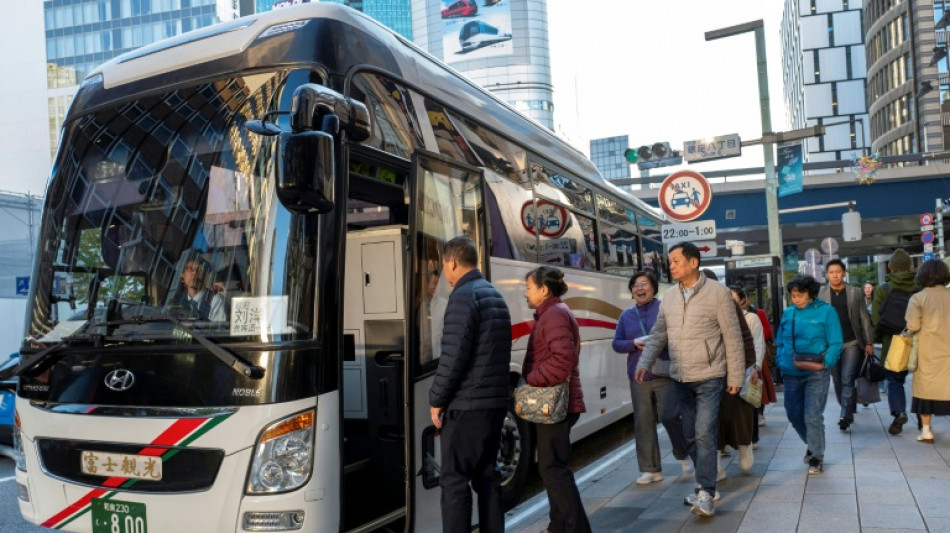
Japan businesses brush off worries over China tourists / Photo: © AFP/File

 Trump wants to turn Florida golf course into presidential retreat

 Mayor of Turkish opposition stronghold defects to Erdogan party

 Children among heavy casualties in Ukraine after Russian strikes

 Court orders German ex-spy chief kept in jail after spying, treason arrest

 Guinea caps bottled water prices after sachets banned

 Spared, married, hanged: the last weeks of Iranian protester Alireza Sepahi

 Nobel physics winner's pride at pioneering AI role

 IMF preparing El Nino assistance, concerned about AI bubble burst: chief to AFP

 West must embrace 'national power' or face decline: Rubio

 Shell refining margins reach record highs as wars hit supply

 Former Spain, Barca winger Pedro retires from football

 Arteta signs new Arsenal deal until 2030

 Stocks decline as oil climbs on Mideast flareup

 Gauff says online abuse was 'draining' after China Open exit

 As sector struggles, Porsche puts luxury ahead of volume

 'It's personal': Fiji minister pushes better climate finance at pre-COP

 Russia glosses over dark Soviet past in reinvented museum

 UK tax body opened probe into Man City in 2018: FT

 Yemen's Houthis claim new attacks on Saudi airports as conflict deepens

 Germany factory production at highest level for 18 months
 Thailand floods death toll rises to 60 since mid-September

 US pushes Russia for information on plague reports

 Myanmar leader lands in Malaysia for migrant return talks

 Indian central bank hikes rates for first time since 2023

 US military on Okinawa face curfew, alcohol ban after murder case

Shiina Ito has had fewer Chinese customers at her Tokyo jewellery shop since Beijing issued a travel warning in the wake of a diplomatic spat, but she said she was not concerned.
A souring of Beijing-Tokyo relations this month, following remarks by Japanese Prime Minister Sanae Takaichi about Taiwan, has fuelled concerns about the impact on the ritzy boutiques, noodle joints and hotels where holidaymakers spend their cash.
But businesses in Tokyo largely shrugged off any anxiety.
"Since there are fewer Chinese customers, it's become a bit easier for Japanese shoppers to visit, so our sales haven't really dropped," shop manager Ito told AFP.
Chinese buyers normally make up half of the clientele at her business in the capital's traditional Asakusa district, where crowds of tourists stroll through shop-lined alleys.
Many tourism and retail businesses in Japan rely heavily on Chinese visitors, who spend more on average than other foreign tourists on everything from sushi to skincare.
Some hotels, designer clothes shops and even pharmacies have Mandarin-speaking assistants, while department stores often have signs in Chinese.
In Tokyo's upscale Ginza district, Yuki Yamamoto, the manager of an Instagram-famous udon noodle restaurant, said he had not noticed any immediate impact on sales in the days since China warned its citizens to avoid Japan.
"I don't think there's been any sudden, dramatic change," he said, despite estimating that on a normal day around half the hungry diners who queue outside his door are Chinese.
"Of course, if customers decrease, that's disappointing for the shop. But Japanese customers still come regularly, so we're not extremely concerned."
China is the biggest source of tourists to the archipelago, with almost 7.5 million visitors in the first nine months of 2025 -- a quarter of all foreign tourists, according to official Japanese figures.
Attracted by a weak yen, they splashed out the equivalent of $3.7 billion in the third quarter.
Last year, each Chinese tourist spent on average 22 percent more than other visitors, according to the Japan National Tourism Organization.
However, a record 36.8 million arrivals from across the globe last year has also led to fears of overtourism affecting the daily lives of many in Japan.
- 'Economic coercion' -
On November 7, Takaichi implied Tokyo could intervene militarily in any attack on Taiwan, a self-ruled island which China claims as part of its territory.
Beijing then advised Chinese citizens to avoid travelling to Japan, and retail and tourism stocks subsequently plunged. Most have yet to recover.
In response, Kimi Onoda, Japan's hawkish minister of economic security, warned of the danger of "relying too heavily on a country that resorts to economic coercion whenever it is displeased".
That "poses risks not only to supply chains but also to tourism", she said.
Wu Weiguo, the manager of a travel agency in Shanghai, said that "the biggest impact is on group travel", with 90 percent of his clients requesting refunds for planned Japan itineraries.
But according to the national tourism board, only around 12 percent of Chinese visitors last year came to the archipelago as part of organised tours, down from almost 43 percent in 2015.
Transport Minister Yasushi Kaneko said the issue was not "something to get all worked up about", noting an increase in arrivals from other countries.
- 'Take time' -
Nevertheless, hotels in Japan that heavily depend on Chinese customers are feeling the effects.
"Cancellations from travel agencies in China are coming one after another," said Keiko Takeuchi, who runs the Gamagori Hotel in central Japan. "About 50 to 60 percent of our customers are Chinese nationals.
"I hope the situation calms down quickly, but it seems it will take time," she fretted.
Beijing has made clear it was furious with Takaichi, summoning Tokyo's ambassador and, according to Chinese state media, postponing the release of at least two Japanese movies.
But travel agency manager Wu said that the spat would not stop holidaymakers dreaming of Tokyo.
"They believe the service is high-quality and shopping is reasonably priced," he said.
"Chinese people will continue to want to visit Japan."
mac-kh-tjx-aph/ami/lb
S.Keller--BTB