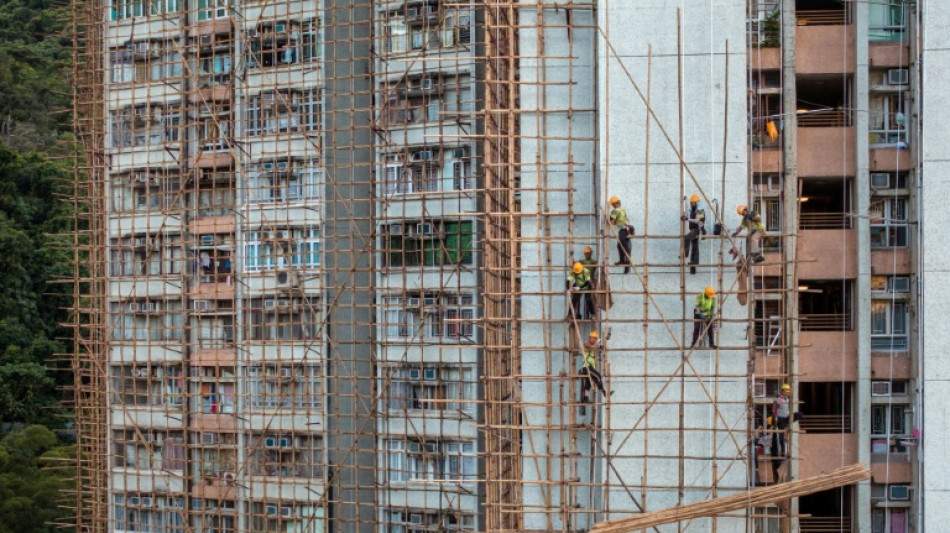
Hong Kong's bamboo scaffolding under scrutiny after fatal fire / Photo: © AFP

 UK court quashes five ex-traders' Libor rate rigging convictions
 XM Receives “Global Customer Experience Leader Award 2026” at the TrustFinance Performance Awards

 Stocks slide as oil climbs on Mideast flareup

 Heavy casualties in Ukraine after Russian strikes

 French wine harvest set to hit historic low

 Kyiv 'cannot agree' to EU membership limiting food exports: minister

 Arteta targets more Arsenal glory after signing new deal until 2030

 Russell hit with Singapore grid penalty for taking new power unit

 Spotify expands audiobooks to more than 180 markets

 French-Japanese duo wins chemistry Nobel for solving molecular 'mystery'

 England's Nations League surge helps heal World Cup wounds

 Mayor of opposition stronghold Izmir defects to Erdogan party

 Mertens beats Gauff to set up Swiatek clash at China Open
 Benin full of pride at role in Messi's last dance

 France suspends stun grenade use at student protests ahead of PM speech

 Indonesian court hears 'negligence' complaint against state over fires, haze
 Rubio in Greece to urge against Western civilisation 'decline'
 Micron workers at Taiwan plant vote in favour of strike

 In 'The Social Reckoning,' Jeremy Allen White takes on Facebook's 'frightening' ambition

 Chip industry activists call for South Korea to recognise cancer cases

 Famine-scarred southern Madagascar braces for El Nino
 How the EU regulates lobbyists
 I.Coast refuge offers lifelong care for youngsters scorned as 'sorcerers'

 Indian central bank hikes rates for first time in more than 3 years

 Hotel Blacklist Launches New Accommodation Industry Risk Assessment Tool

Dozens of deaths in an inferno at a Hong Kong residential estate have ignited debate over the role the city's quintessential bamboo scaffolding played in the fire's spread, as the government promised to phase it out.
Hong Kong is one of the world's last remaining cities to use the frames for modern construction and building repair, a practice which dates back centuries in China and other parts of Asia.
The eight high-rises of Wang Fuk Court had been undergoing major renovations since last year, and were criss-crossed by lattices of bamboo and green protective netting when the fire took hold on Wednesday afternoon.
Hong Kong's government said Friday falling bits of bamboo had helped spread the fire, after saying the day before that it was "imperative to expedite" a transition to metal scaffolding throughout the city for safety reasons.
Some locals have fiercely defended the practice of using bamboo, accusing the government of scapegoating and taking others to task over what they view as orientalist attitudes towards a long-renowned Hong Kong craft.
"This is a really complicated multifaceted problem," Anwar Orabi, a civil engineer specialising in fire safety at the University of Queensland, told AFP.
He stressed that "a clear answer is premature at this stage".
"The bamboo, or rather the entire scaffolding, was on fire... It is not the only contributor... but is very likely a component of it."
Preliminary findings suggest the fire started on protective netting outside the lower floors of one building, and quickly spread upwards thanks to "highly flammable" foam boards, security chief Chris Tang said.
The foam boards were attached to windows, shattering the glass and causing the fire "to intensify and spread indoors", he added.
The intense heat set the bamboo alight, and sticks of it broke off and fell to floors below, meaning the fire spread further, he said.
- 'Inferior' resistance -
Bamboo scaffolding is versatile and sustainable.
It is readily available from southern China and can be cheaply transported, set up and dismantled in tight spaces.
Industry representatives estimated in January that nearly 80 percent of Hong Kong's scaffolds were made of bamboo, and there are thought to be around 3,000 practitioners in the city.
The city's number-two official Eric Chan said on Thursday though that "despite its long history of use... (bamboo's) fire resistance remains inferior to that of metal scaffolding".
The government announced plans in March to drive wider adoption of the latter to improve safety.
In a statement expressing concern, an advocacy group representing victims of industrial accidents highlighted three other scaffolding-related fires reported this year in Hong Kong.
Surveying the blackened buildings, Ho Wing-ip, an engineering professor at Hong Kong Polytechnic University, told AFP both metal and bamboo scaffolding could withstand flames for a short time.
But the Wang Fuk Court inferno burned for over 40 hours.
"You can only see a very small portion of bamboo has been left" on the second block of apartments, he said.
"But for metallic scaffold I think most of them (would) be there."
He lamented that all eight blocks had been renovated simultaneously.
If they had been done one by one, "I don't think the fire will propagate so far", he said.
- 'Blaming the exotic' -
On social media, some Hong Kongers defended the scaffolding, pointing out that large portions of it remained visibly intact despite the fire's length and intensity.
Some criticised media outlets that have put a strong emphasis on bamboo in their coverage of the fire.
"Putting bamboo scaffolding as the main explanation for the fire... is essentially blaming the foreign and exotic," Leung Kai-chi, a Hong Kong studies scholar, said in a post on Threads.
"Identity politics is part of the debate," observed Hong Kong-based journalist Tom Grundy on X.
Others pointed to the myriad other factors involved.
Ho Ping-tak, chairman of a bamboo scaffolders' union, told a morning radio programme that bamboo alone is "hard to ignite", and called for the government to strengthen requirements for flame-retardant materials.
Hong Kong Polytechnic University's Ho emphasised that the foam boards seemed to be the "most critical" reason the blaze enveloped the building so quickly.
Lee Kwong-sing, president of the Hong Kong Institute of Safety Practitioners, blamed the netting.
"Even if you switch to metal scaffolding you still need netting," he said.
"Whether it's bamboo or metal scaffolding, as long as management is done properly and regulations are strictly followed, both are relatively safe," Chau Sze-kit, a local construction union chair, told a radio programme.
H.Seidel--BTB