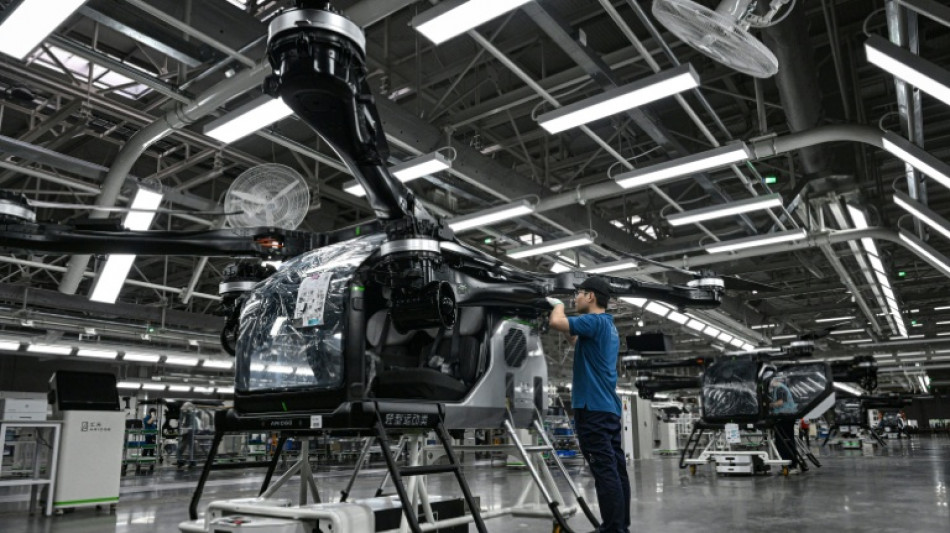
Electric vehicle prowess helps China's flying car sector take off / Photo: © AFP/File

 UK court quashes five ex-traders' Libor rate rigging convictions

 XM Receives “Global Customer Experience Leader Award 2026” at the TrustFinance Performance Awards

 Stocks slide as oil climbs on Mideast flareup

 Heavy casualties in Ukraine after Russian strikes

 French wine harvest set to hit historic low

 Kyiv 'cannot agree' to EU membership limiting food exports: minister

 Arteta targets more Arsenal glory after signing new deal until 2030

 Russell hit with Singapore grid penalty for taking new power unit

 Spotify expands audiobooks to more than 180 markets

 French-Japanese duo wins chemistry Nobel for solving molecular 'mystery'

 England's Nations League surge helps heal World Cup wounds
 Mayor of opposition stronghold Izmir defects to Erdogan party

 Mertens beats Gauff to set up Swiatek clash at China Open

 Benin full of pride at role in Messi's last dance

 France suspends stun grenade use at student protests ahead of PM speech

 Indonesian court hears 'negligence' complaint against state over fires, haze

 Rubio in Greece to urge against Western civilisation 'decline'

 Micron workers at Taiwan plant vote in favour of strike

 In 'The Social Reckoning,' Jeremy Allen White takes on Facebook's 'frightening' ambition

 Chip industry activists call for South Korea to recognise cancer cases

 Famine-scarred southern Madagascar braces for El Nino

 How the EU regulates lobbyists

 I.Coast refuge offers lifelong care for youngsters scorned as 'sorcerers'

 Indian central bank hikes rates for first time in more than 3 years

 Hotel Blacklist Launches New Accommodation Industry Risk Assessment Tool

A worker in white gloves inspects the propellers of a boxy two-seater aircraft fresh off the assembly line at a Chinese factory trialling the mass production of flying cars.
Globally, technical and regulatory challenges have prevented the much-hyped flying car sector from getting off the ground.
But Chinese companies are building on rapid development of drones and electric vehicles (EVs) in the world's second-largest economy, while harnessing government support for the futuristic inventions.
"China has the potential to establish a competitive edge" for flying cars, said Zhang Yangjun, a professor at Tsinghua University's School of Vehicle and Mobility.
"Future competition will increasingly hinge upon cost control and supply-chain efficiency, and these are areas where China holds clear advantages," he told AFP.
At the brightly lit factory in the southern industrial heartland of Guangzhou, logistics robots zip around ferrying unfinished parts.
The lightweight six-propeller aircraft under construction take off vertically and fit into a large car, to create the "Land Aircraft Carrier" -- a modular flying vehicle made by Aridge, an arm of Chinese EV maker XPeng.
The flying part is stored and charged in a wheeled on-land vehicle dubbed "the mothership".
At full capacity, the Aridge factory can churn out one every 30 minutes. It began its trial production phase in early November and the company plans to start deliveries next year, saying it has had more than 7,000 pre-orders.
- James Bond -
But there is a long way to go before flying cars are whizzing through the air every day.
"Regulations, the consumer's comfort with this product, and also how you manage airspaces, your supply chains, all need to catch up gradually," Michael Du, vice president of Aridge, told reporters at a recent event.
Competition is heating up among global tech giants over the future of aerial mobility, with Tesla CEO Elon Musk teasing the debut of a flying car prototype within weeks.
"If you took all the James Bond cars and combined them, it's crazier than that," Musk told the Joe Rogan Experience podcast.
American aviation pioneer Glenn Curtiss debuted the first flying car prototype in 1917.
But successful designs have only become possible in recent years as electric motors and high-performance batteries have advanced.
Major players in the sector have conducted manned test flights, including California-based companies Joby and Archer, as well as Aridge, EHang and Volant in China.
This year EHang became the world's first flying car company to be fully approved for commercial operation, something Aridge has yet to achieve.
EHang plans to introduce an air taxi service, priced similarly to a premium road taxi, within three years.
"Flying cars remain at an early developmental stage," said Zhang, who edited a white paper on China's flying car industry.
He still sees the sector as worthy of long-term endeavour, and authorities agree.
- Low-altitude economy -
Beijing has named the "low-altitude economy" -- flying cars, drones and air taxis -- as a strategic field for the next five years, seeking to accelerate their development.
Provincial governments from Guangdong to Sichuan have pledged to loosen restrictions.
A Boston Consulting Group report said China's flying car market is approaching "a critical inflection point", and predicted it will be worth $41 billion by 2040.
However, the sector has struggled to find viable business models elsewhere, with several high-profile insolvencies in Europe, and leading US players burning through cash with plans for mass production yet to materialise.
Direct comparisons between the sector in China and other international markets is tricky.
But "in terms of the EV supply chain, China is far in the lead", said Brandon Wang, a Beijing-based investor whose portfolio includes AI, robotics and flying cars.
Flying cars can use EV parts once they are certified for aviation use, which may help Chinese companies scale up.
China also has an "engineer dividend" that allows its companies to quickly solve technical issues in the production process, Wang added.
K.Thomson--BTB