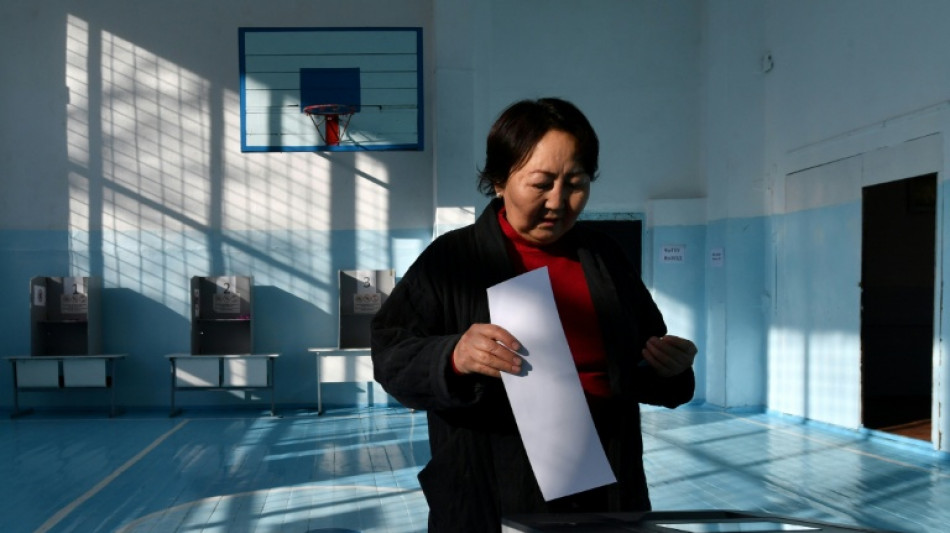
Kyrgyzstan vote in polls set to hand president more power / Photo: © AFP

 UK court quashes five ex-traders' Libor rate rigging convictions
 XM Receives “Global Customer Experience Leader Award 2026” at the TrustFinance Performance Awards
 Stocks slide as oil climbs on Mideast flareup
 Heavy casualties in Ukraine after Russian strikes
 French wine harvest set to hit historic low
 Kyiv 'cannot agree' to EU membership limiting food exports: minister

 Arteta targets more Arsenal glory after signing new deal until 2030

 Russell hit with Singapore grid penalty for taking new power unit

 Spotify expands audiobooks to more than 180 markets
 French-Japanese duo wins chemistry Nobel for solving molecular 'mystery'
 England's Nations League surge helps heal World Cup wounds

 Mayor of opposition stronghold Izmir defects to Erdogan party
 Mertens beats Gauff to set up Swiatek clash at China Open
 Benin full of pride at role in Messi's last dance

 France suspends stun grenade use at student protests ahead of PM speech
 Indonesian court hears 'negligence' complaint against state over fires, haze
 Rubio in Greece to urge against Western civilisation 'decline'
 Micron workers at Taiwan plant vote in favour of strike
 In 'The Social Reckoning,' Jeremy Allen White takes on Facebook's 'frightening' ambition
 Chip industry activists call for South Korea to recognise cancer cases
 Famine-scarred southern Madagascar braces for El Nino
 How the EU regulates lobbyists
 I.Coast refuge offers lifelong care for youngsters scorned as 'sorcerers'

 Indian central bank hikes rates for first time in more than 3 years
 Hotel Blacklist Launches New Accommodation Industry Risk Assessment Tool

Kyrgyzstan began voting Sunday in a snap parliamentary election that featured no formal parties or opposition and that critics say will cement the power of President Sadyr Japarov.
The landlocked Central Asian country was once seen as the most democratic in the region, but Japarov has been criticised for backsliding since he came to power after a revolution in 2020.
Polling stations opened at 8 am local time (0200 GMT), according to an AFP reporter.
Surrounded by highly authoritarian regimes, Kyrgyzstan has gone through three revolutions -- 2005, 2010 and 2020 -- since the collapse of the Soviet Union.
Japarov is seeking to end that cycle by boosting his control over politics and society.
"From now on, you will only see coups in your dreams," he said in early November. He boasted he was "confident" he could win 90 percent of the vote in presidential elections scheduled for 2027.
As polls opened on Sunday, Japarov praised the use of electronic voting, which he said would prevent falsification of the result and further "coups".
- 'No strong parties' -
Several NGOs have denounced a deterioration in freedom of expression and the press since Japarov came to power.
Days ahead of Sunday's election, 10 of his opponents were arrested, adding to a long list of politicians and journalists the state has accused of plotting coups.
Officially there are 329 political parties registered in the country.
But Japarov has changed the electoral system to weaken the role of parties, meaning only one will participate in the vote -- down from 16 in 2020. This will make the result difficult to read.
The estimated 4.3 million voters will choose 90 MPs from 467 candidates with at least 30 seats reserved for women.
"Where there are no strong parties, people vote by district, based on the personalities of individual candidates," Emil Dzhuraev, a professor at the OSCE Academy in Bishkek, told AFP.
"Naturally, this does not lead to any political development."
Without strong parties, both voters and MPs struggle to organise or meaningfully advance different visions for the country's future in any sustainable way.
"This leads to the further strengthening of executive power," Dzhuraev said.
- Russian influence -
Around two-thirds of Kyrgyzstan's seven million people are under 35, with no living memory of when the country was part of the Soviet Union.
But ties with former colonial power Russia remain strong, even as the country has forged its own distinct national identity.
Russian is an official language and Bishkek is a close ally of Moscow.
Remittances from hundreds of thousands of Kyrgyz labour migrants in Russia make up around a quarter of Kyrgyzstan's GDP, according to the World Bank.
And dozens of Kyrgyz have been killed after getting recruited by Moscow to fight in Ukraine, local media have reported based on publicly available data.
Daniel Medetbek Uulu, a 20-year-old student, said people were mainly leaving because of the low wages.
"The authorities should try to raise them. They should build factories to provide new jobs, then it will be possible to work in Kyrgyzstan," he told AFP.
- Energy crisis -
Landlocked Kyrgyzstan is one of the world's most mountainous countries, sitting at an average altitude of 2,630 metres (8,628 feet).
High glaciers give it vital water reserves, a rarity in Central Asia, which is predominantly a desert region thousands of miles from the sea.
But climate change is hitting the region hard, triggering water shortages that hobble the vast Toktogul hydro power plant and lead to electricity shortages.
The energy crisis has been a theme of the election campaign, with the president accusing his opponents of manipulating the population over the extent of the problem.
Major powers including the European Union, United States, Russia and China all compete for influence in the strategic Central Asian region.
China is investing heavily to advance its New Silk Road initiative, a massive transport and infrastructure project to boost land routes between Asia and Europe.
Beijing is now the top trading partner and though it is boosting the economy, increasing numbers of Chinese businesses and visitors are a source of discontent for some.
B.Shevchenko--BTB