French minister urges angry farmers to trust cow culls, vaccines / Photo: © AFP

 Rubio in Greece to urge against Western civilisation 'decline'

 Micron workers at Taiwan plant vote in favour of strike

 In 'The Social Reckoning,' Jeremy Allen White takes on Facebook's 'frightening' ambition

 Chip industry activists call for South Korea to recognise cancer cases
 Famine-scarred southern Madagascar braces for El Nino

 How the EU regulates lobbyists
 I.Coast refuge offers lifelong care for youngsters scorned as 'sorcerers'

 Indian central bank hikes rates for first time in more than 3 years

 Hotel Blacklist Launches New Accommodation Industry Risk Assessment Tool

 Bangladesh nuclear plant draws hope -- and worry

 US beat Canada 1-0 to wrap up four-win international break

 Turkey, Australia's joint COP31 leadership raises doubts

 For Turkish NGOs, COP31 offers rare space for action
 Sleep, appetite, gene-editing experts contend for Nobel chemistry prize

 Nobel Peace Prize haunted by the 'spectre' of Trump

 Africa launches own credit agency in bid for cheaper borrowing

 US, China, EU: three paths to regulating AI

 Australia's High Court rules against coal mine in landmark climate case

 Australia touts new funds for Pacific infrastructure at Fiji 'pre-COP'

 Eva Marie Saint, Oscar winner of Hollywood classics, dies at 102

 Australia probes app used in cheap smart glasses over privacy fears

 England needed to 'move on' from World Cup pain, says Tuchel

 O'Neill to stay at Celtic after period of "reflection"

 Kane marks 125th England cap with Wembley Nations League double

 Quebec's incoming separatist leader wants to block Crown from swearing-in

France's agriculture minister Monday defended planned mass cattle culls and vaccines to control an infectious bovine disease, after farmers vowed no let-up in their protests against what they view as excessive slaughtering.
The state's strategy since nodular dermatitis -- also known as lumpy skin disease -- appeared in France in June has been to kill affected herds and vaccinate all cattle within a 50-kilometre (30-mile) radius.
Last week it then broadened inoculations to include up to one million head of cattle in the southwestern Nouvelle-Aquitaine and southeastern Occitanie regions.
Agriculture Minister Annie Genevard on Monday urged farmers to have faith in the plan.
"We must rely on science," she said in the city of Toulouse, after a secretive tour in the surrounding Occitanie region.
"I want to stand with the breeders in Occitanie," she added.
"But I also want to protect the entirety of the French herd," she said, referring to 125,000 livestock breeders and 16 million head of cattle nationwide.
- 'Cows have a name' -
Agricultural workers have blocked roads since vets on Friday slaughtered a herd of more than 200 cows in a village near the Spanish border after discovering a single case of the disease.
Police used teargas to disperse the last protesters trying to protect them in Les Bordes-sur-Arize.
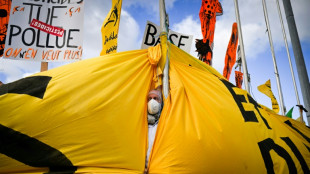
At a roadblock on the motorway south of Toulouse earlier Monday, protesters had grilled sausages near hay bales in the shape of a cow.
"Leaving the motorway is out of the question," said livestock breeder Cedric Baron near the village of Carbonne.
"We've put up Christmas trees and we're ready to celebrate," he said.
"Stop the slaughter," read a sign over the motorway.
Dozens also blocked the motorway outside the southwestern city of Bordeaux, where farmer Christophe Ubeda late Sunday said he thought the government's policy was excessive.
"You can't just wipe out herds like that, just because one of them is sick. You do tests," he told AFP in the Cestas area near Bordeaux.
"When a human is ill, you don't kill the whole family."
Sarah Dumigron, who runs a farm in the village of Cabanac-et-Villagrain near Bordeaux, said she would fight "to the end" for her 30 Galloway cows.
"At the farm, cows have a name, their own personality and story," she said in another part of the Bordeaux region. "I've looked after them at night, I work with them seven days a week."
- 'Commercial balances' -
But Culture Viande, a union representing slaughterhouses and meat wholesalers, on Monday defended the government's plan as "the only one capable of ensuring total control of health risks while preserving economic and commercial balances".
French farmers -- some independent and others large agro-businesses -- rear cows for both milk and meat, and France is the world's leading exporter of live animals.
In 2024, it sent abroad nearly 1.3 million young cattle worth over one billion euros ($1.17 billion), according to French customs. They were mostly sent to Italy and Spain to be fattened.
French farmers are also upset the European Union is this week expected to sign a trade deal with South America they say will flood the market with cheap products that will outcompete them.
Some plan to drive tractors to Brussels on Thursday to protest the so-called Mercosur deal, which will allow the EU to export more vehicles, machinery, wines and spirits to Latin America while facilitating the entry of South American beef, sugar, rice, honey and soybeans into Europe.
burs-ah/cc
W.Lapointe--BTB