Kenyan girls still afflicted by genital mutilation years after ban / Photo: © AFP

 Rubio in Greece to urge against Western civilisation 'decline'
 Micron workers at Taiwan plant vote in favour of strike
 In 'The Social Reckoning,' Jeremy Allen White takes on Facebook's 'frightening' ambition
 Chip industry activists call for South Korea to recognise cancer cases

 Famine-scarred southern Madagascar braces for El Nino
 How the EU regulates lobbyists

 I.Coast refuge offers lifelong care for youngsters scorned as 'sorcerers'

 Indian central bank hikes rates for first time in more than 3 years
 Hotel Blacklist Launches New Accommodation Industry Risk Assessment Tool

 Bangladesh nuclear plant draws hope -- and worry

 US beat Canada 1-0 to wrap up four-win international break

 Turkey, Australia's joint COP31 leadership raises doubts

 For Turkish NGOs, COP31 offers rare space for action
 Sleep, appetite, gene-editing experts contend for Nobel chemistry prize

 Nobel Peace Prize haunted by the 'spectre' of Trump

 Africa launches own credit agency in bid for cheaper borrowing

 US, China, EU: three paths to regulating AI

 Australia's High Court rules against coal mine in landmark climate case

 Australia touts new funds for Pacific infrastructure at Fiji 'pre-COP'

 Eva Marie Saint, Oscar winner of Hollywood classics, dies at 102

 Australia probes app used in cheap smart glasses over privacy fears

 England needed to 'move on' from World Cup pain, says Tuchel

 O'Neill to stay at Celtic after period of "reflection"

 Kane marks 125th England cap with Wembley Nations League double

 Quebec's incoming separatist leader wants to block Crown from swearing-in

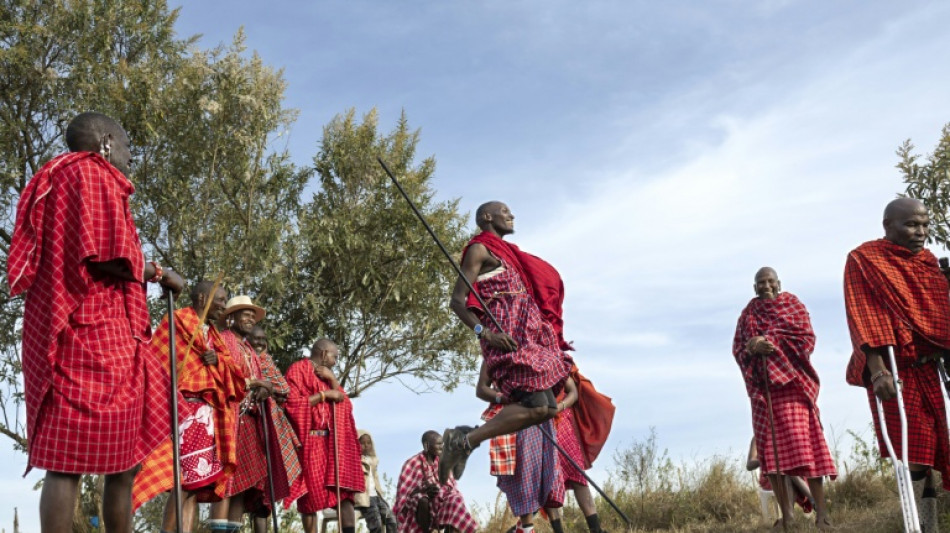
Maasai women erupted with mocking heckles as a community elder, wrapped in a traditional red blanket, claimed that female genital mutilation had all but stopped in their community in southern Kenya.
The women know that mutilating young girls by removing their clitoris and inner labia -- framed as a rite of passage -- is still an entrenched practice in some remote villages of Narok county, around three hours from the nearest tarmac road.
One local nurse told AFP some 80 percent of girls in the area are still affected, despite the practice being made illegal in 2011.
"Why are you telling people that you have stopped, when we have teenage girls coming to the hospital who have been cut?" asked a woman in the crowd, gathered in Entasekera village to discuss the issue.
The women nodded emphatically, while the men sat stone-faced.
Female genital mutilation (FGM) has survived decades of pressure to end it, from British colonialists and later Kenyan and global NGOs.
It still exists not only among the rural southern Maasai, but also in Kenya's northeast -- with parts of the Somali diaspora community in the region reporting rates over 90 percent -- as well as in some urban areas and among educated groups, where campaigners have highlighted the rise of so-called medicalised FGM.
A 2022 government survey said the number of affected teenage girls had fallen from 29 percent to nine percent since 1998 nationally.But that does not reflect reality in some areas.
"We don't circumcise girls because the culture has changed," Maasai elder Moses Letuati, 50, told AFP -- before admitting one of his four daughters was cut.
Many of the Maasai men at the meeting said it should end, although one said only because an "uncut woman is better" in bed.
- Cries and curses -
"I was screaming and struggling," said Martha, 18, who was 10 when two women, under pressure from their community, cut her at home in Narok East on her father's say-so.
She later fled to a local shelter run by activist Patrick Ngigi, who says his organisation Mission with a Vision has rescued some 3,000 victims of FGM since 1997.
The shelter, supported by the United Nations Population Fund, has CCTV and panic buttons to protect the girls from fathers and elders who disagree with its mission.
"It's a dangerous job... You make so many enemies, but slowly with time, you get used to it," said Ngigi, who has faced curses by community elders.
The work is endless: at the village meeting, Ngigi was quietly approached by women pleading with him to take six more girls at risk of FGM.
The practise persists among the community thanks to beliefs that a girl should be cut ahead of marriage, and should she not undergo it will face ostracism.
As a result, Ngigi said change requires education, dialogue and an end to corruption.
"When a policeman comes and finds you doing it, you just give him something and you continue," he said.
Police officer Raphael Maroa rejected the accusation of corruption but admitted FGM was entrenched, with many girls now spirited over the nearby Tanzanian border for the procedure.
Ngigi criticised the community's lack of education -- roughly half of Narok's population is illiterate, according to 2022 figures -- but then admitted to AFP that his two daughters had also been cut, to avoid "conflict with my parents".
- 'A monster' -
The Maasai remain among Kenya's poorest communities and have faced decades of land loss due to colonial settlers and now tourism, and some remain suspicious of outsiders trying to change their way of life.
One young Maasai man told AFP he had friends who still believed in FGM, but said girls were no longer cursed -- a form of social control, used by elders -- for refusing it.
Cynthia Taruru would disagree.
Her father cursed her when her college-educated sister rescued her from FGM aged 11.
"I could see myself dying, or not getting children, because I believed my father had just cursed me," said Taruru, now 23.
"I had to pay my father a cow to get the curse lifted," she said.
Local health officials said victims of FGM often suffer fistulas and obstructed labour in childbirth, exacerbated by long distances to health facilities.
Many young women, hoping to protect their families from arrest for allowing FGM, opt for home births, raising the risk of complications and death, although officials said data was lacking on exact numbers.
Nurse Loise Nashipa, 32, at the Entasekera Health Centre, described FGM as "a monster".
"There's bleeding, and there's pain, and infection," she said, saying most cutting was still done by elderly women in unsanitary conditions.
Officially, FGM rates have fallen, said Rhoda Orido, head nurse at Narok County Hospital, "but I think it's because some deliver at home".
- 'He'll forgive me' -
As night fell at Ngigi's shelter, the girls celebrated the graduation of Cecilia Nairuko, 24, who ran away from FGM and forced marriage at the age of 15 and has qualified as a psychologist.
Beaming, she danced around the facility in a graduation gown that has passed from one girl to the next.
But her mood darkened when asked about her family: her father and three of her four brothers have not forgiven her.
She knows there is one path back to her family: "If I can earn enough money, he'll forgive me."
P.Anderson--BTB