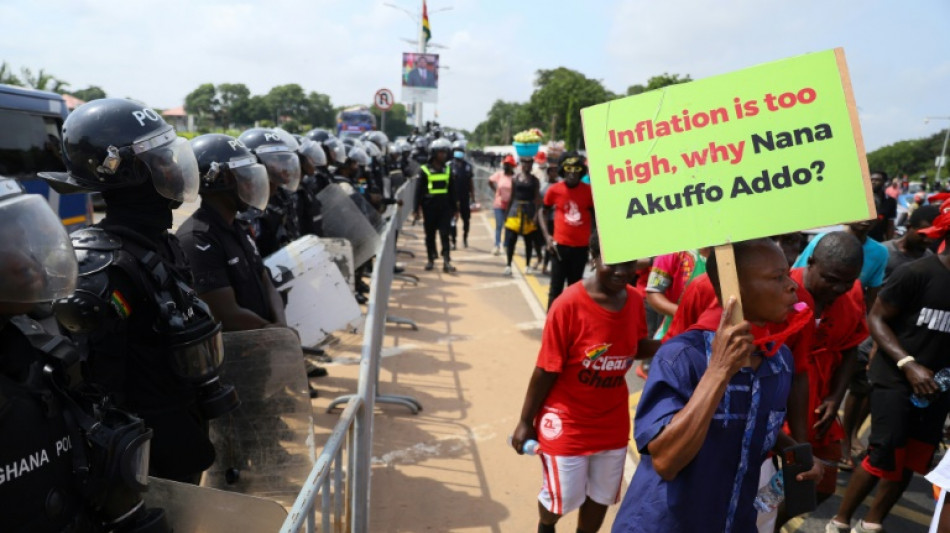
Ghana IMF loan outcry pressures government over economy / Photo: © AFP/File

 FIFA chief Infantino hit by Norwegian double complaint

 Exiled Catalan separatist leader Puigdemont cleared to return to Spain
 Stock markets climb as oil prices retreat
 'No future': Thousands mass in France for high school protests
 Nobel physics prize honours work on 'ghostly messengers' from outer space

 Bulgaria searches for missing crew after drones hit two more ships in Black Sea
 Le Pen vows drastic cost savings to prevent French 'default'

 'Eats through a straw': French teens wounded in high school protests
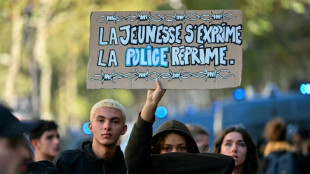 Thousands mass in France for high school protests
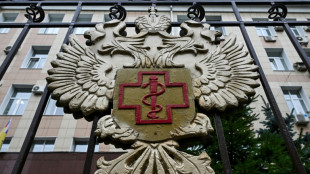 Moscow denies sanitary measures over plague reports
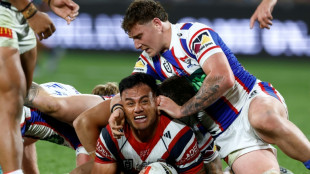 Samoa look to recreate 2022 final run at Rugby League World Cup
 Asian stocks mostly up after tech-led Wall St record
 German factory orders plunge as recovery still fragile
 Coco Gauff calls out online racism following China open video review
 KVB Accelerates Middle East Footprint with Strategic MENA Regional Expansion
 Purple reign: Philippines seeks to keep grip on ube throne
 Seoul weighs steps to force North Korea landmine apology
 Yemen's Houthis say struck Riyadh airport, other Saudi sites

 Changer+ Launches Stablecoin-First Self-Custodial Wallet to Make Stablecoins Easier to Use
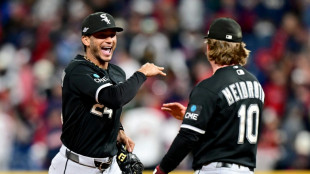 White Sox down Guardians, Yankees on brink after Rays loss
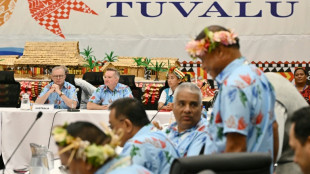
 COP31 eyes modest steps as climate disasters multiply
 American Nobel laureate in medicine hopes to illuminate the brain
 Trump approves firing squad for convicted US military base shooter
 Grappling with 'homework scams,' US universities shun AI detectors
 Separatists win Quebec election in test for Canada PM
Ghanaian trader Mohammed Biney was already struggling when the government passed a new tax on electronic money transactions this year to try to revive the economy.
With Ghana now buckling under nearly 30 percent inflation, the Accra shoe seller was shocked when the government announced in July it would have to seek help from the IMF.
President Nana Akufo-Addo once promised "Ghana Beyond Aid" to keep his West African country off foreign aid dependency.
But a sudden U-turn over an IMF credit has sparked fierce debate over his economic management as Ghana struggles with the highest costs of living in two decades.
"You can’t impose taxes on us under the guise of saving the economy and then overnight come and tell us you’re going to the IMF," trader Biney told AFP.
"I think they ran out of ideas."
Hit by the global pandemic and fallout from the Russian war in Ukraine on fuel and food prices, Ghana is in talks with International Monetary Fund to help stabilise its public finances.
But the decision prompted fears IMF-imposed austerity measures will force the end to Akufo-Addo's social programmes and hurt Ghanaians already struggling with soaring costs.
A new opposition-led protest movement and unions threatening strikes over hardships have added pressure on the government just as an IMF team begins initial talks.
Saddled with heavy debt, limited access to fresh funds and few revenue options, the government says the IMF offers short-term help.
Ghana's Deputy Finance Minister Abena Osei-Asare said after the pandemic eroded economic gains, the IMF deal would help with balance of payments and open the door to new financing while protecting social programmes.
"People don’t have an understanding of the sort of engagement we’re going to have with the IMF that’s why they are a bit apprehensive," she told AFP.
- Soaring inflation -
Ghana's economic data is not rosy. Growth slowed this year while inflation broke two decade highs at 29.8 percent in June, driven by transport and food costs.
Ghana's debt to GDP ratio -- a measure of what it owes against what it produces -- rose from 65 percent to 80 percent during the pandemic, the IMF says.
Moody's credit agency in February downgraded its outlook on Ghana's bonds, citing the government's liquidity and debt challenges.
"Ghana’s fiscal and debt vulnerabilities are worsening fast amid an increasingly difficult external environment," the IMF said after the team's visit this month.
"An IMF-supported program aims to provide space for Ghana to implement policies."
This deal will be the 18th time Ghana has gone to the IMF after completing a three-year accord in 2019 which saw $918 million in support.
Just in May, Finance Minister Ken Ofori-Atta said an IMF deal was not an option, with the government preferring "home-grown" solutions.
One of those, Ghana's new electronic transaction tax or E-levy, was meant to help raise $900 million in much-needed revenue along with spending cuts.
But the tax was widely criticised and as people curtailed electronic payments, the E-levy has also fallen far short of revenue estimates.
Gabby Otchere-Darko, a leading ruling party member, tweeted in June the tax had only generated 10 percent of estimated revenues.
"Given the situation that we find ourselves... we have no option," John Kwakye, the director of research at the Accra-based IEA think tank, said of the IMF deal.
"Going to the IMF was to build on our credibility."
- Electoral fallout? -
But even with elections still two years away, an IMF deal will likely have political fallout.
Teaching unions went on strike earlier this month until the government agreed to cost of living allowances. Other public sector workers are threatening action.
A "Fix the Country" movement, which holds regular if small protests, has been joined by another group "Arise Ghana". Last month its rally over economic hardships led to clashes with the police.
"The solution to Ghana’s problems doesn’t lie in Washington," Yaw Baah, Secretary General of the Trades Union Congress (TUC) said. "This is a tragic mistake by the government."
Eurasia Group's Africa head Amaka Anku told clients the IMF programme will make it harder for Akufo-Addo's New Patriotic Party to argue they are better economic managers.
That may weaken the position of likely NPP candidate for 2024 Vice President Mahamudu Bawumia though his probably opponent National Democratic Congress or NDC leader and ex-president John Mahama also faces challenges.
"Bottom-line, this makes for a very close election in 2024," Anku said.
Already the opposition has hit out.
"President Akufo-Addo and Dr. Mahamudu Bawumia should take full responsibility for incompetently managing the economy," said NDC lawmaker Haruna Iddrisu.
"The government must come clean and tell us what the people of Ghana should expect instead of blaming Ukraine and Russia."
J.Horn--BTB