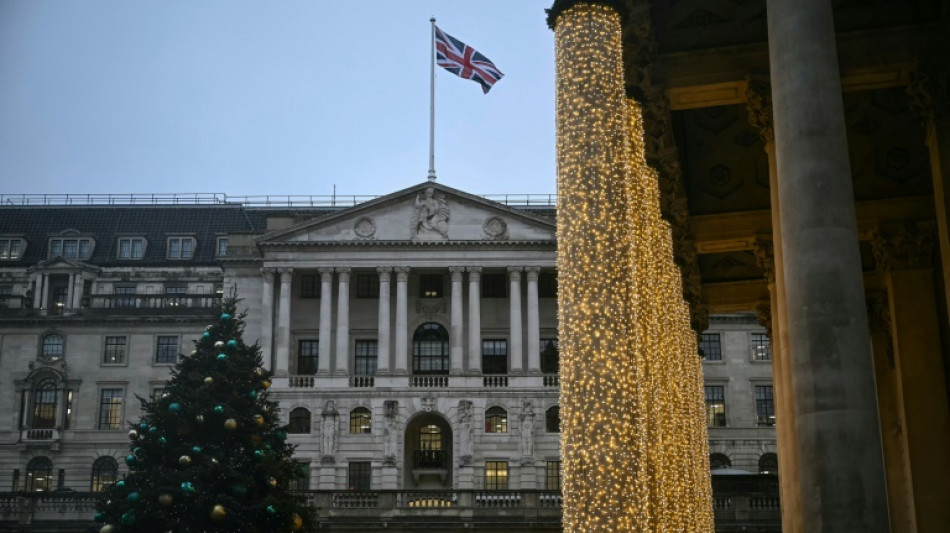
Bank of England cuts interest rate after UK inflation slides / Photo: © AFP

 Rubio in Greece to urge against Western civilisation 'decline'

 Micron workers at Taiwan plant vote in favour of strike

 In 'The Social Reckoning,' Jeremy Allen White takes on Facebook's 'frightening' ambition

 Chip industry activists call for South Korea to recognise cancer cases
 Famine-scarred southern Madagascar braces for El Nino

 How the EU regulates lobbyists

 I.Coast refuge offers lifelong care for youngsters scorned as 'sorcerers'

 Indian central bank hikes rates for first time in more than 3 years

 Hotel Blacklist Launches New Accommodation Industry Risk Assessment Tool

 Bangladesh nuclear plant draws hope -- and worry

 US beat Canada 1-0 to wrap up four-win international break

 Turkey, Australia's joint COP31 leadership raises doubts

 For Turkish NGOs, COP31 offers rare space for action

 Sleep, appetite, gene-editing experts contend for Nobel chemistry prize

 Nobel Peace Prize haunted by the 'spectre' of Trump

 Africa launches own credit agency in bid for cheaper borrowing

 US, China, EU: three paths to regulating AI

 Australia's High Court rules against coal mine in landmark climate case

 Australia touts new funds for Pacific infrastructure at Fiji 'pre-COP'

 Eva Marie Saint, Oscar winner of Hollywood classics, dies at 102

 Australia probes app used in cheap smart glasses over privacy fears
 England needed to 'move on' from World Cup pain, says Tuchel

 O'Neill to stay at Celtic after period of "reflection"

 Kane marks 125th England cap with Wembley Nations League double

 Quebec's incoming separatist leader wants to block Crown from swearing-in

The Bank of England cut its key interest rate to 3.75 percent on Thursday after UK inflation eased faster than expected and as the economy weakens.
"We've passed the recent peak in inflation and it has continued to fall, so we have cut interest rates," BoE governor Andrew Bailey said.
The widely expected quarter-point reduction followed a regular policy meeting and came ahead of the European Central Bank's rate decision Thursday.
Expectations for the reduction were cemented by official data Wednesday showing Britain's annual inflation rate had slowed more than expected to 3.2 percent in November.
Analysts forecast the BoE to cut borrowing costs further next year with UK inflation set to move closer to the central bank's two-percent target.
Thursday's decision marks the sixth reduction since the BoE began a trimming cycle in August 2024, one month after Britain's Labour party won a general election.
In a close result, policymakers including Bailey voted 5-4 for a cut Thursday. Four members of the Monetary Policy Committee voted to hold borrowing costs at 4.0 percent.
"We still think rates are on a gradual path downward," Bailey said.
"But with every cut we make, how much further we go becomes a closer call."
The central bank last cut its key interest rate in August amid concerns over the impact of US tariffs on the UK economy.
- Sluggish economy -
A cut to interest rates eases pressure on Prime Minister Keir Starmer, who has struggled to revive Britain's sluggish economy since Labour came to power in July 2024.
"Inflation is coming down and looks to be supportive to future rate cuts," said Lindsay James, investment strategist at Quilter.
"With economic growth also in the doldrums, and showing no sign of improvement in 2026, there will be a huge amount of pressure on the Bank of England to help stimulate some sort of economic activity," she added.
Finance minister Rachel Reeves welcomed the rate cut but acknowledged in a statement that "there's more to do to help families with the cost of living".
Reeves raised taxes on businesses in her inaugural budget last year -- a decision widely blamed for causing weak UK economic growth and rising unemployment.
She returned in her November budget with fresh tax hikes to bring down government debt, this time hitting workers.
While a cut to the interest rate can help individuals and businesses taking out loans, it reduces returns on savings deposited in banks.
Britain's retail banks tend to mirror changes to BoE monetary policy on their accounts, including for mortgages.
Elsewhere, the ECB is set to hold interest rates steady Thursday for a fourth meeting in a row as eurozone inflation remains in check.
With the hold likely a done deal, investors will be paying close attention to ECB President Christine Lagarde's press conference for any hints on the path forward after Governing Council members gave conflicting signals.
Friday will likely see the Bank of Japan hike its key rate to a 30-year high as the country's inflation stays high and after BoJ governor Kazuo Ueda said the impact of US tariffs was less than feared.
M.Odermatt--BTB