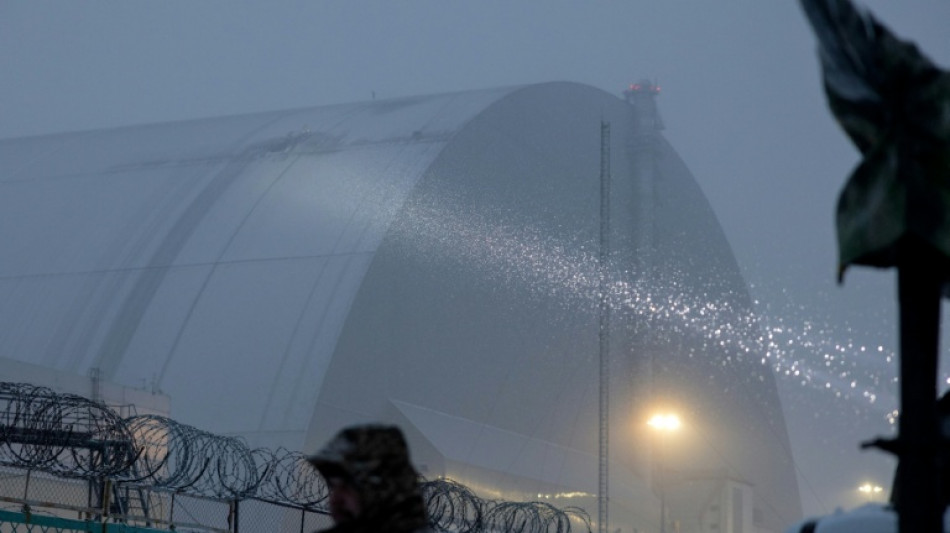
Russian strike could collapse Chernobyl shelter: plant director / Photo: © AFP

 Chip industry activists call for South Korea to recognise cancer cases

 Famine-scarred southern Madagascar braces for El Nino
 How the EU regulates lobbyists

 I.Coast refuge offers lifelong care for youngsters scorned as 'sorcerers'

 Indian central bank hikes rates for first time in more than 3 years

 Hotel Blacklist Launches New Accommodation Industry Risk Assessment Tool

 Bangladesh nuclear plant draws hope -- and worry

 US beat Canada 1-0 to wrap up four-win international break

 Turkey, Australia's joint COP31 leadership raises doubts

 For Turkish NGOs, COP31 offers rare space for action

 Sleep, appetite, gene-editing experts contend for Nobel chemistry prize
 Nobel Peace Prize haunted by the 'spectre' of Trump

 Africa launches own credit agency in bid for cheaper borrowing

 US, China, EU: three paths to regulating AI

 Australia's High Court rules against coal mine in landmark climate case

 Australia touts new funds for Pacific infrastructure at Fiji 'pre-COP'

 Eva Marie Saint, Oscar winner of Hollywood classics, dies at 102

 Australia probes app used in cheap smart glasses over privacy fears

 England needed to 'move on' from World Cup pain, says Tuchel

 O'Neill to stay at Celtic after period of "reflection"

 Kane marks 125th England cap with Wembley Nations League double

 Quebec's incoming separatist leader wants to block Crown from swearing-in

 Emmys gala will now stream its premier television awards

 Paramount completes Warner Bros takeover, creating Skydance
 Trump blames France unrest on Islam, migration

A Russian strike could collapse the internal radiation shelter at the defunct Chernobyl nuclear power station in Ukraine, the plant's director has told AFP.
Kyiv has accused Russia of repeatedly targeting the facility, the site of a 1986 meltdown that is still the world's worst ever nuclear disaster, since Moscow invaded in February 2022.
A hit earlier this year punched a hole in the outer radiation shell, triggering a warning from the International Atomic Energy Agency (IAEA) that it had "lost its primary safety functions."
In an interview with AFP, plant director Sergiy Tarakanov said fully restoring that shelter could take three to four years, and warned that another Russian hit could see the inner shell collapse.
"If a missile or drone hits it directly, or even falls somewhere nearby, for example, an Iskander, God forbid, it will cause a mini-earthquake in the area," Tarakanov told AFP in an interview conducted last week.
The Iskander is Russia's short-range ballistic missile system that can carry a variety of conventional warheads, including those to destroy bunkers.
"No one can guarantee that the shelter facility will remain standing after that. That is the main threat," he added.
The remnants of the nuclear power plant are covered by an inner steel-and-concrete radiation shell -- known as the Sarcophagus and built hastily after the disaster -- and a modern, high-tech outer shell, called the New Safe Confinement (NSC) structure.
The roof of the NSC was severely damaged in a Russian drone strike in February, which caused a major fire in the outer cladding of the steel structure.
"Our NSC has lost several of its main functions. And we understand that it will take us at least three or four years to restore these functions," Tarakanov added.
The IAEA said earlier this month an inspection mission found the shelter had "lost its primary safety functions, including the confinement capability, but also found that there was no permanent damage to its load-bearing structures or monitoring systems."
Director Tarakanov told AFP that radiation levels at the site remained "stable and within normal limits."
The hole caused by the drone hit has been covered with a protective screen, he said, but 300 smaller holes made by firefighters when battling the blaze still need to be filled in.
Russia's army captured the plant at the start of its 2022 invasion, before withdrawing a few weeks later.
F.Pavlenko--BTB