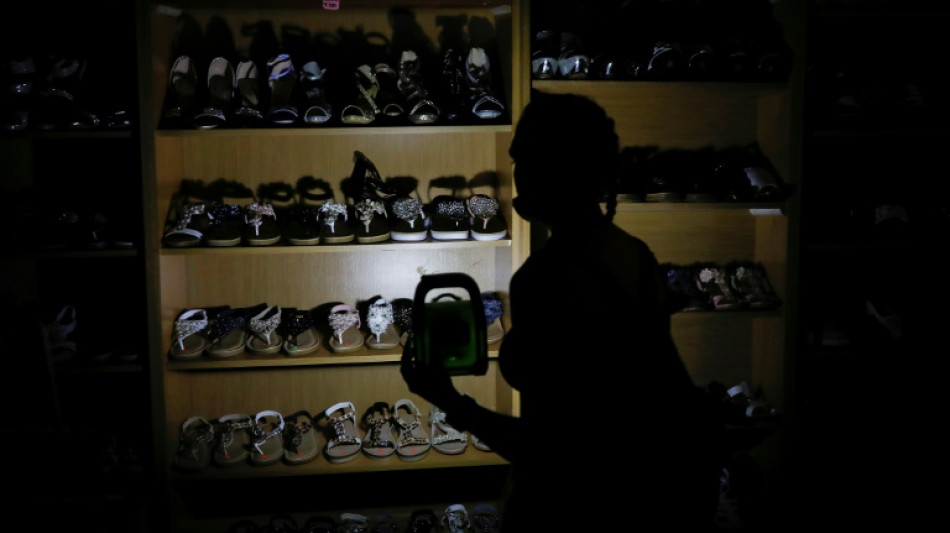
South Africa's power cuts take a toll on mental health / Photo: © AFP/File

 Stocks climb as oil prices retreat

 Vstock Transfer Names Securities Industry Veteran Erica Goodstein General Counsel and Chief Compliance Officer

 Four Indonesian seamen return home after Somali pirate ordeal

 Crisis-striken Haiti postpones elections

 Germany arrests ex-spy chief on suspicion of giving secrets to foreign powers
 Djokovic wins China Open after de Minaur retires
 IMF warns cost-of-living shocks cause 'lasting deterioration' in affordability

 Alcaraz wins Japan Open for first title since injury return
 'We're working to keep football clean', Turkish minister says

 FIFA chief Infantino hit by Norwegian double complaint

 Exiled Catalan separatist leader Puigdemont cleared to return to Spain
 Stock markets climb as oil prices retreat

 'No future': Thousands mass in France for high school protests

 Nobel physics prize honours work on 'ghostly messengers' from outer space

 Bulgaria searches for missing crew after drones hit two more ships in Black Sea
 Le Pen vows drastic cost savings to prevent French 'default'

 'Eats through a straw': French teens wounded in high school protests
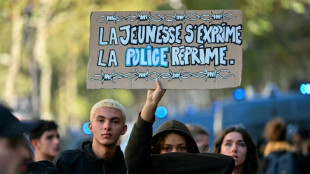 Thousands mass in France for high school protests

 Moscow denies sanitary measures over plague reports
 Samoa look to recreate 2022 final run at Rugby League World Cup

 Asian stocks mostly up after tech-led Wall St record

 German factory orders plunge as recovery still fragile
 Coco Gauff calls out online racism following China open video review
 KVB Accelerates Middle East Footprint with Strategic MENA Regional Expansion

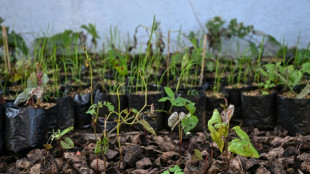 Purple reign: Philippines seeks to keep grip on ube throne

You can't do your work because there's no power. You eat late and bolt your food before the lights fail. And then to be at home, in the utter dark, gives you the creeps.
As blackouts unfurl across South Africa, triggered by problems that have overwhelmed its energy provider, stress is taking a mounting toll on mental health, experts say.
"People are frustrated, some (are) angry, some are experiencing symptoms" of post-traumatic stress disorder, said Sinqobile Aderinoye, a psychologist in Johannesburg.
"The consistent on-and-off of the electric grid is creating an air of disillusionment."
South Africa has struggled for years with power cuts, known here as load-shedding, as as its monopoly utility Eskom failed to keep pace with demand.
But ageing infrastructure and labour disputes have added to the crisis -- and in recent weeks, the country has been hit by rolling blackouts that can last up to nine hours a day.
"There was a time ... I felt like I was going to scream," said Blessed Dlamini, a 25-year-old father living in downtown Johannesburg.
For five hours, he recalled, he had no power as he struggled to work and at the same time deal with a hungry two-year-old.
"It was very, very hectic," said Dlamini who works for a sexual health centre.
Blackouts eased this week, with cuts reduced to about two hours a day.
But the schedule of cuts provided by Eskom is not always followed, giving rise to an unpredictability that leaves many people on edge.
The crisis "is leading to feelings of hopelessness, which is associated with depression," said Claire Lownie, a psychiatrist in Johannesburg's financial centre, Sandton.
- Fight-or-flight-
Plunged into darkness with a sense of unmet basic needs, the human brain can be triggered into survival mode, leading to a fight-or-flight response, explained Aderinoye.
"The brain starts to think we are under attack. The body is then notified that we are in danger and we create an anxiety response," she said.
At work, on the streets or around the dinner table, swapping tips on how to cope with blackouts has become a national pastime.
Some people prefer the romantic feel of candles to light their homes, while others resort to camping lanterns.
Others debate whether coughing up money for take-out meals is preferable to investing in gas cookers or simply eating at odd hours.
Yet, in a country burdened by high crime rates, outages aren't a simple inconvenience. Fear of burglary, assault or rape runs deep.
"You cannot go around when it's dark," said Flora Sithole, 30, a domestic worker employed in the upmarket Johannesburg suburb of Rosebank.
"We are so afraid of that -- it's not safe. Our country is not safe."
The added stress caused by power cuts often compounds an already precarious situation, psychologists say.
Anxiety, depression and other disorders were already up almost two-thirds since the start of the coronavirus pandemic, according to Cheryl Johnston, a Johannesburg-based psychologist.
"A lot of people are at or crossing over (their) breaking point," she said.
The result can be "abnormal behaviour" as well as angry or violent outbursts, Johnston said.
Having a plan and being prepared to deal with the cuts is the best way to cope, according to health experts.
Dlamini said he has joined Twitter to follow the city's electricity updates more closely.
Better mental health awareness is also crucial, Johnston said.
"Being able to be honest with yourself about the emotions that you're having and waiting for yourself to be calm before taking action… is best thing you can do," she said.
E.Schubert--BTB