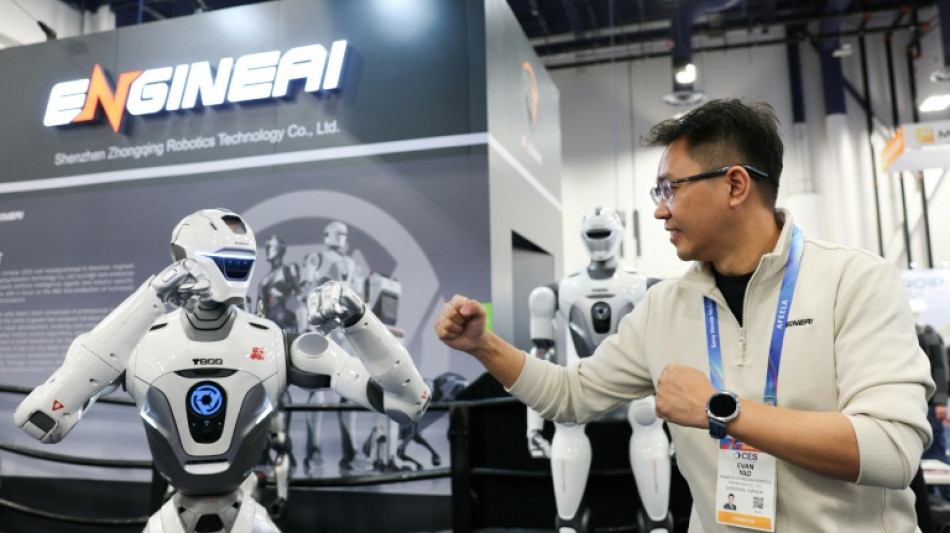
Dancing isn't enough: industry pushes for practical robots / Photo: © AFP

 Turkey, Australia's joint COP31 leadership raises doubts

 For Turkish NGOs, COP31 offers rare space for action

 Sleep, appetite, gene-editing experts contend for Nobel chemistry prize

 Nobel Peace Prize haunted by the 'spectre' of Trump

 Africa launches own credit agency in bid for cheaper borrowing

 US, China, EU: three paths to regulating AI

 Australia's High Court rules against coal mine in landmark climate case

 Australia touts new funds for Pacific infrastructure at Fiji 'pre-COP'

 Eva Marie Saint, Oscar winner of Hollywood classics, dies at 102

 Australia probes app used in cheap smart glasses over privacy fears

 England needed to 'move on' from World Cup pain, says Tuchel

 O'Neill to stay at Celtic after period of "reflection"

 Kane marks 125th England cap with Wembley Nations League double

 Quebec's incoming separatist leader wants to block Crown from swearing-in

 Emmys gala will now stream its premier television awards

 Paramount completes Warner Bros takeover, creating Skydance

 Trump blames France unrest on Islam, migration

 Apple's Cook praises EU over efforts to protect children online

 Nobel winner Halzen says years of October 'misery' finally over

 Quebec separatist win rattles Carney's unity push

 'Itching' for change: Shiffrin cuts back slaloms this season

 'Gen Z has risen up': Tens of thousands mass for tense France school protests

 Caribbean tourism hotspot loses men to Russian war machine

 Danish reservists practice war games to respond to 'aggression'

 Bhuvneshwar returns to India's T20 squad for New Zealand tour

Humanoid robots danced, somersaulted, dealt blackjack and played ping-pong at the Consumer Electronics Show this week, but some in the industry are impatient for them to become more useful, not just a promise of things to come.
As robots take their usual spotlight at the annual CES gadget fest, insiders caution that making them truly like humans will take several more years and require lots of training.
To become autonomous, humanoid robots need AI that translates what is seen and heard into actions, which is beyond the scope of today's large language models that power tools like ChatGPT.
Training a large language model relies on massive amounts of data -- mainly vacuumed up from the internet -- that is of little use when it comes to human-like robots seeking to be useful in the kitchen or on a factory floor.
"If you want (robots) to learn embodied things, you have to put them inside a body," said Henny Admoni, an associate professor at the robotics institute at Carnegie Mellon University.
Humanoid Guide founder Christian Rokseth, who specializes in the technology, likened the situation to locking a child in a room and expecting it to learn about the world.
Even if the pace of development accelerated last year, particularly on the hardware side, Rokseth expressed a degree of impatience about innovation.
"They've shown robots dancing and doing kung fu; now show us that they can be productive," Rokseth said.
EngineAI founder Evan Yao told AFP that the Shenzhen-based company is working with tech titans such as Amazon and Meta to give its creations AI brains.
"We are trying to simulate humans, but the robots will never become human," Yao told AFP as one of his robots kicked in his direction.
"Because a human is emotional and much more."
Nearby, Yiran Sui was part of a Robotera team whose humanoid robot, developed for researchers, is training to complete the Beijing marathon a few months from now.
- Factories first? -
According to the Consumer Technology Association that runs CES, the robotics industry is showing dynamism and potential.
It projects the global market will hit $179 billion by 2030.
The bulk of that growth is expected in factories, warehouses and other business operations, where robots -- not necessarily humanoid ones -- work in controlled environments.
But for Artem Sokolov, founder of the Humanoid robotics startup based in London, humans work in factories so robots copying their bodies can thrive there too.
South Korean automotive giant Hyundai used CES to unveil a humanoid robot called Atlas, created in collaboration with Boston Dynamics, that it plans to test in factories.
Given the training limitations, industry trackers advise caution when it comes to companies claiming to have humanoid robots that can operate without flesh-and-blood managers overseeing them.
"There has been a ton of new companies claiming that they are developing autonomous humanoid robots," Admoni told AFP.
But "these systems tend to be teleoperated; you have a person in a suit or using controllers and every movement of that person is then translated into the robot."
To solve the training problem, new startups are using methods such as having people wear cameras and haptic gloves while doing chores at home, according to Rokseth.
"To make robots general machines, they need to be let out in the real world," Rokseth said, not just assembly lines or warehouses.
L.Janezki--BTB