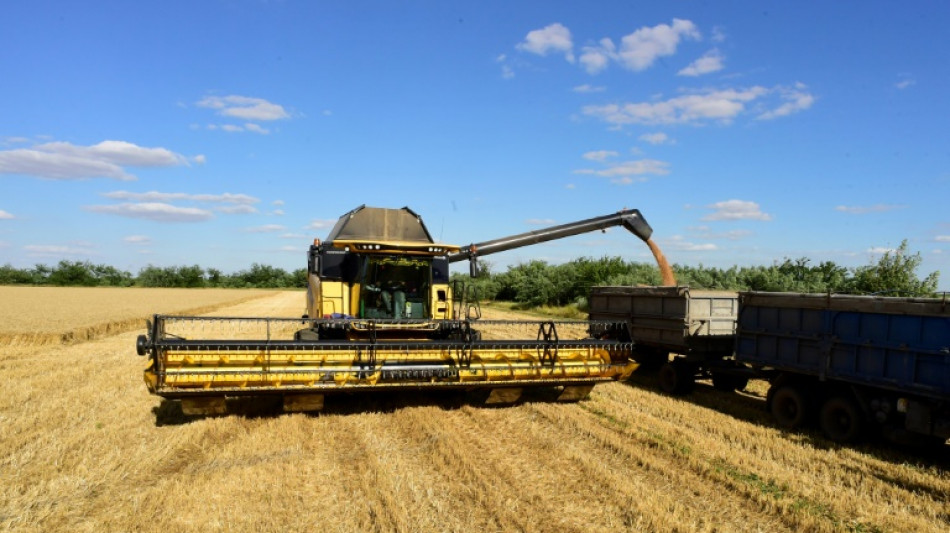
New customers: in occupied Ukraine, grain is sold to Russia / Photo: © AFP

 Stocks climb as oil prices retreat
 Vstock Transfer Names Securities Industry Veteran Erica Goodstein General Counsel and Chief Compliance Officer

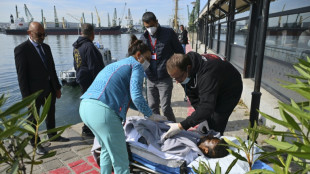
 Four Indonesian seamen return home after Somali pirate ordeal

 Crisis-striken Haiti postpones elections

 Germany arrests ex-spy chief on suspicion of giving secrets to foreign powers
 Djokovic wins China Open after de Minaur retires
 IMF warns cost-of-living shocks cause 'lasting deterioration' in affordability
 Alcaraz wins Japan Open for first title since injury return
 'We're working to keep football clean', Turkish minister says

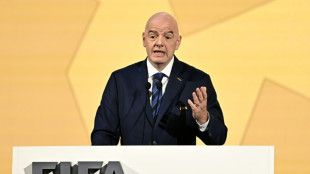 FIFA chief Infantino hit by Norwegian double complaint

 Exiled Catalan separatist leader Puigdemont cleared to return to Spain
 Stock markets climb as oil prices retreat

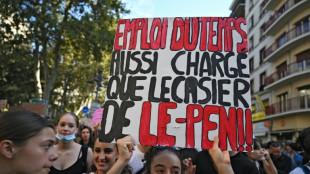 'No future': Thousands mass in France for high school protests
 Nobel physics prize honours work on 'ghostly messengers' from outer space

 Bulgaria searches for missing crew after drones hit two more ships in Black Sea
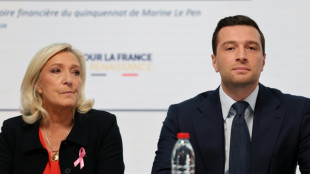 Le Pen vows drastic cost savings to prevent French 'default'

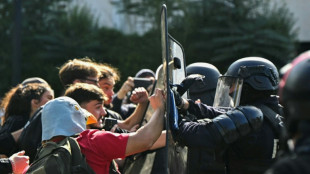 'Eats through a straw': French teens wounded in high school protests
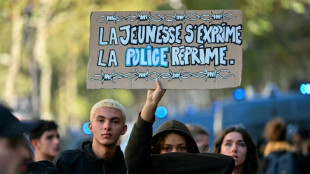 Thousands mass in France for high school protests

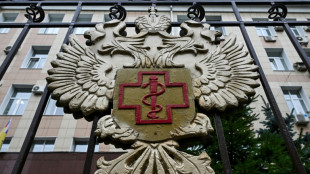 Moscow denies sanitary measures over plague reports
 Samoa look to recreate 2022 final run at Rugby League World Cup

 Asian stocks mostly up after tech-led Wall St record

 German factory orders plunge as recovery still fragile
 Coco Gauff calls out online racism following China open video review

 KVB Accelerates Middle East Footprint with Strategic MENA Regional Expansion
 Purple reign: Philippines seeks to keep grip on ube throne
In an east Ukrainian village under Russian control, farm manager Viktor Molotok is surrounded by several tonnes of grain, piled up around him in mounds.
"We won't go hungry, that's certain," he said, laughing. "But Europe... I'm not so sure."
AFP met Molotok during a tightly-controlled press tour organised by the Russian army.
He manages a 5,500-hectare farm in the village of Kalmykivka, in eastern Ukraine's Lugansk region that Moscow claimed full control of in early July.
Wearing a chequered shirt, Molotok avoids all talk of politics and says that -- despite the Russian offensive -- business is going well.
What has changed, he said, are his customers.
He now sells his grain and sunflower seeds to Russian clients.
"Our company is working as it used to work," he said, adding that "not a single" worker had left.
Molotok said he had to look for "new logistics" and that he was in touch with Russian firms.
"Whoever gives the best price, that's where we will sell."
Ukraine, often called Europe's "breadbasket", is one of the world's main grain producers.
Moscow's offensive has massively hampered grain exports and sparked hunger fears far beyond the warring countries.
Thousands of tonnes of grain have been stuck in blocked Ukrainian ports since President Vladimir Putin launched the assault in late February.
On Friday, Moscow and Kyiv signed an agreement to open maritime export routes -- the first major accord between the warring parties.
Kyiv accuses Moscow of stealing its crops in occupied territories for its own consumption or to resell abroad and even of bombing its fields to damage harvests.
Moscow has denied the claims.
- 'Maybe Africa or Asia' -
Farmer Molotok says he does not know what happens to his grain once it reaches Russia.
He does not rule out that it could be re-sold further afield.
"We sell through traders to Russia. I cannot say for sure where this production goes," he said.
"Maybe they take it to Africa or Asia, I don't know."
Since the start of the year, he has sold 800 tonnes of sunflower seeds to Russia, through companies in territory held by pro-Russia separatists.
Though workers say there was no fighting when Kalmykivka fell to Russian troops and AFP saw no sign of destruction, heavy battles took place just a few dozen kilometres away.
Molotok said farmers "heard echoes of artillery" during weeks-long battles for Lysychansk, a city that fell to Moscow's forces in early July.
Alexander, a 21-year-old seasonal worker at the farm who preferred not to give his last name, said there was "panic" in the village at the start of Moscow's intervention.
But now, he said as he swept bits of grain off the floor, people have "got used" to the Russian army's presence.
Alexander, who spoke a mix of Russian and Ukrainian typical for the region, said he was promised a salary in rubles but did not know how much he would receive.
Though spared from armed clashes, the farm's crops have suffered from low rainfall, with production reduced by around 15 percent compared to the previous year, according to Molotok's estimates.
- Russian empire past -
Six hundred kilometres away in the southeastern region of Zaporizhzhia, partially controlled by Moscow, wheat fields stretch as far as the eye can see.
A combine harvester engulfs heavy ears of corn with a loud sound of clanking metal.
Trucks unload their cargo in industrial yards in the city of Melitopol, which fell to Russian troops in the first week of Moscow's offensive.
At a plant in the city, wheat is processed into flour.
Employees in masks and headbands fill the bags with the white powder, then line them up to be taken away.
Melitopol is lined with Russian flags and banners that read "220 years of the Taurida Governorate", a reminder that the territory was once part of the Russian empire.
Andrey Siguta, the pro-Russian head of the Melitopol district administration, seemed satisfied with the flour plant's operations.
He wore a badge with the letter Z -- the symbol of the Russian army fighting in Ukraine -- on his blazer.
He said local grain elevators had signed a deal with authorities.
"We have organised a state-owned grain company that purchases from all elevators in the region," he said.
He added that his priority was now "the food security of the region."
"After that, it will be determined to who and in what volumes we will sell anything," he said.
M.Odermatt--BTB