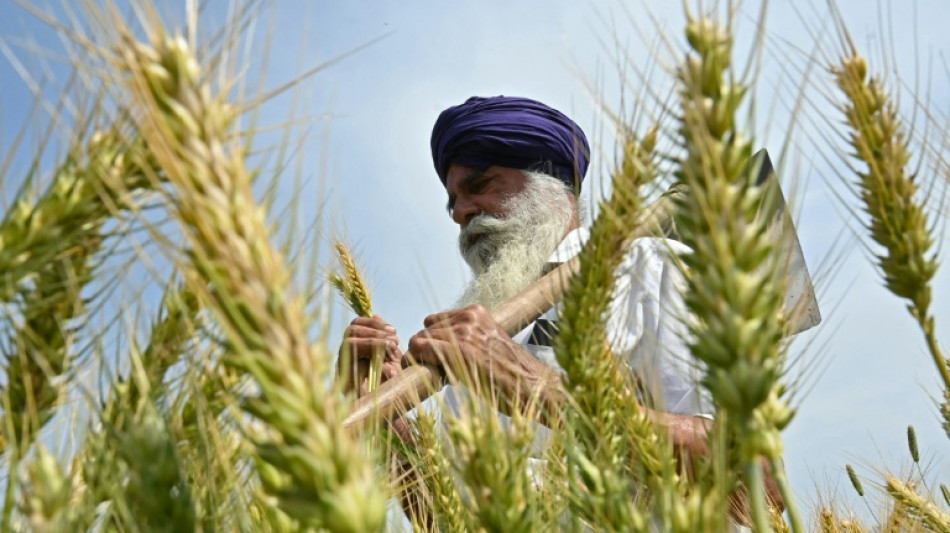
What's at stake for Indian agriculture in Trump's trade deal? / Photo: © AFP/File

 Paris Women's Fashion Week: the key trends

 i-payout Introduces a New Approach to Payments, Closing the Beneficiary Information Gap

 New Generation of Crypto Miners Released by ASICID

 New investor forecasts LIV Golf teams could be worth $100 mn each

 Shakira, Pique return to court over children visit arrangements

 Nobel physics prize hails 'ghostly messengers' from space
 France's Mistral unveils latest model in sovereign AI push

 Stocks climb as oil prices retreat

 Vstock Transfer Names Securities Industry Veteran Erica Goodstein General Counsel and Chief Compliance Officer

 Four Indonesian seamen return home after Somali pirate ordeal

 Crisis-striken Haiti postpones elections

 Germany arrests ex-spy chief on suspicion of giving secrets to foreign powers

 Djokovic wins China Open after de Minaur retires
 IMF warns cost-of-living shocks cause 'lasting deterioration' in affordability

 Alcaraz wins Japan Open for first title since injury return
 'We're working to keep football clean', Turkish minister says

 FIFA chief Infantino hit by Norwegian double complaint

 Exiled Catalan separatist leader Puigdemont cleared to return to Spain

 Stock markets climb as oil prices retreat

 'No future': Thousands mass in France for high school protests

 Nobel physics prize honours work on 'ghostly messengers' from outer space

 Bulgaria searches for missing crew after drones hit two more ships in Black Sea
 Le Pen vows drastic cost savings to prevent French 'default'

 'Eats through a straw': French teens wounded in high school protests

 Thousands mass in France for high school protests

Indian farmers have expressed concern that New Delhi has made too many concessions to Washington after the two countries brokered a new trade deal that would lower tariffs.
Under the terms of the deal that was laid out in a joint statement from both countries released on Saturday, India will "eliminate or reduce tariffs on all US industrial goods" and other food and agricultural products.
Meanwhile, the US will apply a reciprocal tariff rate of 18 percent on goods from India, including textiles and apparel, leather and footwear, plastic and rubber, organic chemicals, and certain machinery, the joint statement added.
The terms were released after US President Donald Trump announced a trade deal with India, stating that Prime Minister Narendra Modi had promised to halt Russian oil purchases.
Modi lauded the new trade deal in a post on the social media platform X later on Saturday, saying it would open up opportunities and generate jobs.
But Indian farmer unions weren't convinced, calling the deal a "total surrender" to American agricultural giants.
"Indian industry, agriculture... are now under grave threat of cheap imports that will be dumped into Indian markets," the Samyukt Kisan Morcha (SKM), a coalition of multiple farmers' unions, said in a statement following the announcement.
The group also called on farmers to join a nationwide protest on February 12.
- What's on the table? -
The joint statement states that India will "eliminate or reduce" tariffs on a "wide range of US food and agricultural products".
This includes tree nuts, some fresh fruit, soybean oil, wine, spirits and other "additional products" that were not specified.
Siraj Hussain, a former agriculture ministry top official, said Indian consumers were purchasing more nuts, "so it's import may not have much impact on local production", and will help satisfy high demand.
Domestic growers do worry, however, about cheap imports on items such as apples, which they believe could have dire impacts on local producers.
"Import of fresh fruits such as apples... will ruin the farmers," SKM said. Officials hope safeguards included into the agreement -- such as import quotas or minimum import prices for commodities including apples -- will reduce the impact of foreign competition.
New Delhi's promise of lower duties on dried distillers' grains and red sorghum for animal feed could also reduce the need for local soybean meal.
Opposition lawmaker Jairam Ramesh said the move to ease imports of dried distillers' grains and soybean oil would hurt "millions of soybean farmers" in key Indian states such as Maharashtra and Madhya Pradesh.
- What's off the table? -
To stem concerns, India's Trade Minister Piyush Goyal reassured farmers that their interests would be safeguarded, adding that the key red lines that had been drawn by New Delhi had not been crossed.
He said "no concessions" had been extended in "sensitive areas" such as grains, spices, dairy, poultry, meat and several vegetables and fruits -- including potatoes, oranges and strawberries.
The trade minister also said genetically modified crops were not part of the agreement.
This includes GM soybean, which the US has searched hard to find new markets for.
- Small farms 'can't compete' -
While the farm sector contributes just 16 percent to India's GDP, it provides livelihood to over 45 percent of the population.
This makes the industry a key voting bloc often wooed by political parties. Farmer groups have also shown, on multiple occasions, that they are a street force to be reckoned with.
In 2021, the government abandoned plans to reform the sector after months of intense protests that blocked the national capital's highways and led to Delhi's historic Red Fort complex being stormed by tractors.
"Indian farms are very small and they can't really compete with highly subsidised US agriculture," Hussain, the former agriculture ministry official, said.
- India and US trade -
Between January-November 2025, when New Delhi was negotiating with Washington, Indian imports of American agricultural goods rose 34 percent year-on-year, raking in just under $2.9 billion.
Top imports included cotton, soybean oil, ethanol and various nuts such as almonds. This happened even before the trade deal, although the rise is partly due to India reducing tariffs on some of these US items.
Experts have said that a further reduction on duties for products such as soybean oil, which was announced in the joint statement, will likely lead to a jump in goods being imported by India from the US.
G.Schulte--BTB