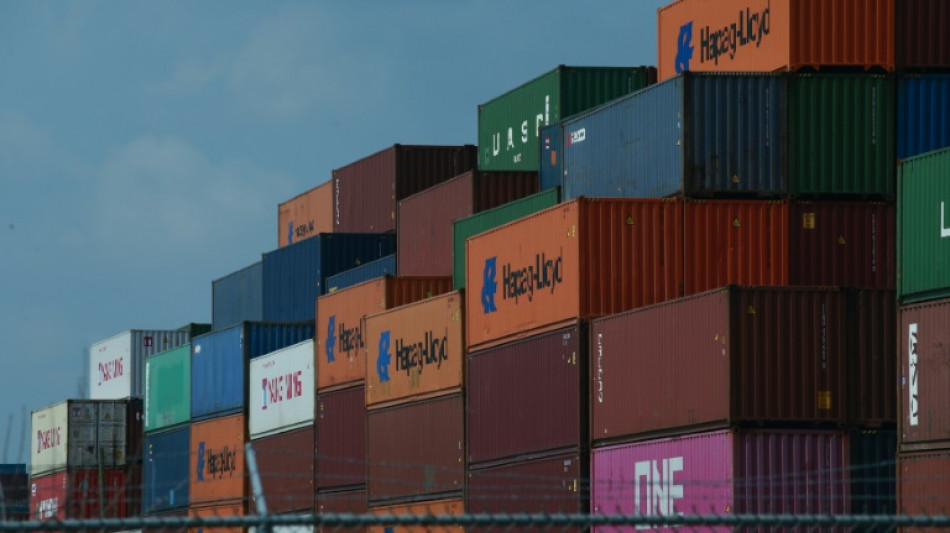
No slowdown yet: US import deluge tests supply chain / Photo: © AFP/File

 Paris Women's Fashion Week: the key trends

 i-payout Introduces a New Approach to Payments, Closing the Beneficiary Information Gap

 New Generation of Crypto Miners Released by ASICID

 New investor forecasts LIV Golf teams could be worth $100 mn each

 Shakira, Pique return to court over children visit arrangements

 Nobel physics prize hails 'ghostly messengers' from space
 France's Mistral unveils latest model in sovereign AI push

 Stocks climb as oil prices retreat

 Vstock Transfer Names Securities Industry Veteran Erica Goodstein General Counsel and Chief Compliance Officer

 Four Indonesian seamen return home after Somali pirate ordeal

 Crisis-striken Haiti postpones elections

 Germany arrests ex-spy chief on suspicion of giving secrets to foreign powers

 Djokovic wins China Open after de Minaur retires
 IMF warns cost-of-living shocks cause 'lasting deterioration' in affordability

 Alcaraz wins Japan Open for first title since injury return

 'We're working to keep football clean', Turkish minister says

 FIFA chief Infantino hit by Norwegian double complaint

 Exiled Catalan separatist leader Puigdemont cleared to return to Spain

 Stock markets climb as oil prices retreat

 'No future': Thousands mass in France for high school protests

 Nobel physics prize honours work on 'ghostly messengers' from outer space

 Bulgaria searches for missing crew after drones hit two more ships in Black Sea

 Le Pen vows drastic cost savings to prevent French 'default'

 'Eats through a straw': French teens wounded in high school protests
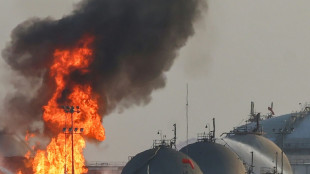
 Thousands mass in France for high school protests
Throngs of 18-wheelers are the clearest sign of brisk activity at the Port Newark-Elizabeth marine terminals in northern New Jersey, defying talk of a US economic slowdown.
Last week, the Port of New York and New Jersey reported that its June 2022 volumes were the second-highest in history, capping a torrid semester that has overtaken the first half of the record-setting 2021 year by 11.4 percent.
"Volumes continue to be extremely strong," said Michael Bozza, assistant director of commercial development at the Port of New York and New Jersey, who nonetheless expects a moderation in activity later in 2022, partly due to inflation.
Bozza said warehouses, freight rail and other supply chain nodes remain "stressed" and are at or near capacity. Some of the cargo is being held for later in the year as importers shift from a "just in time" strategy to "just in case," he said.
A key report Thursday could show the US economy technically entered recession last quarter. But the nation's ports tell a different story.
"Are we seeing an economy that's screeching to a halt? No, we are not," said Phil Levy, chief economist of Flexport, a freight forwarding company. "We are seeing continued imports. We are seeing continued consumption."
That persistent deluge of imports -- which is also playing out at other key US container ports such as Los Angeles and Savannah, Georgia -- is one reason logistics experts remain cautious about the state of the US supply chain, even though ports no longer face the backlogs of last fall.
New problems sometimes surface quickly, as was the case last week, when protests from truckers over a newly implemented California law effectively halted deliveries at the Port of Oakland, another of the nation's larger container ports.
Normal operation has since resumed, but the incident underscores the brittle state of play for overtaxed US infrastructure during the pandemic.
"There's not a lot of slack in the system when something goes wrong," said Sal Mercogliano, a maritime historian at Campbell University in North Carolina.
"While the economy is slowing and inflation is rising, people are still buying a lot."
- Rail bottleneck -
Worries in the United States about the supply chain hit a peak last fall when dozens of stalled vessels of the Ports of Los Angeles and Long Beach sparked worries of a spartan holiday season.
Those fears proved overwrought. To secure merchandise, retailers took extraordinary measures, making greater use of air cargo and in some cases chartering their own vessels to keep store shelves full.
Most major ports no longer have big backlogs, but there are other problems in the system.
Gene Seroka, executive director of the Port of Los Angeles, recently highlighted freight rail delays as a worry. He pointed to an excess of some 20,000 rail containers stuck on the facility.
"We must take action on this immediately to avoid a nationwide logjam," Seroka said two weeks ago.
At least part of the problem in rail transport stems from staff cutbacks at freight rail companies such as CSX and Union Pacific in the years immediately preceding the pandemic.
"The rail is a big piece of why things are still snarled up," said Jason Miller, a supply chain management professor at Michigan State University, who notes that overall freight rail employment is about 40,000 below its level in 2016.
The unresolved state of labor talks between rail companies and rail worker unions also adds unease. The two sides have been unable to reach an accord on a contract to oversee wages, health care and working conditions.
On July 15, President Joe Biden blocked a freight railroad strike for at least 60 days, signing an executive order to establish an arbitration system to resolve the conflict.
Another outstanding labor issue is the contract for West Coast longshoremen, which expired at the end of June. Again, there has been no strike as the two sides continue negotiations.
East Coast ports such as New York and others in the Gulf Coast have picked up incremental business from shippers worried about strike risk, as well as a repeat of last fall's travails in Los Angeles and Long Beach.
Bozza estimates that about seventy percent of the New York and New Jersey port's new volumes in 2022 is displaced cargo from the West Coast.
Despite these issues, Miller does not expect a repeat of last fall's crisis, saying, "We're in a better place than we were eight or nine months ago."
"There's a lot of uncertainty over just how much spending power the US consumer has this holiday season," said Miller, who pointed to China's zero-tolerance Covid-19 policy as another big supply chain wildcard.
But Levy of Flexport notes that port delivery times, while improving, are still running much longer than in the pre-pandemic period.
"We are still experiencing ample supply chain difficulties," Levy said. "Lately, we've seen ports do better and rail do worse."
I.Meyer--BTB