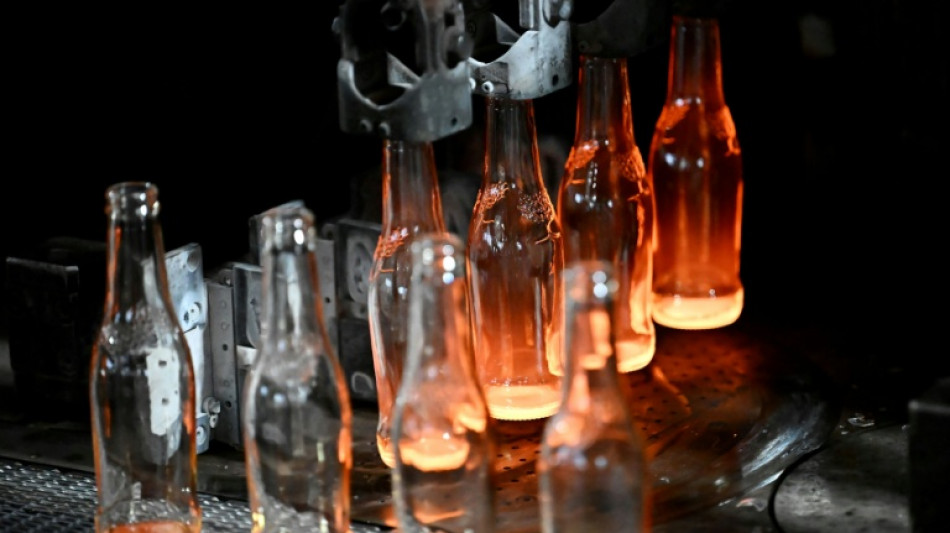
UK manufacturers struggle under sky-high energy bills / Photo: © AFP

 FIFA chief Infantino hit by Norwegian double complaint

 Exiled Catalan separatist leader Puigdemont cleared to return to Spain

 Stock markets climb as oil prices retreat

 'No future': Thousands mass in France for high school protests

 Nobel physics prize honours work on 'ghostly messengers' from outer space

 Bulgaria searches for missing crew after drones hit two more ships in Black Sea

 Le Pen vows drastic cost savings to prevent French 'default'

 'Eats through a straw': French teens wounded in high school protests
 Thousands mass in France for high school protests

 Moscow denies sanitary measures over plague reports

 Samoa look to recreate 2022 final run at Rugby League World Cup

 Asian stocks mostly up after tech-led Wall St record

 German factory orders plunge as recovery still fragile

 Coco Gauff calls out online racism following China open video review

 KVB Accelerates Middle East Footprint with Strategic MENA Regional Expansion

 Purple reign: Philippines seeks to keep grip on ube throne

 Seoul weighs steps to force North Korea landmine apology

 Yemen's Houthis say struck Riyadh airport, other Saudi sites

 Changer+ Launches Stablecoin-First Self-Custodial Wallet to Make Stablecoins Easier to Use

 White Sox down Guardians, Yankees on brink after Rays loss

 COP31 eyes modest steps as climate disasters multiply

 American Nobel laureate in medicine hopes to illuminate the brain

 Trump approves firing squad for convicted US military base shooter
 Grappling with 'homework scams,' US universities shun AI detectors

 Separatists win Quebec election in test for Canada PM

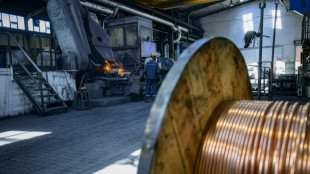
Molten glass drops through chutes before being blown into bottles at manufacturer Encirc's northwest England plant, where intensive operations are under strain from exorbitant energy prices weighing on Britain's heavy industry.
"We're paying a lot more energy costs than our European competitors," said Oliver Harry, head of corporate affairs at Encirc, which makes over a third of the UK's glass bottles.
Britain has some of the highest energy prices in Europe, driven by its reliance on natural gas and the costs of transitioning to renewables, which are passed on to bills.
The country's industrial electricity prices were also the steepest in Europe in 2024, according to the latest annual government data.
Standing in the intense heat of the factory's two huge furnaces, Harry warned: "We're already seeing an increase in imports into the UK as customers turn to cheap, more unsustainable glass producers", notably from China and Turkey.
- More action needed -
Across energy-intensive industries -- from steel and chemicals to glass and cement -- companies are warning that government support does not go far enough to keep them competitive.
The government said it will increase discounts on electricity network charges to 90 percent from April, which will save around 500 of the UK's biggest energy users a cumulative £420 million ($570 million) per year in electricity bills.
"Lowering bills is central to every decision we make," a government spokesperson told AFP.
But the steel sector, already weakened by the closure of traditional coal-fired blast furnaces, argues that more action is needed.
"The industry still faces industrial power prices almost 40 percent higher than in France and Germany," Gareth Stace, director general of the steel union, UK Steel, told AFP.
The union has called for stronger protections similar to those in France, Italy, Spain and the UAE to shield heavy industry from high wholesale power costs.
- Decarbonisation -
Electricity is so expensive in the UK largely because more than a quarter of its power still comes from gas, which surged in price after Russia's 2022 invasion of Ukraine.
While wholesale prices have since fallen, they remain elevated.
Under the liberalised electricity market, the last power station switched on to meet demand sets the price for all generators, and in the UK, that station is usually gas-powered.
"In France, nuclear sets the price fairly often and nuclear is cheaper ... so it's not always the same expensive gas that sets the price," Sam Frankhauser, professor of economics and climate change policy at Oxford University, told AFP.
In other countries "there's moments in the day where somebody cheaper sets the price and in the UK, those moments don't exist" as it is almost always a natural gas plant setting the price, he added.
At Encirc's Elton factory, where bottles clatter along the conveyor belts to be filled and labelled, executives say energy prices are inseparable from the push to decarbonise.
By the end of the decade, "we're going to be producing glass bottles that are 80 percent reduced carbon," said Harry.
"The UK managed to decarbonise the grid phenomenally because of the exit of coal," said Gregor Singer, professor at the London School of Economics.
"It's really unfortunate that this gas price shock came now, exactly at that point where you sort of exited coal but you don't quite have enough renewables yet."
"In the medium to long run... it's almost guaranteed that prices are coming down," he said.
A.Gasser--BTB