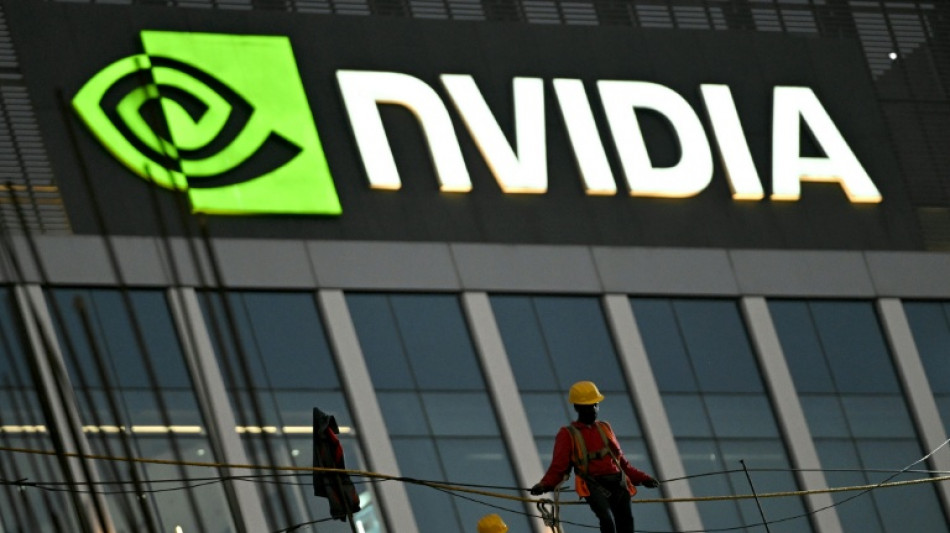
Battered by Gaza war, Israel's tech sector in recovery mode / Photo: © AFP

 FIFA chief Infantino hit by Norwegian double complaint

 Exiled Catalan separatist leader Puigdemont cleared to return to Spain

 Stock markets climb as oil prices retreat

 'No future': Thousands mass in France for high school protests

 Nobel physics prize honours work on 'ghostly messengers' from outer space

 Bulgaria searches for missing crew after drones hit two more ships in Black Sea

 Le Pen vows drastic cost savings to prevent French 'default'

 'Eats through a straw': French teens wounded in high school protests
 Thousands mass in France for high school protests
 Moscow denies sanitary measures over plague reports
 Samoa look to recreate 2022 final run at Rugby League World Cup

 Asian stocks mostly up after tech-led Wall St record

 German factory orders plunge as recovery still fragile
 Coco Gauff calls out online racism following China open video review

 KVB Accelerates Middle East Footprint with Strategic MENA Regional Expansion

 Purple reign: Philippines seeks to keep grip on ube throne

 Seoul weighs steps to force North Korea landmine apology

 Yemen's Houthis say struck Riyadh airport, other Saudi sites

 Changer+ Launches Stablecoin-First Self-Custodial Wallet to Make Stablecoins Easier to Use

 White Sox down Guardians, Yankees on brink after Rays loss

 COP31 eyes modest steps as climate disasters multiply

 American Nobel laureate in medicine hopes to illuminate the brain

 Trump approves firing squad for convicted US military base shooter
 Grappling with 'homework scams,' US universities shun AI detectors

 Separatists win Quebec election in test for Canada PM

Israel's vital tech sector, dragged down by the war in Gaza, is showing early signs of recovery, buoyed by a surge in defence innovation and fresh investment momentum.
Cutting-edge technologies represent 17 percent of the country's GDP, 11.5 percent of jobs and 57 percent of exports, according to the latest available data from the Israel Innovation Authority (IIA), published in September 2025.
But like the rest of the economy, the sector was not spared the knock-on effects of the war, which began in October 2023 and led to staffing shortages and skittishness from would-be backers.
Now, with a ceasefire largely holding in Gaza since October, Israel's appeal is gradually returning, as illustrated in mid-December, when US chip giant Nvidia announced it would create a massive research and development centre in the north that could host up to 10,000 employees.
"Investors are coming to Israel nonstop," Prime Minister Benjamin Netanyahu said at the time.
After the war, the recovery can't come soon enough.
"High-tech companies had to overcome massive staffing cuts, because 15 to 20 percent of employees, and sometimes more, were called up" to the front as reservists, IIA director Dror Bin told AFP.
To make matters worse, in late 2023 and 2024, "air traffic, a crucial element of this globalised sector, was suspended, and foreign investors froze everything while waiting to see what would happen", he added.
The war also sparked a brain drain in Israel.
Between October 2023 and July 2024, about 8,300 employees in advanced technologies left the country for a year or more, according to an IIA report published in April 2025.
The figure represents around 2.1 percent of the sector's workforce.
The report did not specify how many employees left Israel to work for foreign companies versus Israeli firms based abroad, or how many have since returned to Israel.
- Rise in defence startups -
In 2023, the tech sector far outpaced GDP growth, increasing by 13.7 percent compared to 1.8 percent for GDP.
But the sector's output stagnated in 2024 and 2025, according to IIA figures.
Industry professionals now believe the industry is turning a corner.
Israeli high-tech companies raised $15.6 billion in private funding in 2025, up from $12.2 billion in 2024, according to preliminary figures published in December by Startup Nation Central (SNC), a non-profit organisation that promotes Israeli innovation.
Deep tech -- innovation based on major scientific or engineering advances such as artificial intelligence, biotech and quantum computing -- returned in 2025 to its pre-2021 levels, according to the IIA.
The year 2021 is considered a historic peak for Israeli tech.
The past two years have also seen a surge in Israeli defence technologies, with the military engaged on several fronts from Lebanon and Syria to Iran, Yemen, Gaza and the occupied West Bank.
Between July 2024 and April 2025, the number of startups in the defence sector nearly doubled, from 160 to 312, according to SNC.
Of the more than 300 emerging companies collaborating with the research and development department of Israel's defence ministry, "over 130 joined our operations during the war", Director General Amir Baram said in December.
Until then, the ministry had primarily sourced from Israel's large defence firms, said Menahem Landau, head of Caveret Ventures, a defence tech investment company.
But he said the war pushed the ministry "to accept products that were not necessarily fully finished and tested, coming from startups".
"Defence-related technologies have replaced cybersecurity as the most in-demand high-tech sector," the reserve lieutenant colonel explained.
"Not only in Israel but worldwide, due to the war between Russia and Ukraine and tensions with China".
I.Meyer--BTB