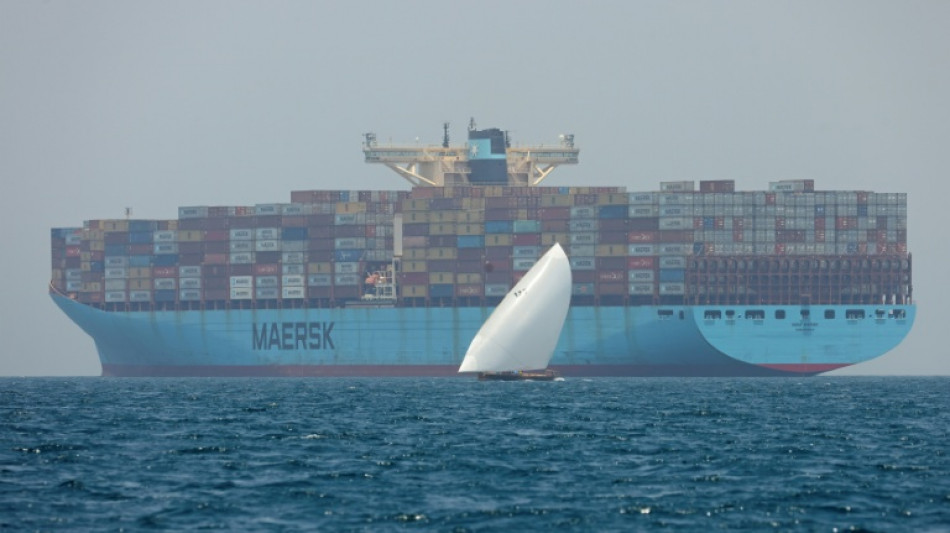
Strait of Hormuz impasse squeezes world shipping / Photo: © AFP

 Zuckerberg skewered again on screen in 'The Social Reckoning'

 Fiji urges 'just' climate transition, financing at pre-COP gathering

 Thailand's Jeeno overcomes late wobble to win Lotte Championship

 Brazil heads to run-off as Bolsonaro pulls off shock first place finish over Lula
 EU, China to hold Beijing talks to avert trade war
 Bolsonaro edges past Lula as nail-biter Brazil vote goes to a run-off

 Rubio visits Iceland as US boosts Arctic presence

 Bolsonaro leads Lula as nail-biter Brazil vote goes to a run-off

 Patriots inflict first Bills defeat as Chiefs keep winning

 Pacific nations take centre stage at 'pre-COP' climate summit

 Ronaldo can return to Portugal team if he wants: coach Jesus

 Portugal move into Nations League knockout stage, Germany held

 Ronaldo-less Portugal beat Norway to reach Nations League quarters

 Bosnian Serb strongman claims election win, thanks Trump and Putin

 Israel wear black armbands in Ireland tie over Hamas attack

 'I fear it could drag on': anxiety takes hold in Ethiopian city wrested from rebels

 Brazil's Lula and Flavio Bolsonaro face off in knife-edge election

 UK Green party adopts 'Zionism is racism' policy

 Rio favela residents vote with little hope

 Evenepoel puts worlds 'disappointment' to bed with European crown

 Two-time winning Arc trainer Rouget bows out in emotional farewell

 Battling Djokovic stuns top seed Zverev at China Open

 Spy chief Clayton, the Trump loyalist tech bosses trust on AI

 UK's Glastonbury festival tickets sell out in 45 minutes
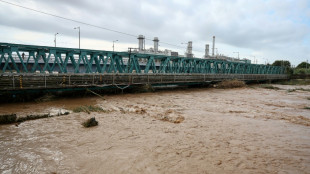 Two dead in Catalonia due to torrential rains: Spanish officials

With few captains willing to brave the Strait of Hormuz as war rages around the Gulf, companies will have to do business without one of the world's most vital shipping lanes, especially for oil and gas.
- What is the strait's importance to world markets? -
The strait is especially key to the world energy markets, with around 20 percent of global seaborne oil passing through.
That said, analysts believe that cutting off access, as Iran has threatened to do, will not affect the major Asia-Europe shipping route, with the Gulf ending in a cul-de-sac by the shores of Kuwait, Iraq and Iran.
But the strait is essential to all regional trade as it allows access to Dubai's Jebel Ali port, the world's 10th-largest container port and a redistribution hub for more than a dozen countries in the region.
In Jebel Ali, container ships are unloaded onto smaller vessels bound for countries ranging from east Africa to India, noted Anne-Sophie Fribourg, vice-president of France's TLF freighters union.
- Has it ever been closed? -
The Strait of Hormuz has always been open for business.
Even during the Iran-Iraq war between 1980 and 1988, commercial passage was maintained despite attacks on oil tankers, said Paul Tourret, director of the French High Institute for Maritime Economy.
The current "freeze" on goods transiting through the strait is "unprecedented", said Cyrille Poirier-Coutansais, research director at the French Navy's Strategic Studies Centre.
Since Israel and the United States launched strikes on Iran on Saturday, the world's largest shipping firms -- Italian-Swiss MSC, Denmark's Maersk, France's CMA CGM, Germany's Hapaq Lloyd and China's Cosco -- have ordered their ships to find shelter and stay safe.
On the Marine Traffic map, which tracks world shipping movements, you can make out clusters of ships, mainly tankers, anchored far to the north near Kuwait, as well as off the coast near Dubai.
The Iranian merchant navy is likewise visible off the Iranian port of Bandar Abbas on the other side of the strait.
Several other distinct groups of ships can be seen just before the entry to Hormuz, Tourret said.
- What goods transit through Hormuz? -
Germany ships cars, machinery and industrial products via the strait, while France mainly sells cereals and agricultural products, cosmetics, luxury goods and pharmaceuticals.
Italy, meanwhile, exports food, large quantities of marble and ceramics, said TLF's Fribourg.
In the other direction, besides oil and gas, from which fertilisers and plastics are derived, the Middle East accounts for nine percent of the world's primary aluminium production, nearly all of which is exported, according to TD Commodities.
- Will there be delays? Price increases? -
Several online shopping platforms have warned their clients that delivery times may increase.
Temu and Shein have warned of delays of several days, while Amazon forecast even longer waits, according to Bloomberg.
Freight costs are already rising as a result of the additional charges shipping companies are imposing for transit in the region.
For the Europe-Asia route, ships are also no longer using the passage through the Red Sea and the Suez Canal due to fears of renewed attacks by Iran's allies in Yemen, the Houthis.
Rounding the Cape of Good Hope, at the tip of South Africa, adds around 10 extra days at sea and increases costs by roughly 30 percent.
N.Fournier--BTB