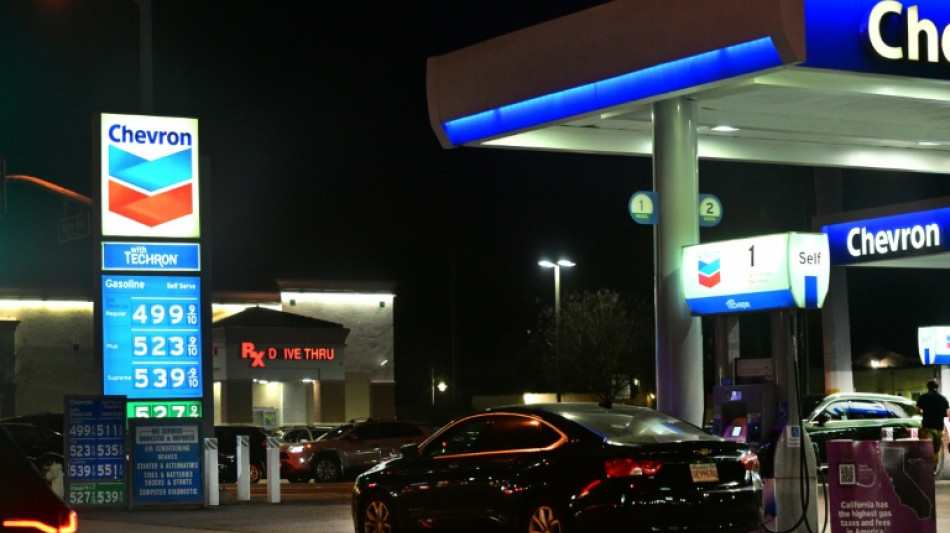
Mideast war threatens to spark world energy crisis / Photo: © AFP

 Zuckerberg skewered again on screen in 'The Social Reckoning'

 Fiji urges 'just' climate transition, financing at pre-COP gathering

 Thailand's Jeeno overcomes late wobble to win Lotte Championship

 Brazil heads to run-off as Bolsonaro pulls off shock first place finish over Lula

 EU, China to hold Beijing talks to avert trade war
 Bolsonaro edges past Lula as nail-biter Brazil vote goes to a run-off

 Rubio visits Iceland as US boosts Arctic presence

 Bolsonaro leads Lula as nail-biter Brazil vote goes to a run-off

 Patriots inflict first Bills defeat as Chiefs keep winning

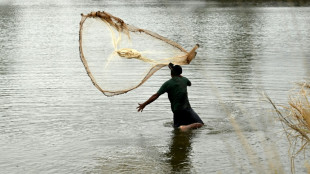 Pacific nations take centre stage at 'pre-COP' climate summit

 Ronaldo can return to Portugal team if he wants: coach Jesus

 Portugal move into Nations League knockout stage, Germany held

 Ronaldo-less Portugal beat Norway to reach Nations League quarters

 Bosnian Serb strongman claims election win, thanks Trump and Putin

 Israel wear black armbands in Ireland tie over Hamas attack

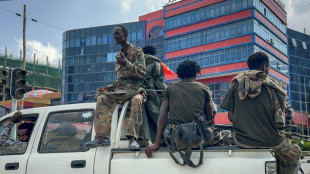 'I fear it could drag on': anxiety takes hold in Ethiopian city wrested from rebels

 Brazil's Lula and Flavio Bolsonaro face off in knife-edge election

 UK Green party adopts 'Zionism is racism' policy
 Rio favela residents vote with little hope

 Evenepoel puts worlds 'disappointment' to bed with European crown

 Two-time winning Arc trainer Rouget bows out in emotional farewell

 Battling Djokovic stuns top seed Zverev at China Open

 Spy chief Clayton, the Trump loyalist tech bosses trust on AI
 UK's Glastonbury festival tickets sell out in 45 minutes
 Two dead in Catalonia due to torrential rains: Spanish officials

Asia and Europe's oil reserves can soften the immediate impact of the Middle East war sparked by US and Israeli strikes on Iran, but a prolonged conflict could trigger major disruptions and sharp price increases, analysts warn.
Here are facts and expert views on some of the possible impacts on the world energy market from the conflict in a key oil- and gas-producing region.
- Gulf crisis -
Saudi Arabia is the world's second‑biggest oil producer after the United States, and Iran ranks among the top 10.
Qatar, though small, is the world's second‑largest exporter of liquefied natural gas (LNG), behind the United States. Kuwait, Iraq and the United Arab Emirates are also major producers.
The Strait of Hormuz -- the gateway to the Gulf -- has been largely paralysed by the violence in the region.
Usually around 20 million barrels of oil, roughly one‑fifth of global consumption, pass through the strait every day.
LNG exports from Qatar and the UAE, which together represent about 20 percent of global exports, must also pass through this chokepoint.
- Asia exposed -
Asian countries are the most exposed in energy terms: 80 percent of the oil and nearly 90 percent of the gas transiting through Hormuz is destined for them, according to the International Energy Agency (IEA).
China is the world's leading importer of crude oil and production from Gulf countries accounts for nearly half of its oil imports.
India depends heavily on crude from Iraq and Saudi Arabia -- even more so since the United States pressed it to reduce its purchases of Russian oil.
- Europe vulnerable on gas -
Europe is less dependent on the oil that passes through Hormuz thanks to its diversified supply sources -- the United States, Norway, Africa and Kazakhstan.
But it has turned massively toward LNG since the war in Ukraine and now depends on three major suppliers for 80 percent of its imports: the United States, Russia and Qatar.
Qatar alone produces around eight percent of the EU's LNG imports. And the LNG market, concentrated among a handful of major exporters, is extremely sensitive to disruptions.
Since Asia is also a major LNG consumer, Europe risks ending up in direct competition with it if Qatari gas becomes inaccessible.
"Prices will be higher because Europe will be importing some other gas that comes from somewhere else," Adi Imsirovic, director of consultancy Surrey Clean Energy, told AFP.
Europe's TTF benchmark gas price has surged since the beginning of the week, after state‑owned QatarEnergy announced on Monday that it was suspending LNG production due to strikes.
- Oil reserves -
Alternative routes exist: Saudi and Emirati pipelines can bypass the strait. But their capacity remains limited, and for LNG, there is no alternative route at all.
IEA member states hold more than 1.2 billion barrels of emergency crude reserves, while China has roughly 400 million barrels in its strategic stockpile, according to analysis group Kpler.
"This oil is sitting out there. It's not going to disappear," Imsirovic said. "All of this is a big, big buffer for the next few weeks and that's why the market is not panicking."
- Long‑term risk -
Beyond that, the picture is far more uncertain.
"The longer‑term impact on energy prices will depend on how long hostilities last and their impact on shipping through the Strait of Hormuz," said Simone Tagliapietra of the Bruegel Institute think tank.
"A brief conflict would inject a geopolitical risk premium into oil and gas markets," he added.
"A prolonged disruption... would begin to erode inventories, constrain logistics and tighten global oil and gas balances, with much greater effects on prices."
Credit rater Moody's said its baseline scenario was for the conflict to be "relatively short-lived, likely a matter of weeks".
After that, it judged, "navigation through the Strait of Hormuz will then resume at scale."
H.Seidel--BTB