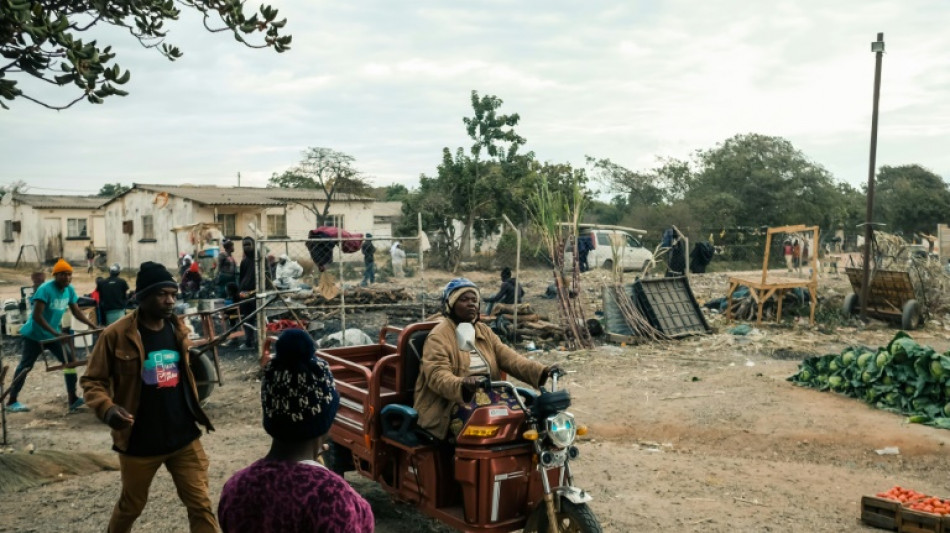
Solar electric tricycles give Zimbabwean women a lift / Photo: © AFP

 WADA seeks tough anti-doping stance from Kenya

 German ex-spy chief arrested for suspected espionage, treason

 Furyk vows US will 'do more' to end Ryder Cup losing streak

 Iyer hits ton as India hammer West Indies in T20 opener

 Mandhana named India women's team captain after Kaur quits

 'The sound keeps coming back': children maimed in Ethiopia's Tigray clashes

 Paris Women's Fashion Week: the key trends

 i-payout Introduces a New Approach to Payments, Closing the Beneficiary Information Gap

 New Generation of Crypto Miners Released by ASICID

 New investor forecasts LIV Golf teams could be worth $100 mn each

 Shakira, Pique return to court over children visit arrangements

 Nobel physics prize hails 'ghostly messengers' from space

 France's Mistral unveils latest model in sovereign AI push

 Stocks climb as oil prices retreat

 Vstock Transfer Names Securities Industry Veteran Erica Goodstein General Counsel and Chief Compliance Officer

 Four Indonesian seamen return home after Somali pirate ordeal

 Crisis-striken Haiti postpones elections

 Germany arrests ex-spy chief on suspicion of giving secrets to foreign powers

 Djokovic wins China Open after de Minaur retires
 IMF warns cost-of-living shocks cause 'lasting deterioration' in affordability

 Alcaraz wins Japan Open for first title since injury return

 'We're working to keep football clean', Turkish minister says

 FIFA chief Infantino hit by Norwegian double complaint

 Exiled Catalan separatist leader Puigdemont cleared to return to Spain

 Stock markets climb as oil prices retreat

For years, selling eggs was a joyless business for Danai Bvochora, as most of the money she made went to cover minibus fares to the market in a rural area of Zimbabwe.
That was until an earth-brown solar-powered electric tricycle changed her life.
"We used to carry loads on our heads before. The tricycle has lessened the burden," said the 47-year-old from Domboshava, about 40 kilometres (25 miles) north of Zimbabwe's capital, Harare.
She carefully loads eggs onto the tricycle's trailer before embarking on a bumpy eight-kilometre journey to the market.
"We even use it to go to church and worship," Bvochora said, explaining a single trip to buy chicken feed from a local business centre used to cost her $12.
But charging her new solar-powered vehicle sets her back only $2.50 every two weeks, and the mother of two is now making a profit.
Bvochora is among groups of women in Domboshava, a district renowned for its picturesque hills and giant boulders, who received a tricycle last year as part of a European Union-funded project to assist small-scale farmers.
Assembled by Harare-based social enterprise Mobility for Africa, the three-wheelers were first introduced in Zimbabwe in 2019 to help women develop their businesses, said the company's director Shantha Bloemen.
Transport has historically been inadequate in sparsely populated rural areas of Zimbabwe, where women often have to walk long distances carrying heavy loads on their heads to trade products -- which sometimes spoil on the way in the heat.
- Electric push -
Yet the idea of addressing that with electric three-wheelers raised a few eyebrows at first, said American-born Bloemen, who is a permanent resident in Zimbabwe and lived in the country in the 1990s when she worked for UNICEF.
"It was very lonely when we started," Bloemen said, explaining her team had to work hard to prove to funders that the idea was viable.
"No one was talking about electric mobility in Africa let alone for rural women."
Three years later, the social enterprise is planning to more than triple its current fleet of 88 motorised vehicles by the end of 2022.
It operates three solar-powered stations, where drivers can come to swap their lithium battery for a fully charged one when running low on energy -- and foots the bill when something breaks.
Zimbabwe has for more than two decades faced tough economic conditions, with rural areas particularly hard hit. The country's economy is mainly driven by the informal sector, to which Domboshava women farmers such as these belong.
While some of the three-wheelers -- nicknamed "Hamba" or "go" in the local Ndebele language -- were bought by the EU and then gifted to locals, others are rented out for $5 a day.
Phyllis Chifamba, a 37-year-old mother of four, uses her rented vehicle as a taxi.
Her clients include sick people going to a clinic, pregnant women going for medical checks, and villagers and farm dwellers going to do their shopping and other errands.
"I am able to provide food for my family and pay school fees for my children with the money I make from using the Hamba," she said.
Mobility for Africa said it was planning to expand operations to other areas.
Beneficiary Frasia Gotosa said her small business has improved since she has been driving to the market as her vegetables no longer rot while waiting for the bus or pushing a wheelbarrow.
"Now I get to the market while my produce is still fresh," she said.
F.Müller--BTB